Anion–Diluent Decoupled Solvation Chemistry in Ionic Liquid‑Based Localized High‑Concentration Electrolytes Toward High‑Voltage Lithium Metal Batteries
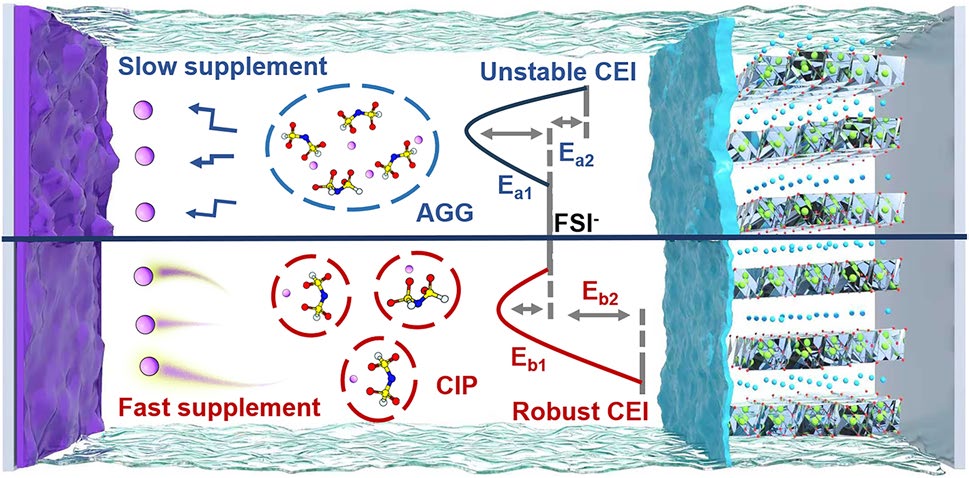
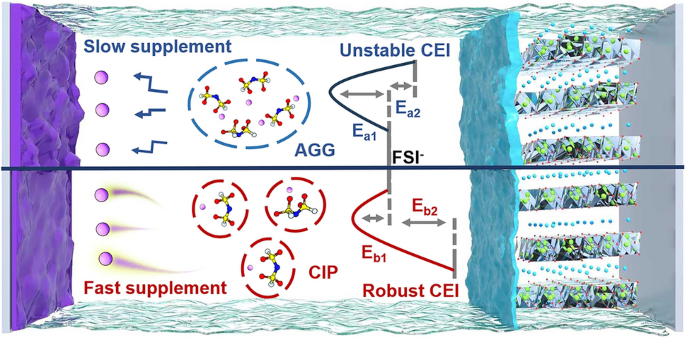

As the pursuit of ultrahigh-energy-density lithium metal batteries (LMBs) intensifies, pairing dendrite-free lithium metal anodes with high-voltage cathodes remains the ultimate frontier. Yet, conventional carbonate and ether electrolytes force a brutal trade-off: either they react violently with the lithium anode or they collapse under high-voltage cathode oxidation. Ionic liquids (ILs) offer a promising alternative, but their notorious viscosity, sluggish ion transport, and "liquid gold" cost have kept them confined to the laboratory. Now, researchers led by Professor Zhicheng Wang and Professor Xiaodong Wu, in collaboration with teams from the Suzhou Institute of Nano-Tech and Nano-Bionics (Chinese Academy of Sciences), Shanghai University, and partner institutions, have shattered this paradigm with a transformative electrolyte design strategy that redefines how we think about "inert" diluents.
Why This Electrolyte Matters
Conventional wisdom has long treated fluorinated ether diluents as mere physical spacers—molecules that simply reduce viscosity and cut costs while leaving the solvation structure untouched. This work overturns that assumption entirely. By revealing that diluent–anion interactions at the molecular scale dictate the entire solvation architecture, the team demonstrates that the choice of diluent is not a secondary formulation detail but the primary lever for controlling battery life, safety, and voltage tolerance. The breakthrough lies in engineering an anion–diluent decoupled solvation structure that unlocks the full potential of ionic liquid-based localized high-concentration electrolytes (IL-based LHCEs).
Innovative Design and Mechanism
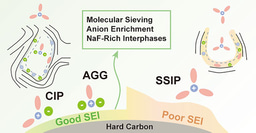
Using two structurally similar hydrofluoroethers—1,1,2,2-tetrafluoroethyl methyl ether (TFE) and its dimer counterpart TFEE—as model systems, the researchers uncovered a stark divergence rooted in electrostatics. TFEE, with its higher maximum electrostatic potential (ESPₘₐₓ = 1.811 eV vs. 1.635 eV for TFE), forms strong ion–dipole and hydrogen-bonding interactions with FSI⁻ anions, drawing 0.0371e of negative charge away from each anion. This cripples FSI⁻'s ability to coordinate with Li⁺, forcing the system to recruit more anions into bulky, electron-rich aggregate (AGG) networks to neutralize Li⁺.
In contrast, the more "inert" TFE interacts weakly with FSI⁻ (charge transfer of only 0.0189e), leaving anions fully charged and free to pair directly with individual Li⁺ ions. The result is a solvation structure dominated by compact contact ion pairs (CIPs) rather than sprawling AGGs. Molecular dynamics simulations and Raman spectroscopy confirm the stark contrast: TFE-LHCE achieves 51% CIPs and 25% AGGs, while TFEE-LHCE inverts this to 33% CIPs and 41% AGGs. This CIP-dominated architecture fundamentally reshapes interfacial chemistry—delivering intrinsically higher oxidation stability, faster Li⁺ desolvation kinetics, and lower charge-transfer resistance across both the anode and cathode.
Outstanding Performance
The electrochemical dividends of this molecular-level decoupling are extraordinary. The TFE-LHCE electrolyte achieves an ionic conductivity of 2.284 mS cm-1 (vs. 1.602 mS cm-1 for TFEE-LHCE) and a Li⁺ transference number of 0.26, with a desolvation energy of merely 23.45 kJ mol-1 (vs. 25.84 kJ mol-1).
On the lithium metal anode, the impact is immediate and dramatic. Li||Cu cells using TFE-LHCE maintain an average Coulombic efficiency of 98.84% and cycle stably for over 600 cycles, while TFEE-LHCE cells fluctuate after ~200 cycles and fail near 400. In Li||Li symmetric cells, TFE-LHCE sustains ultralow polarization for 2,000 hours at 0.5 mA cm-2, whereas TFEE-LHCE suffers voltage divergence after ~1,000 hours. Post-mortem analysis reveals why: TFE-LHCE produces a dense, flat lithium deposit just 14 μm thick (close to the theoretical 10 μm), while TFEE-LHCE spawns porous, dendrite-ridden deposits ballooning to 30 μm with severe "dead Li" formation.
On the cathode side, the CIP structure's superior oxidation stability manifests in a dramatically thinner, more robust cathode electrolyte interphase (CEI). After 200 cycles at 4.5 V, NCM811 cathodes in TFE-LHCE carry a 3 nm CEI with minimal microcracking, while TFEE-LHCE produces a thick, high-impedance 8 nm CEI accompanied by severe intergranular fracture.
Applications and Future Outlook
When paired with practical high-loading cathodes, the TFE-LHCE system delivers metrics that approach real-world deployment. A 4.3 V Li||NCM523 cell achieves 70% capacity retention after 600 cycles, and a 4.5 V Li||NCM811 cell retains 88% capacity after 200 cycles—both with highly reversible phase transitions confirmed by dQ/dV analysis. Most critically, a 2.6 Ah Li||Ni83 pouch cell (using LiNi0.83Mn0.1Co0.07O2) cycles stably for 40 cycles at 0.1C with 95% capacity retention and, crucially, passes nail penetration safety tests without ignition or explosion—a milestone for non-flammable, high-energy LMBs.
This work establishes that diluent design is interfacial design. By decoupling anions from diluents, the team has provided a rational, predictive framework for screening next-generation electrolyte components, bridging the long-standing gap between ionic liquid stability and practical fast-charging, high-voltage performance.
Stay tuned for more groundbreaking research from this collaborative team at the Suzhou Institute of Nano-Tech and Nano-Bionics, Shanghai University, and the Tianmu Lake Institute of Advanced Energy Storage Technologies!

Editor of Nano-Micro Letters, which is an Open-Access, peer-reviewed journal reported papers that have at least one dimension ranging from a few sub-nanometers to a few hundreds of micrometers. The journal is published by Springer Nature and indexed by SCI, EI, SCOPUS, Pubmed, etc. The 2025 JCR Impact Factor is 38.5. The 2025 CiteScore is 58.9.
Follow the Topic
-
Nano-Micro Letters
Nano-Micro Letters is a peer-reviewed, international, interdisciplinary and open-access journal that focus on science, experiments, engineering, technologies and applications of nano- or microscale structure and system in physics, chemistry, biology, material science, and pharmacy.