Beyond Isolated Optimization: A Holistic Review Across the Pre‑Mid Post‑Treatment Chain for Hard Carbon in Sodium‑Ion Battery
Published in Materials

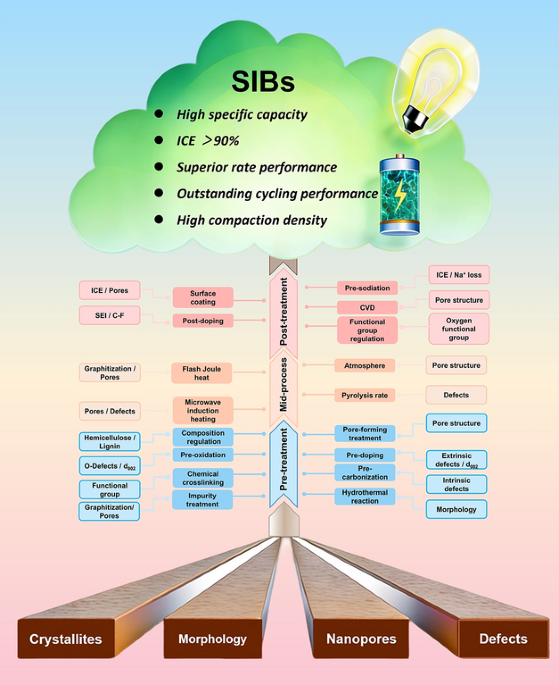

As the global energy transition accelerates, sodium-ion batteries (SIBs) are emerging as a compelling alternative to lithium-ion systems, offering superior low-temperature performance, enhanced safety, and faster charging at a fraction of the cost. Yet, the commercialization bottleneck remains locked in the anode—specifically, hard carbon (HC), the only commercially viable anode material for SIBs today. Now, researchers from Qilu University of Technology, Henan University, City University of Hong Kong, and Wuhan University of Science and Technology, led by Professor Qingwei Li, Professor Jiwei Zhang, and Professor Paul K. Chu, have delivered a landmark review that redefines how we engineer HC from the ground up.
Why This Review Matters
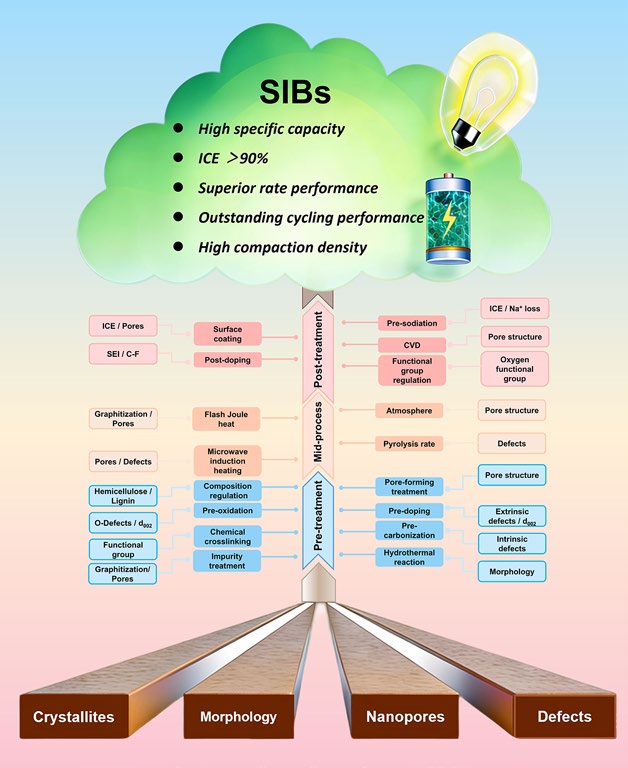
Traditional HC research has long been trapped in a fragmented paradigm—optimizing precursors, pyrolysis, or post-treatment in isolation. These single-point improvements often yield disappointing results because they ignore the intricate synergies and trade-offs across the entire fabrication chain. This work shatters that paradigm by proposing a holistic "Pre-Mid-Post" full-process engineering framework, treating HC development as a systematically coordinated chain rather than a collection of disconnected steps.
Innovative Framework and Mechanism
The review first decodes the "house-of-cards" microstructure of HC—randomly oriented graphitic nanodomains, nanopores, and defects—and clarifies how these four core structural features collectively govern sodium storage. It then systematically dissects each stage of the fabrication chain:
Pretreatment Engineering: From hydrothermal crosslinking and chemical crosslinking to pre-oxidation, pre-carbonization, pre-doping, component regulation, and pore-forming treatments. Each strategy is evaluated for its capacity to modulate graphitic domain growth, pore topology evolution, and defect engineering at the precursor stage.
Mid-Pyrolysis Control: The review critically compares conventional slow heating carbonization with next-generation technologies including flash Joule heating (FJH) and microwave-induced heating. Notably, FJH enables millisecond-scale carbonization that suppresses excessive graphitization while preserving expanded interlayer spacing—yielding HC with plateau capacities up to 290 mAh g-1 and energy savings of ~80%.
Post-Treatment Modification: Surface functional group regulation, post-doping, pore filling, surface coating, and pre-sodiation are analyzed as precision "pruning" tools to refine the preformed carbon framework. For instance, fluorine grafting via "grafting technology" achieves ICE up to 90.0% and stable cycling over 5,000 cycles at 2.0 A g-1.
Outstanding Synergies and Trade-offs
The review's analytical depth lies in exposing the dynamic contradictions within HC microstructures: expanded interlayer spacing boosts ion transport but may compromise electronic conductivity; abundant closed pores enhance plateau capacity but require careful control of open-to-closed pore ratios; defects provide active sites yet exacerbate irreversible SEI formation. The authors demonstrate that only cross-stage co-optimization—where pretreatment preconditions mid-pyrolysis outcomes, which in turn dictate post-treatment efficacy—can resolve these antagonistic effects.
Industrial Relevance and Future Outlook
Drawing from commercial benchmarks including Kuraray, ShengQuan Group, and BSG New Energy, the review addresses the critical gap between laboratory innovation and industrial mass production. It emphasizes raw material consistency control, continuous rotary kiln/roller furnace engineering, and batch-to-batch stability as prerequisites for scaling.
Looking forward, the authors chart six strategic directions: (1) establishing multi-scale quantitative structure–performance relationships via advanced characterization and machine learning; (2) developing cross-stage synergistic modification strategies; (3) promoting interdisciplinary integration of computational simulation and in situ characterization; (4) resolving engineering bottlenecks in large-scale fabrication; (5) standardizing precursor physicochemical information disclosure; and (6) harnessing machine learning to accelerate R&D cycles.
Stay tuned for more groundbreaking insights from this collaborative team across Qilu University of Technology, Henan University, City University of Hong Kong, and Wuhan University of Science and Technology!

Editor of Nano-Micro Letters, which is an Open-Access, peer-reviewed journal reported papers that have at least one dimension ranging from a few sub-nanometers to a few hundreds of micrometers. The journal is published by Springer Nature and indexed by SCI, EI, SCOPUS, Pubmed, etc. The 2025 JCR Impact Factor is 38.5. The 2025 CiteScore is 58.9.
Follow the Topic
-
Nano-Micro Letters
Nano-Micro Letters is a peer-reviewed, international, interdisciplinary and open-access journal that focus on science, experiments, engineering, technologies and applications of nano- or microscale structure and system in physics, chemistry, biology, material science, and pharmacy.