Assessment and Optimization of 2T Perovskite/CIGS Tandems via Data‑Driven and Optoelectronic Modelling
Published in Materials and Mechanical Engineering


Introduction: The Evolution of Thin-Film Photovoltaics
As the global energy landscape shifts toward renewable sources, the demand for high-efficiency, scalable, and flexible photovoltaic (PV) technologies has never been greater. While single-junction silicon solar cells are approaching their theoretical efficiency limits, tandem solar cells (TSCs) offer a way to break through these barriers. By stacking two different materials with complementary bandgaps, TSCs can harvest a broader spectrum of sunlight and minimize thermalization losses.
Among various tandem configurations, the monolithic (2-terminal) perovskite/Cu(In,Ga)Se2 (CIGS) tandem solar cell stands out as a premier all-thin-film solution. It combines the high performance of metal-halide perovskites with the proven durability and flexibility of CIGS. A recent study published in Nano-Micro Letters by a collaborative team from Helmholtz-Zentrum Berlin and University of Rome Tor Vergata provides a comprehensive roadmap for pushing the efficiency of these devices beyond 30% through advanced optoelectronic modelling.
The Current Benchmark: Certified 24.6% Efficiency
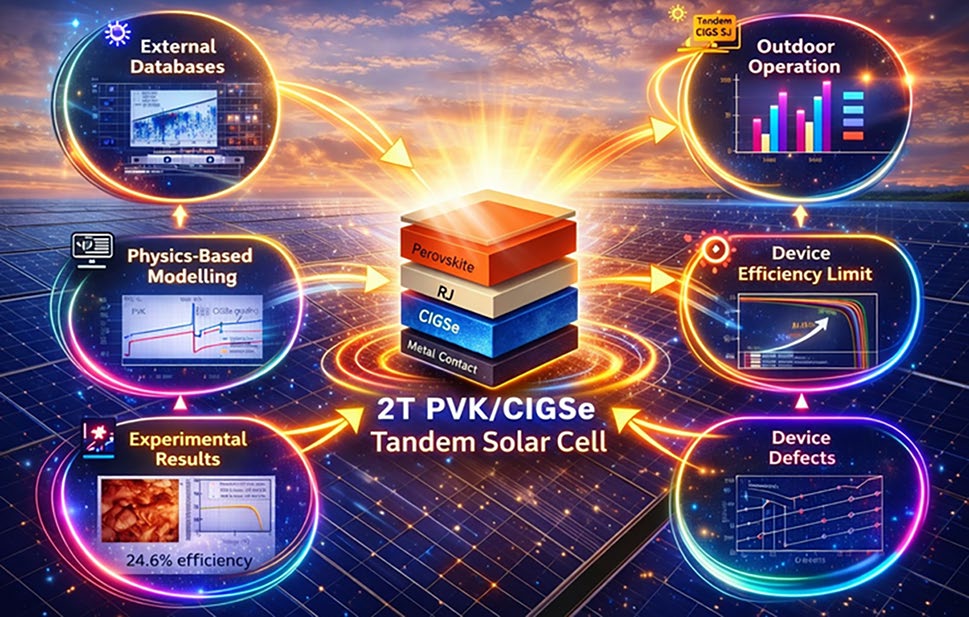
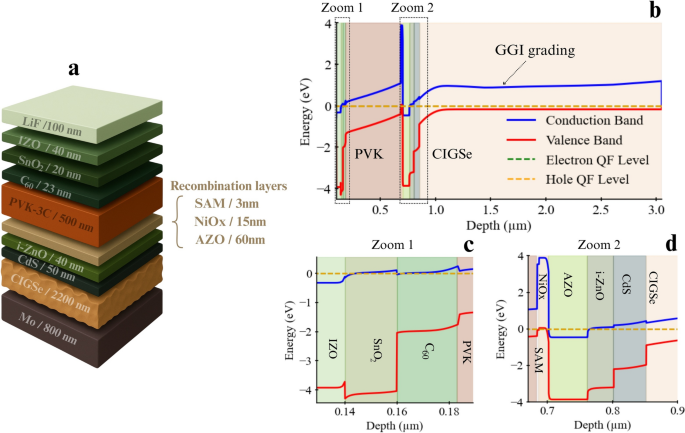
The starting point of this research is a state-of-the-art perovskite/CIGS tandem device with a certified power conversion efficiency (PCE) of 24.6%. Despite this high performance, significant losses remain. The researchers utilized a "physics-based modelling" approach to look inside the device layers and identify the exact locations where energy is lost.
By calibrating their models with experimental data—including current-voltage characteristics and external quantum efficiency (EQE)—the team identified two primary "efficiency killers":
- Interfacial Recombination: A significant portion of charge carriers is lost at the interface between the CdS buffer layer and the CIGS absorber.
- Bulk Defects: The surface roughness of the CIGS layer induces structural defects in the overlying perovskite film, leading to non-radiative recombination.
The Synergetic Approach: Data-Driven and Optoelectronic Modelling
The researchers moved beyond simple trial-and-error experiments by integrating two powerful theoretical frameworks:
- Optoelectronic Calibrated Simulation: Using drift-diffusion solvers, the team simulated the transport of electrons and holes through the complex multi-layer stack. This allowed them to decouple optical losses (like reflection and parasitic absorption) from electrical losses (like series resistance and carrier trapping).
- Shockley-Queisser (SQ) Analysis with Realistic Constraints: The team applied a modified SQ analysis that incorporates the "external radiative efficiency" (ERE) of the materials. This data-driven approach provides a more realistic limit than the ideal SQ limit because it accounts for the actual quality of the perovskite and CIGS films currently available in laboratories.
Roadmap to 35% Efficiency: Stepwise Optimization
Based on their models, the researchers proposed a three-step optimization strategy to reach the theoretical potential of this technology:
- Step 1: Interface and Bulk Passivation: By reducing the defect density at the CdS/CIGS interface and improving the perovskite film quality (potentially through smoother CIGS surfaces or specialized interlayers), the PCE can be boosted to approximately 30%. This step focuses on maximizing the "Open-Circuit Voltage" (Voc) of both sub-cells.
- Step 2: Optical Refinement and Management: Optimizing the thickness of the transparent conductive oxides (TCOs) and implementing advanced anti-reflective coatings can minimize parasitic absorption. This ensures that more photons reach the CIGS bottom cell, which is often the current-limiting component in 2-terminal stacks.
- Step 3: Precise Bandgap Tuning: The researchers demonstrated that the ideal bandgap for the perovskite top cell should be around 1.68 to 1.70 eV to achieve perfect "current matching" with the CIGS bottom cell. Achieving this balance while maintaining material stability is the final hurdle to unlocking efficiencies exceeding 35%.
Real-World Impact: Annual Energy Yield
A unique aspect of this study is its consideration of real-world operating conditions. The performance of a solar cell varies throughout the day as the sun's spectrum changes. Using climate data from various locations, the researchers calculated the "Annual Energy Yield" (AEY). They found that perovskite/CIGS tandems are particularly effective because they maintain high efficiency even under diffuse light and varying temperatures, making them ideal for both rooftop installations and flexible applications in different geographic regions.
Conclusion and Future Outlook
The integration of experimental characterization with sophisticated data-driven modelling marks a significant advance in the field of tandem photovoltaics. By identifying the specific physical mechanisms that limit performance, the researchers have provided a clear engineering manual for the next generation of thin-film solar cells.
As fabrication techniques continue to improve, the move from 24% to 35% efficiency is no longer a distant dream but a planned progression. The perovskite/CIGS tandem solar cell is poised to become a cornerstone of the future fossil-free energy system, offering a combination of high power, low weight, and versatile form factors.

Editor of Nano-Micro Letters, which is an Open-Access, peer-reviewed journal reported papers that have at least one dimension ranging from a few sub-nanometers to a few hundreds of micrometers. The journal is published by Springer Nature and indexed by SCI, EI, SCOPUS, Pubmed, etc. The 2025 JCR Impact Factor is 38.5. The 2025 CiteScore is 58.9.
Follow the Topic
-
Nano-Micro Letters
Nano-Micro Letters is a peer-reviewed, international, interdisciplinary and open-access journal that focus on science, experiments, engineering, technologies and applications of nano- or microscale structure and system in physics, chemistry, biology, material science, and pharmacy.