Before the Storm: Translating Wrist/Ankle AI-Enabled Wearables into Actionable Autism Care
Published in Bioengineering & Biotechnology, Neuroscience, and Computational Sciences
A mother once described her son’s meltdown like this:
“It’s like watching a storm roll in — but I never see the clouds.”
That sentence stayed with me.
Because what if the clouds were there all along —
just invisible to us?
As a psychiatrist working with autistic children and adolescents, I have heard versions of this sentence many times.
Meltdowns are described as unpredictable.
Escalations that feel abrupt.
Distress that seems invisible — until it isn’t.
But physiology rarely shifts without warning. Heart rate changes. Skin conductance rises. Movement patterns alter. The nervous system often signals before behavior does.
And I kept wondering:
What if it wasn’t sudden at all?
What if the body knew before we did?
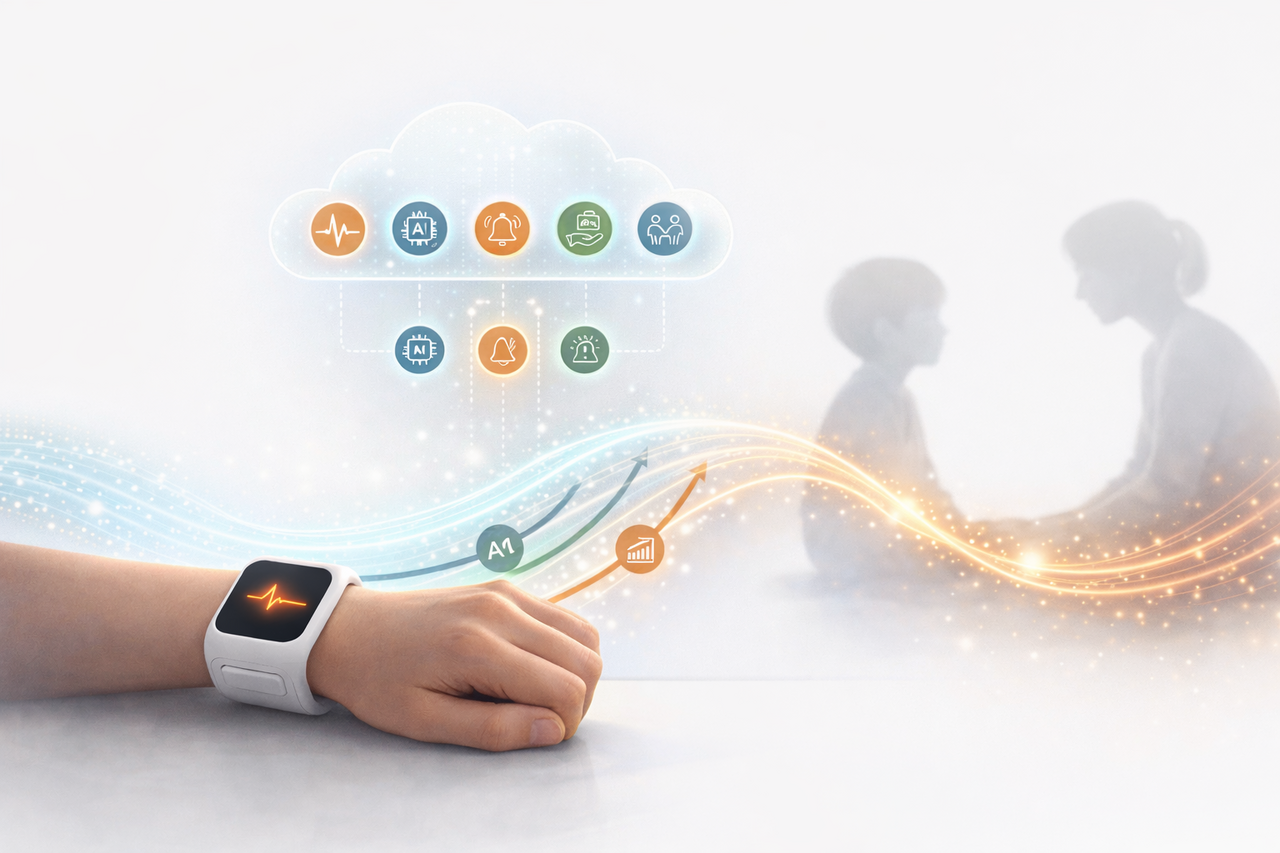
Around the same time, wearable technologies were evolving rapidly. Devices capable of detecting heart rate variability, electrodermal activity, movement patterns — increasingly powered by artificial intelligence.
The promise was bold:
Real-time physiological monitoring.
Early detection of distress.
Predicting behavioural escalation.
But not all wearables are equal.
Head-mounted sensors, chest straps, laboratory rigs — many of these devices perform well in controlled environments. Yet I kept returning to a practical question:
Would a child actually wear this in school?
At home?
In the middle of sensory overwhelm?
That is why this review focused specifically on wrist and ankle wearables — devices that resemble watches or bands. Tools that could blend into daily life rather than disrupt it.
Because if a technology is intrusive, uncomfortable, or stigmatizing, it will never survive real life — no matter how sophisticated the algorithm is.
And so the central question became:
Does the evidence actually support this promise?
Not isolated pilot studies.
Not single innovation reports.
But the global body of evidence.
From Signals to Support
Our systematic review "Effectiveness and Usability of Artificial Intelligence and/or Machine Learning Enabled Wrist and Ankle Wearables for Physiological and Behavioral Monitoring in Children and Adolescents With Autism Spectrum Disorder: A Systematic Review" has been published online in the Journal of Autism and Developmental Disorders.
This systematic review was protocol-registered, methodologically rigorous, and shaped through careful collaboration and verification. Study by study, dataset by dataset, we examined what these AI-enabled wrist and ankle wearables could truly detect — and how usable they were for children and families.
As we synthesized the global evidence base, a clearer pathway began to emerge.
Wearable sensors collect physiological and movement data.
AI models process these signals.
Alerts are generated for caregivers and clinicians.
Intervention pathways are activated.
Below is the conceptual framework we developed to illustrate how AI-enabled wrist and ankle wearables could translate sensor data into actionable autism care pathways.
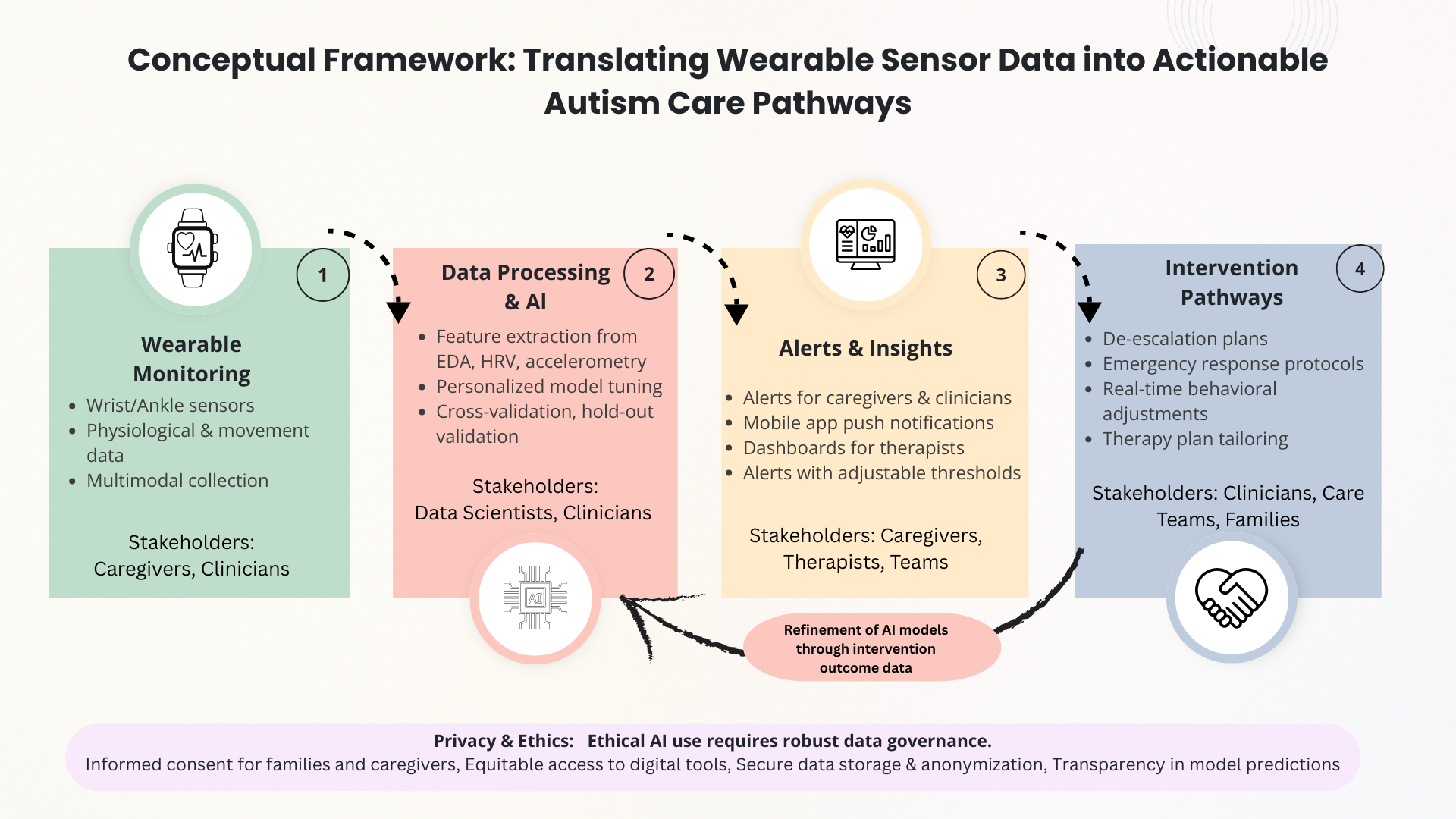
This framework emphasizes multimodal data collection, personalized AI processing, caregiver and clinician alert systems, integration into intervention planning, and continuous refinement through outcome feedback — all underpinned by privacy, consent, transparency, and equitable access (Sheth et al., 2026).
The goal is not surveillance.
The goal is earlier, more supportive care.
Between Innovation and Implementation
What we found was both exciting and sobering.
Yes — there is potential.
Physiological signals often shift before observable behavioural escalation.
Machine learning models can classify arousal states with promising accuracy.
AI-enabled wrist and ankle wearables demonstrate feasibility for anticipating behavioral escalation and detecting emotional states. Short advance-warning windows may support proactive intervention.
However, the field remains young.
Many studies involve small sample sizes.
Long-term ecological trials are limited.
Acceptability and real-world implementation data are inconsistent.
In many ways, the technology is advancing faster than implementation science.
And that gap matters.
Because for autistic children, early detection is not about surveillance.
It is about support.
It is about co-regulation.
It is about preventing distress rather than reacting to it.
This paper represents a bridge — between psychiatry and artificial intelligence, between engineering and lived experience, between promise and proof.
From Promise to Practice
Beyond summarizing the current evidence, we asked a forward-looking question:
If this field is promising, what must happen next?
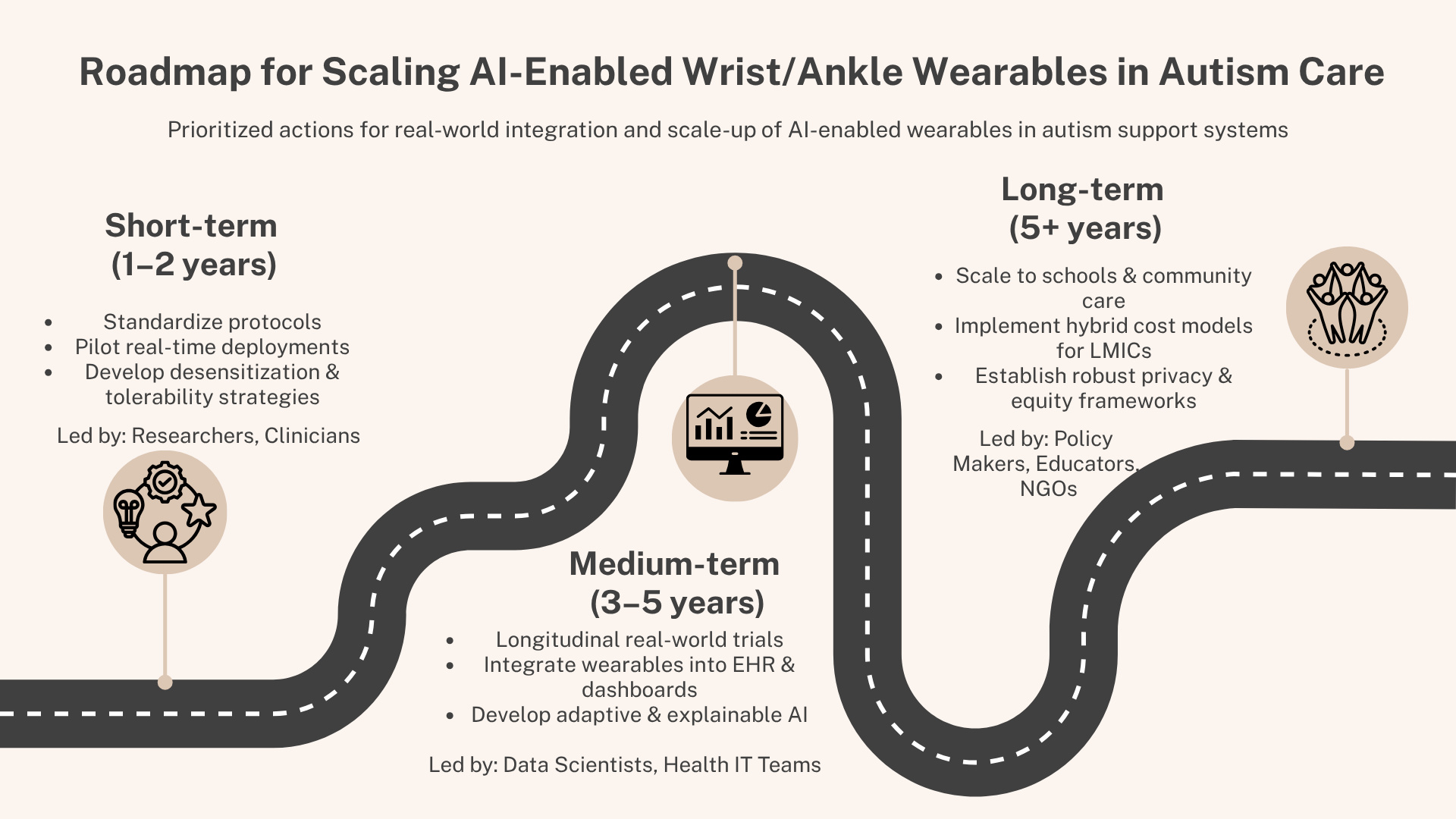
We therefore developed a roadmap outlining short-, medium-, and long-term priorities for scaling AI-enabled wrist and ankle wearables responsibly within autism care systems.
For me personally, it also represents something else.
A commitment to neurodiversity-affirming research.
A belief that innovation must be both ethical and usable.
And the persistence required to complete a rigorous systematic review — from protocol registration to final synthesis — with integrity.
Seeing this work published in the Journal of Autism and Developmental Disorders feels less like an endpoint and more like an invitation.
The question is no longer:
“Can wearables detect distress?”
The question now is:
How do we design them — and test them — in ways that truly help the children they are meant to serve?
And that is where the next chapter begins.




Please sign in or register for FREE
If you are a registered user on Research Communities by Springer Nature, please sign in