Behind the handbook: Springer Handbook of Medical Biotechnology
Published in Bioengineering & Biotechnology and Biomedical Research

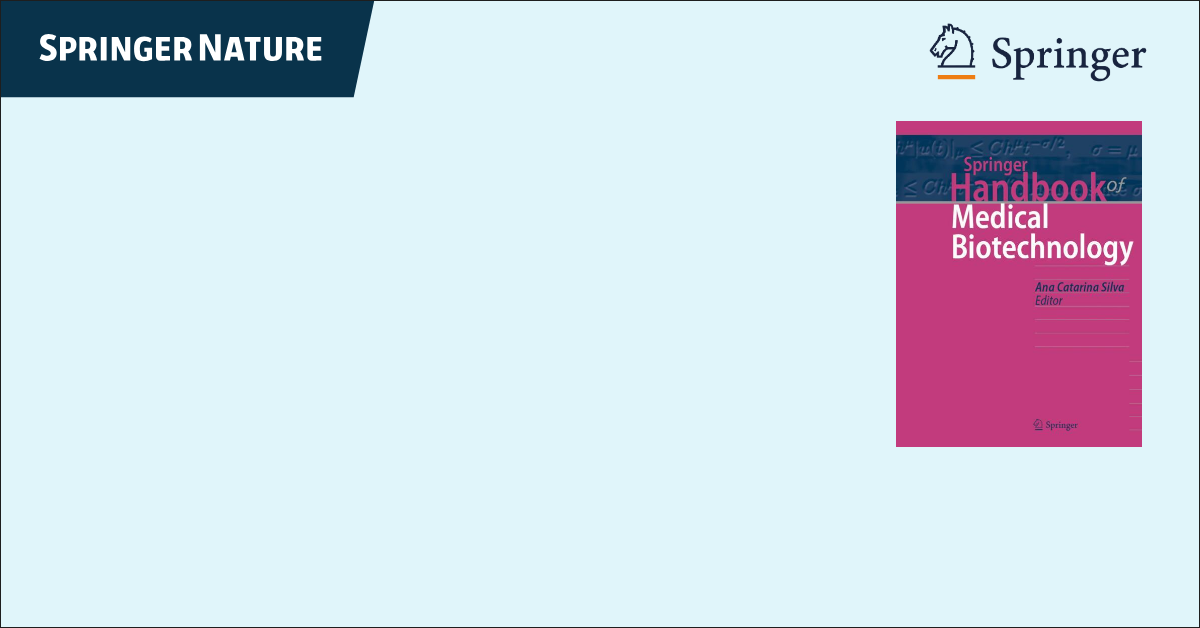



To mark this occasion, we spoke with the handbook’s editor, Ana Catarina Silva, about the motivation behind the project, its structure, and the impact such a comprehensive reference can have on the field of medical biotechnology.
From my side, as a book publishing editor, it is a great honour to see this work come to life. Many thanks to Ana for embracing the original idea and for her continued support, as well as to all section editors and chapter authors who contributed to making this handbook a reality.

1. Story & Motivation
What motivated you to bring together such a comprehensive handbook on medical biotechnology at this moment in time?
Medical biotechnology has undergone remarkable growth in recent years, largely driven by the rapid expansion of biological medicines and biosimilars. More recently, the emergence of Advanced Therapy Medicinal Products (ATMPs), particularly gene and cell-based therapies, has transformed the field. These innovations are not only reshaping treatment paradigms but also redefining the boundaries of modern medicine. This momentum created a clear need for a comprehensive and up-to-date handbook resource that brings together these advances in a structured and accessible way.
Every handbook has a story. Was there a particular moment, conversation or experience, during the COVID-19 era or elsewhere, that convinced you this book needed to exist now?
The COVID-19 pandemic was undoubtedly a turning point for medical biotechnology. It demonstrated, on a global scale, how rapidly and effectively biotechnological innovations can move from the research laboratory to clinical application. The widespread deployment of RNA-based vaccines highlighted both the maturity and the potential of these technologies.
At the same time, my previous experience editing a volume for the Springer ABE series, Current Advances in Pharmaceutical Biotechnology, provided valuable insight into the field’s trajectory. The strong reception of that work, combined with the accelerating pace of innovation in medical biotechnology, made it clear that a more comprehensive and updated handbook was both timely and necessary.
2. Vision & Structure
The book is organized into three sections: Biologicals, Innovative Therapies, and Biotechnology & Healthcare Products. How did you arrive at this structure, and what does it reveal about where medical biotechnology is heading?
Medical biotechnology is inherently multidisciplinary, integrating fields such as biology, chemistry, engineering, pharmacy, medicine, data science, and regulatory science. However, key knowledge is often fragmented across disciplines and scattered throughout different types of publications.
The structure of the handbook was designed to address this fragmentation by organizing the field into three complementary sections, each reflecting a major pillar of contemporary medical biotechnology. Together, they provide a comprehensive overview of recent advances and real-world applications.
Part I focuses on biologicals, which remain the foundation of modern biopharmaceutical development. Part II broadens the scope to innovative therapies, with particular emphasis on ATMPs, highlighting the shift toward more personalized treatments. Part III explores biotechnology-driven medical devices and other healthcare products, illustrating how biotechnology is increasingly extending beyond therapeutics into integrated healthcare solutions.
This structure reflects the direction in which the field is evolving: toward greater integration, diversification, and convergence across technologies, ultimately reshaping how healthcare solutions are developed and delivered.
How do you hope this handbook will shape the field over the next decade?
I hope this handbook will serve as both a reference and a catalyst for progress in medical biotechnology over the coming decade. As a comprehensive and authoritative book, it brings together contributions from leading international experts, offering reliable and up-to-date insights into cutting-edge therapies, regulatory frameworks, and industrial applications.
By bridging the gap between academic research and real-world clinical and industrial practice, the handbook is designed to support a wide range of stakeholders, from scientists and healthcare professionals to students and decision-makers. In doing so, it not only consolidates current knowledge but also facilitates its practical application in increasingly complex healthcare environments.
Beyond its role as a reference, I hope this handbook will foster interdisciplinary collaboration and stimulate innovation by integrating scientific advances with practical and sustainable approaches, ultimately contributing to more effective, accessible, and personalized healthcare solutions.
3. Societal Impact & SDGs
Many chapters, from mRNA vaccines to ATMPs and microbiome research, speak directly to global health priorities. How does this handbook contribute to advancing the UN Sustainable Development Goals, particularly SDG 3: Good Health and Well-being and SDG 9: Industry, Innovation and Infrastructure?
By providing up-to-date and scientifically robust information on innovative areas such as mRNA vaccines, ATMPs, and microbiome-based approaches, the handbook supports the advancement of SDG 3 by facilitating access to knowledge that can improve disease prevention, diagnosis, and treatment. In particular, it serves as a valuable resource for clinicians and healthcare professionals, helping to translate cutting-edge research into better health outcomes and more effective patient care.
In relation to SDG 9, the handbook highlights the development and implementation of innovative biotechnology-based technologies, emphasizing their role in driving sustainable industrial growth and strengthening healthcare infrastructure. By showcasing advances that integrate scientific innovation with scalable and sustainable solutions, it contributes to fostering a more resilient and forward-looking biotechnology sector.
Several chapters address sustainability, such as using biowaste, marine resources, and green biotechnology. How does the book contribute to SDG 12 (Responsible Consumption and Production) and SDG 14 (Life Below Water), and what does ‘sustainable biomedicine’ mean to you?
Biotechnological approaches increasingly rely on the use of living systems and renewable biological resources to develop medicines, offering a more sustainable alternative to traditional chemical synthesis. By highlighting strategies such as the valorization of biowaste, the responsible use of marine resources, and the application of green biotechnology, the handbook aligns closely with the principles of SDG 12 and SDG 14.
In this context, sustainable biomedicine refers to the development of healthcare solutions that not only address medical needs but also minimize environmental impact and support long-term ecological balance. It involves designing processes and medical products that are efficient, scalable, and environmentally responsible, while also promoting equitable access to innovation.
Topics like rare diseases, biosimilars, and pharmacovigilance point to equity in healthcare. How can biotechnology help bridge gaps in access and affordability worldwide?
Biotechnology can play a critical role in improving equity in healthcare by enabling the development of more effective medicines and treatments. For example, the increasing availability of biosimilars can reduce costs for healthcare systems, thereby expanding access to medicines for a larger number of patients.
In the context of rare diseases, biotechnological therapies help address unmet medical needs that have traditionally been overlooked by the pharmaceutical industry due to limited commercial incentives.
In addition, pharmacovigilance systems, supported by data-driven tools, contribute to the safe and more efficient use of medicines, helping to reduce unnecessary healthcare costs.
4. Scientific Innovation & Future Outlook
Looking across chapters on mRNA vaccines, cell and gene therapies, 3D/4D bioprinting, and machine learning in pharmaceutical biotechnology, which advances do you believe will most transform patient care in the next 5–10 years?
I believe that cell and gene therapies will have the most transformative impact on patient care in the next 5–10 years. These approaches are already at the forefront of treating cancer and genetic disorders that have historically had limited or ineffective therapeutic options, offering the potential for long-term remission or even cure.
In addition, the success of mRNA vaccines has clearly demonstrated the maturity and adaptability of this technology, particularly in responding rapidly to global health emergencies such as pandemics. This highlights its broader potential for future therapeutic applications beyond infectious diseases.
Technologies such as 3D/4D bioprinting and machine learning are also playing an increasingly important role by enabling more personalized and precise treatment strategies. While their full clinical integration may still be evolving, they are already reshaping how therapies are designed and delivered.
Overall, the convergence of advanced therapeutics with data-driven approaches will be key to transforming patient care, making it more personalized, efficient, and effective.
5. Translation, Policy & Trust
From AI regulations in medical devices to pharmacovigilance of biological medicines and HTA for ATMPs in the EU, the handbook devotes substantial space to policy and regulation. Why was it important to you to include these dimensions, and how can they help build public trust in cutting-edge therapies?
Policy and regulation are fundamental for translating medical innovations into clinical practice and for building trust among healthcare professionals and patients. Robust regulatory frameworks are essential to ensure the safety, quality, and efficacy of new biotechnology-based therapies. Furthermore, following approval, processes such as HTA and pharmacovigilance enable the continuous evaluation and monitoring of these products. This ongoing oversight is crucial to ensure their safe and effective use, while also demonstrating their clinical value and real-world benefits in improving patient outcomes.
If a researcher, clinician, policymaker, or student picks up this handbook, what is the one mindset shift you hope they walk away with, and how would you like them to use this knowledge to improve health outcomes in their own context?
The most important mindset is to recognize that medical biotechnology is not just an emerging field, but a transformative force reshaping the future of healthcare. It has the potential to significantly improve both quality of life and life expectancy through more precise, effective, and personalized treatments.
I hope readers develop a strong appreciation for integrating innovation into their own work and decision-making, using this knowledge to inform research, support evidence-based policies, or implement advanced therapies in clinical practice. Ultimately, the goal is for them to translate this knowledge into action, adapting advances in medical biotechnology to their specific contexts in order to improve health outcomes and contribute to more resilient and forward-looking healthcare systems.


Please sign in or register for FREE
If you are a registered user on Research Communities by Springer Nature, please sign in