Exploring the impact of sister city partnerships on emerging African cities
Published in Arts & Humanities



The Story Behind the Paper: Exploring the Impact of Sister City Partnerships on Emerging African Cities
When Eldoret was officially designated as a city in Kenya in 2021, the event was not merely ceremonial. It marked a new chapter in the town’s evolution from a colonial railway stop to one of East Africa’s fastest-growing urban centers. As I followed the discussions on what it means for a town to become a city, I was struck by a central question: How do new African cities position themselves globally while safeguarding their local identities? This question became the seed of my research and eventually the basis for my paper Exploring the Impact of Sister City Partnerships on Emerging African Cities. The idea was simple yet powerful. In a globalized era where cities, not just nations, compete for recognition, resources, and resilience, sister city partnerships provide an important lens for understanding how emerging cities like Eldoret navigate modernization.
Why Eldoret
You may know Eldoret City as the athletic capital for long distance runners, hence the name “City of Champions” because of its production of world-class long-distance runners, it also anchors a strong agricultural economy and a growing manufacturing sector. Yet it also embodies the contradictions of urban Africa: rapid expansion alongside infrastructural strain, global ambitions alongside deeply local roots.
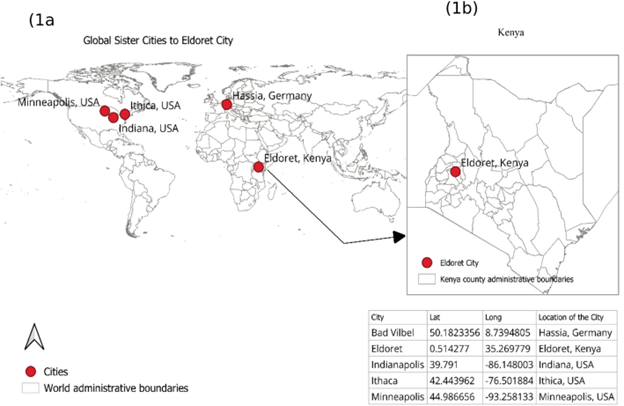
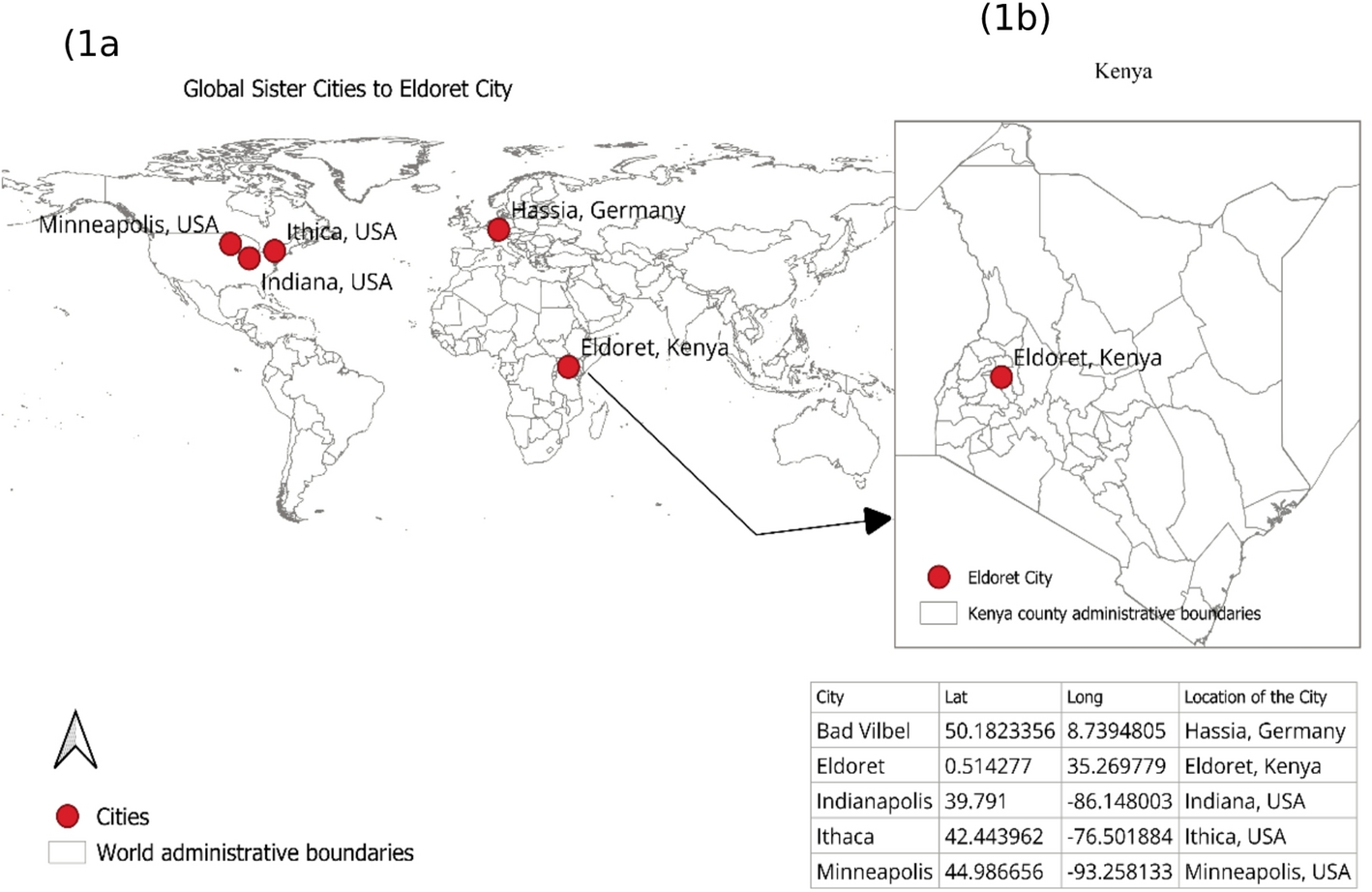
What drew my attention was how Eldoret had quietly woven itself into international city networks, building sister city agreements with Bad Vilbel in Germany, Indianapolis and Minneapolis in the United States, and Ithaca in New York. These agreements were not symbolic handshakes. Each partnership opened opportunities: sports diplomacy through athletics, knowledge exchange in agriculture, collaborations in manufacturing, and cultural linkages through festivals and student exchanges. I began to wonder whether these relationships could go beyond ceremony and shape Eldoret’s growth, diplomacy, and identity.
Conceptual Spark
The inspiration was also intellectual. Sister city partnerships are often dismissed as ceremonial and rarely feature in mainstream urban studies. African urban scholarship typically concentrates on megacities such as Lagos, Johannesburg, or Nairobi, leaving smaller but rapidly growing cities under-examined. Eldoret provided an opportunity to look at this overlooked category.
Another aspect that intrigued me was the language used to describe such partnerships. Terms like “twin towns,” “Partnerstadt,” “Ville Jumelée,” and “Stedenband” carry cultural histories and different shades of meaning, yet few studies bring together this semantic richness with empirical economic analysis. I wanted to test whether partnerships had measurable impacts on Eldoret’s trajectory while also situating them in broader traditions of urban collaboration.
Methodological Choices
The first challenge was methodological. How does one measure the impact of an intangible relationship like a sister city agreement? We adopted a comparative and mixed-methods approach. I reviewed historical and policy documents to trace the origins and activities of Eldoret’s partnerships. I also looked for a quantitative marker that could anchor the analysis. GDP trends emerged as a useful indicator. By comparing Eldoret’s GDP before and after the establishment of partnerships, I could assess whether these relationships correlated with economic shifts.
The regression model showed that post-partnership years explained about 37 percent of the variation in Eldoret’s GDP, with a positive slope estimate of 1.64 billion US dollars. While correlation is not causation, these results suggested that sister city ties may be linked to tangible economic outcomes.
The Human Side of Partnerships
Numbers only tell part of the story. What stood out most were the human stories.
Through athletics diplomacy, Eldoret’s runners have acted as cultural ambassadors. Partnerships with cities like Indianapolis created opportunities for scholarships, sponsorships, and global branding that reinforced the city’s identity. In agriculture, collaboration with Bad Vilbel brought exposure to sustainable farming techniques that supported food security. Student and institutional exchanges with Ithaca expanded opportunities for young people, instilling a global outlook in a city still deeply rooted in communal traditions.
These examples revealed that sister city agreements are not hollow rituals. They are vehicles for soft power, mutual learning, and identity building.
Broader Reflections
Writing the paper made me reflect on the politics of urban belonging. African cities are often portrayed in deficit terms: overcrowded, under-planned, and perpetually catching up. Yet Eldoret’s experience tells a different story. By leveraging partnerships, emerging cities can proactively define their modernization pathways, blending external linkages with local strengths.
At the same time, challenges remain. Partnerships can reproduce asymmetries, where African cities are positioned as recipients rather than equals. The task ahead is to ensure reciprocity, where Eldoret not only learns from Minneapolis but also contributes insights on resilience, athletics, or community solidarity.
Contributions to Scholarship
The story of Eldoret fits into a larger puzzle: what role do international networks play in shaping Africa’s urban frontier?
My paper makes three contributions. First, it empirically links sister city partnerships to economic trends, something rarely attempted in African urban research. Second, it reframes these partnerships as dynamic tools of cultural diplomacy rather than symbolic gestures. Third, it highlights the role of emerging cities as laboratories for studying globalization from below, moving beyond the overemphasis on megacities.
Lessons Learned
The biggest lesson for me was the importance of interdisciplinarity. Studying sister city partnerships required insights from economics, anthropology, linguistics, and urban planning. Cities are complex organisms shaped by both numbers and narratives, by flows of capital and flows of culture.
I also realized that stories matter. When athletes from Eldoret compete in Boston or Berlin, they are not only chasing medals. They are carrying the story of their city, projecting its identity, and forging global connections.
Moving Forward
This paper is a beginning. Future research could compare Eldoret with other emerging African cities such as Kisumu, Arusha, or Gulu to see if similar patterns emerge. It could also examine the sustainability of partnerships when political leadership changes or funding declines. Another area worth exploring is how ordinary residents perceive and benefit from these ties.
Ultimately, I hope this research encourages policymakers, planners, and communities to see sister city partnerships not as side projects but as strategic levers for development and identity-building.
Final comments
The story behind this paper mirrors the story of Eldoret itself: a city in motion, balancing tradition with modernity, local pride with global ambition. By examining its sister city partnerships, I sought to show that emerging African cities are not isolated. They are active participants in shaping globalization. And perhaps, in tracing these connections, we are reminded that cities, like sisters, grow stronger not in isolation but in relationship with each other, with their histories, and with the world.

Follow the Topic
-
Discover Cities
This is a fully open access, peer-reviewed journal that supports multidisciplinary research and policy developments across the field of urban science.

Related Collections
With Collections, you can get published faster and increase your visibility.
Green Spaces and Sustainability in Cities
In recent decades, with the rapid development of urbanization, it has brought about rapid economic development and convenient life, while it has also brought a series of environmental problems, including global warming, air pollution, ecosystem chaos, biodiversity decline and other environmental problems, which will also lead to the physical and mental health of residents in cities. Green spaces in cities plays multiple roles in the city of ecological, social and economic services, is an integral part of the urban ecosystem, and plays an indispensable role in improving environmental problems and promoting sustainable development in cities.
This series aims to discuss the role of green spaces in alleviating environmental problems in cities, as well as research on the use and management of green spaces in sustainable urban development. Through this series of studies, we will explore how to better play the ecological and social service functions of green spaces in cities and promote the sustainable development of cities.
The research collected in this series includes, but is not limited to, the following topics:
• Evaluation of green spaces and ecological services value in cities;
• Evaluation the accessibility and equity of green spaces in cities;
• The impact of green spaces on microclimate in cities;
• Green spaces and health in cities;
• Green spaces and resilient cities;
• Green spaces and social justice;
• Green spaces and the well-being of residents in cities;
• Governing, planning and management of green spaces in cities.
• Green spaces in smart cities;
• Sustainable development in cities.
Keywords: Green space; Environmental sustainability; Climate change; Social justice; Resilient cities; Smart cities; Health; Urban planning; Urban service
Publishing Model: Open Access
Deadline: Jan 31, 2027
Urban Futures: Strategies for Decarbonized, Resilient, and Equitable Cities
Cities stand at the forefront of the global sustainability challenge. This Collection explores how urban areas can become drivers of climate action, social equity, and systemic transformation. Drawing from contributions presented at the Urban Futures Symposium 2025 (hosted by the Urban Energy Systems Laboratory at Empa, Switzerland), this Collection brings together research, practice, and policy insights on how to build decarbonized, resilient, and equitable cities.
The articles cover a wide range of themes, including integrated urban energy systems, low-carbon mobility, participatory governance, just and equitable transitions, sufficiency-based planning, nature-based solutions, circularity, embodied emissions, digital urban innovations, financing and economics, and building and energy technologies. With case studies from cities across the Global North and South, and perspectives from both academic and practitioner communities, the Collection highlights interdisciplinary and cross-scale strategies for navigating urban complexity in a rapidly changing world.
We invite contributions that explore theoretical frameworks, empirical studies, modeling approaches, or co-designed solutions for shaping just, climate-compatible urban futures.
Keywords: Urban transitions; Urban resilience; Participatory urban planning; Justice, equity, and well-being; Urban governance and policy; Integrated energy systems and technologies; Sustainable mobility; Sufficiency strategies; Circular economy and resource flows; Materials and embodied emissions; Nature-based solutions; Urban ecology and environmental systems; Financing mechanisms and urban economics; Innovations in the built environment; Systemic innovation for urban sustainability.
This Collection supports and amplifies research related to SDG 11 (Sustainable Cities and Communities), SDG 7 (Affordable and Clean Energy), SDG 13 (Climate Action), SDG 12 (Responsible Consumption and Production), and SDG 10 (Reduced Inequalities).
Publishing Model: Open Access
Deadline: Dec 31, 2026