From microscopic diffusion to mechanical yielding in sheared soft jammed matter
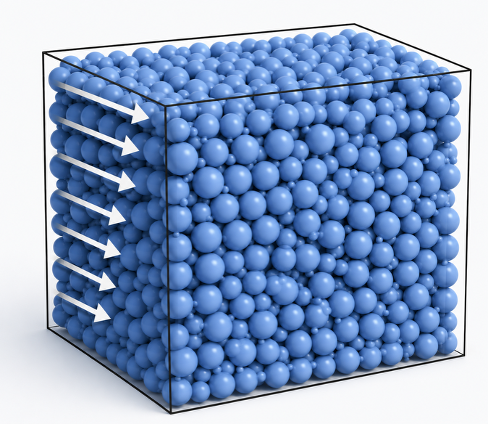

Soft materials such as colloidal suspensions, emulsions, foams, and gels often display complex and unusual behaviors compared with ordinary solids or liquids. From a mechanical point of view, for instance, they can resist deformation like solids, but they can also start to flow like liquids when a sufficiently strong external drive is applied. This transition from solid-like to liquid-like behavior, known as yielding, is central to the physics of soft amorphous materials and to many industrial and biological processes. Some of these systems are also athermal: they are made of particles large enough that thermal motion plays no role in their dynamics. Their microscopic motion is therefore governed mainly by mechanical driving and by interactions with neighboring particles, making their behavior even more unusual and intriguing.
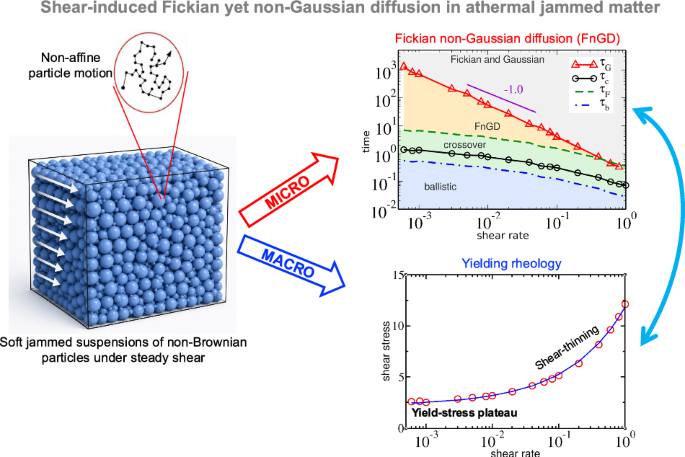
In our recent work, published in Communications Physics, we establish a connection between the mechanical yielding of soft athermal matter and a distinctive form of microscopic dynamics: Fickian yet non-Gaussian Diffusion (FnGD). This phenomenon, also referred to as Brownian yet non-Gaussian diffusion, was first reported in 2009 and has since been identified in a variety of molecular systems, as well as in thermal and active soft matter, especially for particles moving in heterogeneous environments. Using numerical simulations, we showed that FnGD can emerge even in athermal jammed matter, such as compressed emulsions, granular suspensions, and foams, when particle motion is driven by imposed shear. Our results connect this unusual microscopic transport regime to the onset of yielding rheology in soft jammed solids.
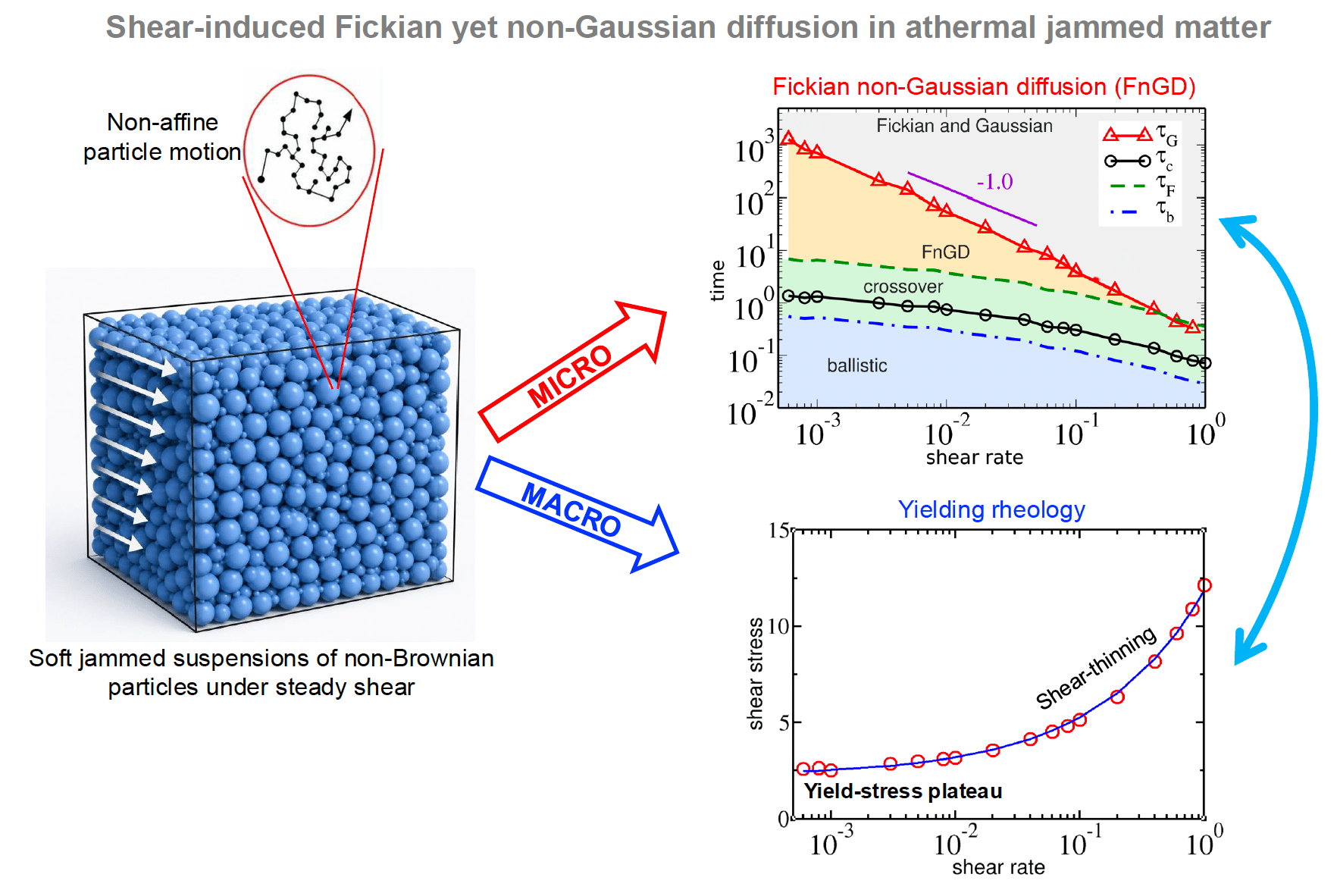
From Communications Physics (2026), DOI: 10.1038/s42005-026-02817-y
A puzzling form of diffusion
In recent years, FnGD has attracted considerable attention because it challenges the standard picture of microscopic diffusion and its usual dichotomous classification into standard Brownian motion and anomalous diffusion. Indeed, FnGD combines a mean square displacement that increases linearly in time (Fickian), as in standard Brownian motion, with a non-Gaussian displacement distribution, as typically found in anomalous diffusion. So far, however, this hybrid form of diffusion has mostly been viewed as a signature of single-particle dynamics, with its relevance apparently confined to the microscopic realm. Whether it is also connected to large-scale material responses has remained much less clear.
As Principal Investigator of the Italian national research project PRIN 2022, “Fickian non-Gaussian Diffusion in Static and Dynamic Environments”, which funded this study, one question was especially important to me: whether FnGD is mainly a microscopic feature of particle dynamics or can also affect the macroscopic behavior of a material. Soft jammed matter under shear combines a rich mechanical response at the macroscopic level with heterogeneous dynamics at the microscopic level. For this reason, it seemed to me an ideal setting ito address this question. Our study shows that, for these materials, FnGD is not only a microscopic feature of particle dynamics, but is closely connected to the mechanical response near yielding.
From microscopic motion to mechanical yielding
We focused on the non-affine motion of individual particles, namely the stochastic part of the motion that remains after subtracting the ordered flow imposed by shear. A key role in this work was played by Palak Patel, who joined our group at the University of Naples Federico II as a postdoctoral researcher after completing her PhD in Physics at the University of Pune, India. Her numerical work was essential to follow the single-particle dynamics over the broad range of timescales and shear rates needed to identify the Fickian and non-Gaussian regimes. The work also benefited from the contributions of Francesco Rusciano and Francesco Greco. At sufficiently low shear rates, after an initial ballistic motion, particles enter a regime in which their mean square displacement is compatible with normal diffusion, while the distribution of displacements remains markedly non-Gaussian over extended time windows. In other words, the system displays shear-induced FnGD.
The review process was also an important part of the story. The reviewers’ comments, together with Felix Höfling’s careful and constructive editorial handling, encouraged us to sharpen the physical interpretation of our results. In particular, they prompted us to develop a minimal theoretical model to rationalize the observed dynamics. This led us to introduce the Heterogeneous Persistent Random Walk model. In this description, particles move through heterogeneous environments composed of different domains. Within each domain, particles move approximately straight for a characteristic persistence time before randomly changing direction. Different domains are characterized by different persistence times, while the local environment itself is not permanent, but renews after a finite time because of the applied shear. This combination of spatial heterogeneity and temporal renewal captures the main dynamical features observed in the simulations.
A key result of the study is that the microscopic time scales characterizing FnGD are closely connected to the material’s macroscopic rheology. In soft jammed matter close to yielding, the flow curves display an apparent decoupling between shear rate and shear stress: the shear stress tends to saturate toward a plateau value, the so-called yield stress, becoming nearly independent of the imposed shear rate. The authors showed that an analogous decoupling also emerges in the microscopic dynamics. Decreasing the shear rate, the characteristic time marking the onset of the Fickian regime tends to saturate, in analogy with the shear stress, whereas the time needed to recover a Gaussian displacement distribution continues to grow, approximately as the inverse shear rate. This separation between microscopic time scales gives rise to FnGD and suggests that it can be regarded as a microscopic counterpart of mechanical yielding.
A single-particle perspective on collective dynamics
The mechanical response of soft jammed materials close to yielding has often been ascribed to collective and correlated particle dynamics, including avalanche-like rearrangements. I believe that our results have the merit of showing how microscopic signatures of yielding can also be found in the behavior of simpler single-particle quantities related to particle diffusion. The findings may help clarify how single-particle diffusion, collective dynamics, and macroscopic rheology are intertwined in soft amorphous solids. They also point to FnGD as a useful framework for studying driven materials far from thermal equilibrium.

Follow the Topic
-
Communications Physics
An open access journal from Nature Portfolio publishing high-quality research, reviews and commentary in all areas of the physical sciences.

Related Collections
With Collections, you can get published faster and increase your visibility.
Nonlinear dynamics of living systems
Publishing Model: Open Access
Deadline: Nov 09, 2026
Active, Entangled or Confined: Polymer Physics Across Synthetic and Living Matter
Publishing Model: Open Access
Deadline: Dec 31, 2026