October Highlights from Mathematics, Physical and Applied Sciences Communities
Published in Chemistry, Earth & Environment, and Electrical & Electronic Engineering




Welcome to our October roundup from the Mathematics, Physical and Applied Sciences Communities! This month, we’re exploring fascinating discoveries, from unusual carbon structures and ancient ice shelves to tiny flying robots and the long history hidden in rocks. We’ll also look at how global consumption contributes to forest loss. Read on to discover the stories behind the research and the people bringing these findings to life.
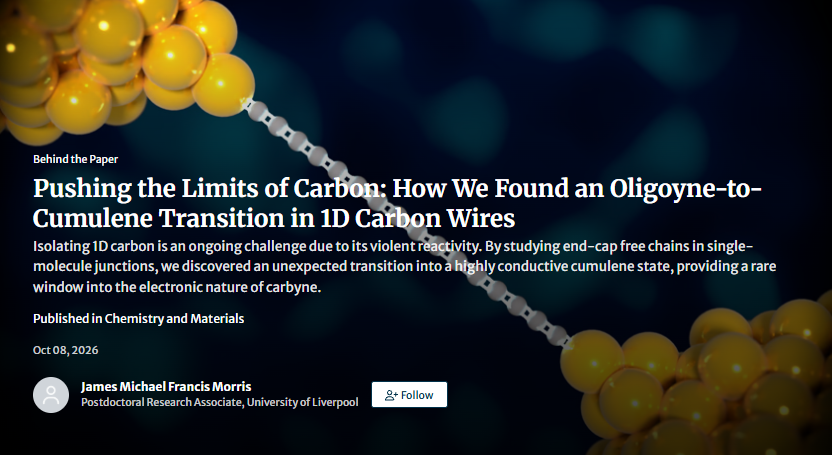
What Happens When Carbon Chains Change Their Bonding?
What if a carbon chain could switch into a completely different electronic state? In this Behind the Paper story, @James Michael Francis Morris shares how his team explored one-dimensional carbon wires, a challenging system to study because of their extreme reactivity. By investigating end-cap-free chains in single-molecule junctions, the researchers uncovered an unexpected transition from oligoyne to cumulene, revealing a new perspective on the fascinating behaviour of carbyne.
Published in Nature Chemistry, this work goes beyond carbon's familiar forms to explore how changes in bonding can transform electrical conductivity. The discovery of a highly conductive cumulene state offers a rare glimpse into the electronic properties of one-dimensional carbon and opens up intriguing questions about what these unusual structures might make possible. Read the full Behind the Paper post to see how the team pushed the limits of carbon research!
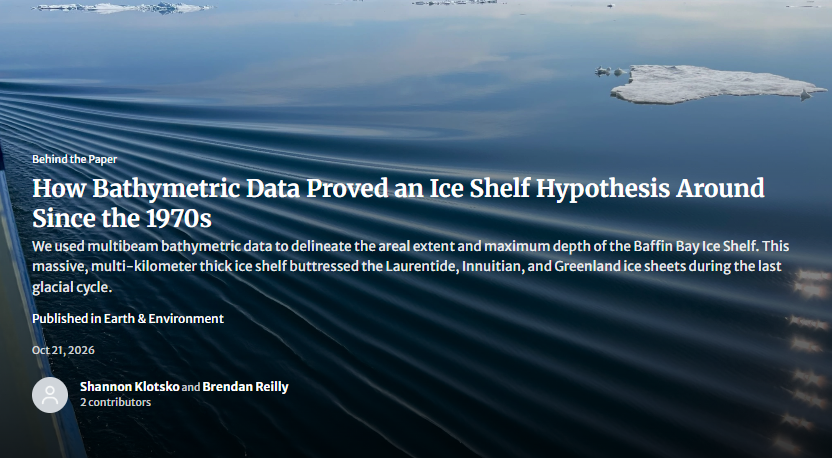
The Hidden Ice Giant Beneath Baffin Bay: Solving a Glacial Mystery
A remarkable discovery on the ocean floor is shedding new light on a glacial mystery that has puzzled scientists for decades. @Shannon Klotsko and @Brendan Reilly take us aboard a research expedition off Greenland, where multibeam bathymetric data revealed a distinctive boundary marking the former extent of a vast ice shelf in Baffin Bay. The findings provide compelling evidence for a hypothesis first proposed in the 1970s.
Featured in Nature Geoscience, the research reconstructs a remarkable ice shelf that may have reached 2,100 metres in thickness and helped stabilise three major ice sheets. Beyond offering a glimpse into Earth's icy past, the discovery provides valuable insights into how ice shelves support ice sheets and what their loss could mean for future sea-level rise. Read the full Behind the Paper post to discover how an unexpected seafloor discovery helped unravel this long-standing scientific mystery.
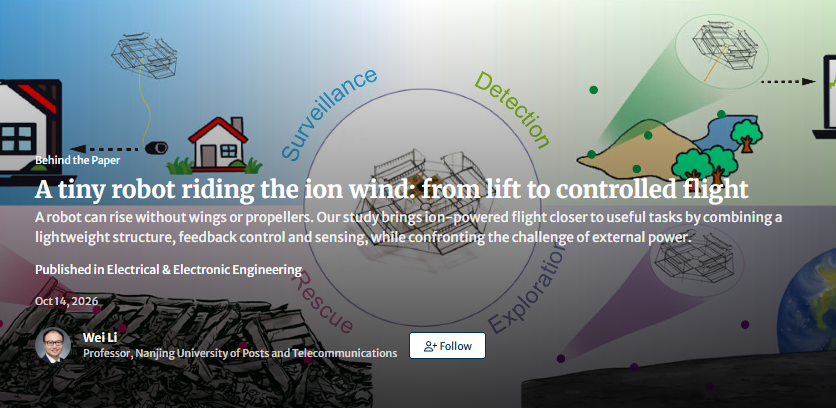
How Can a Tiny Robot Fly Without Wings or Propellers?
What makes a tiny robot fly without wings or propellers? @Wei Li explains how his team used ion wind to lift a lightweight robot into the air. With a new flight control system, the robot can stay more stable and carry small sensors, opening up exciting possibilities for future applications.
Published in Nature Communications, the study is an important step towards developing tiny flying robots. However, the technology still faces challenges, including how to power the robot without external equipment. Discover how the team brought this tiny robot to life in the full Behind the Paper story.
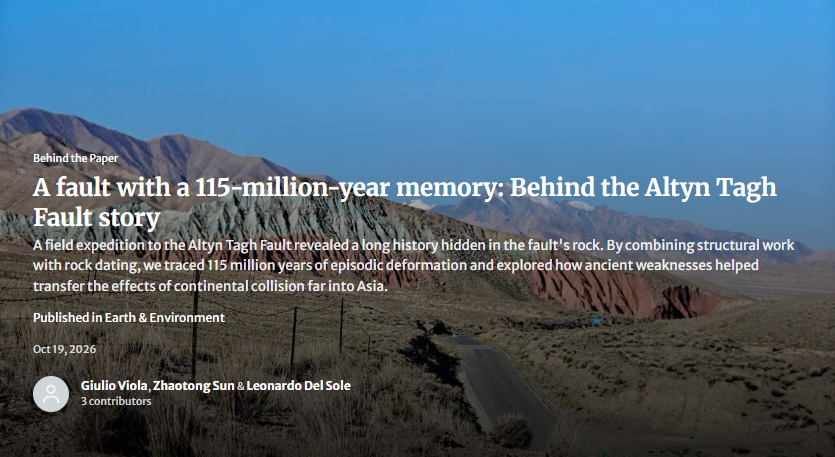
15 Million Years in the Making: The Story of a Giant Fault
A field trip to northwestern China led to an exciting discovery about one of Asia’s largest fault systems. @Giulio Viola , @Zhaotong Sun and @Leonardo Del Sole studied rocks along the Altyn Tagh Fault to uncover its history. By combining field observations with mineral dating, they uncovered several episodes of deformation, including activity that predates the collision between India and Asia.
Their study in Nature Communications shows how ancient weaknesses in Earth's crust can become active again as the continents change over time. The team even made one of their most exciting discoveries after taking an unplanned detour during fieldwork. Explore the team’s journey in this Behind the Paper post and find out how small pieces of rock can reveal millions of years of Earth's history.
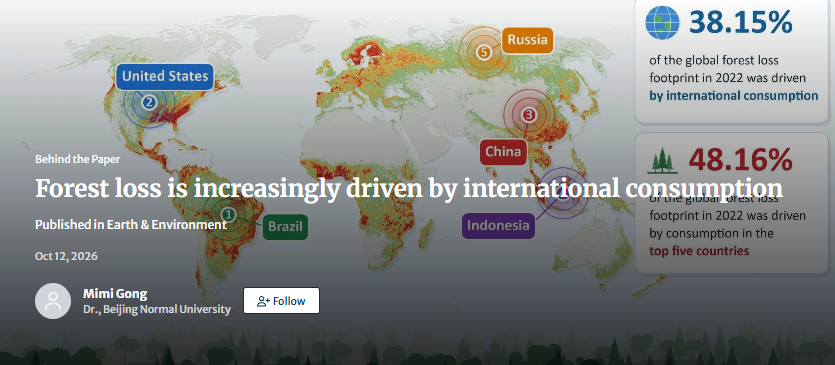
Who Is Really Driving Global Forest Loss?
Forest loss may happen in one part of the world to meet demand thousands of miles away. By linking satellite observations with global economic data, researchers traced how consumption across countries contributes to forest loss associated with logging, agriculture, mining and infrastructur @Mimi Gong found that in 2022, around 38% of the forest loss covered by the study was linked to international consumption, highlighting how global supply chains connect consumer choices with environmental change.
The findings published in Communications Earth & Environment reveal how these connections are shifting, with China accounting for a growing share of the global footprint and different industries showing very different patterns. The research also explores how countries’ economic and environmental characteristics relate to their forest-loss footprints, offering new ways to understand shared responsibility for protecting forests. Explore how global trade connects everyday consumption with forest loss around the world in this Behind the Paper post.
More stories worth exploring
Enjoyed the stories above? Here are more highlights worth exploring, featuring fresh perspectives on sustainability and how research can change the way we see the world.
- I thought I was living Sustainably. Research changed my mind. @Ludovica Serafini
More updates from Research Communities
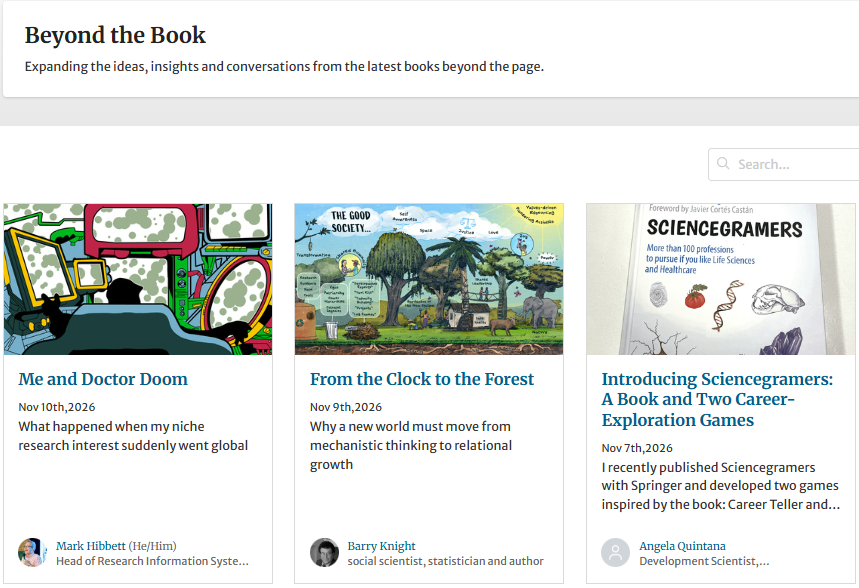 Have you explored our latest Channels and community stories yet? We recently launched Beyond the Book Channel, a dedicated place to helping book authors share their work and reach wider audiences. Here’s a useful post from our colleague on how to maximise the impact of your book:
- How to maximise the impact of your book @Christabell Ndive
 We also have a new story in the ECR Hub from one of our ECR Hub Ambassadors, @Lei Guo , who shares his experience and key takeaways from attending the Nature Precision Medicine Conference.
That’s a wrap for October! I hope you’ve enjoyed this month’s discoveries and the stories behind them. If you’re curious to explore more, I’ve included a few other highlights from our Research Communities below. Happy reading, and see you in the next roundup!
Explore more research breakthroughs
Follow the Topic
-
Nature Chemistry
A monthly journal dedicated to publishing high-quality papers that describe the most significant and cutting-edge research in all areas of chemistry, reflecting the traditional core subjects of analytical, inorganic, organic and physical chemistry.
-
Nature Geoscience
A monthly multi-disciplinary journal aimed at bringing together top-quality research across the entire spectrum of the Earth Sciences along with relevant work in related areas.