Quarterly Highlights from the Health & Clinical Research and Life Sciences Communities (July to September 2026)
Published in Cancer, Ecology & Evolution, and Microbiology


It’s time for another round-up from posts in the Health & Clinical Research and Life Sciences Communities! We’re looking back at some of the most interesting posts across our Communities between July and September 2026.
Our third round-up of 2026 brings together a great mix of research, covering the likes of disease detection, gut health and some fascinating discoveries in the natural world.
These are the posts that caught readers’ attention this quarter, so take a look and see what you might have missed!
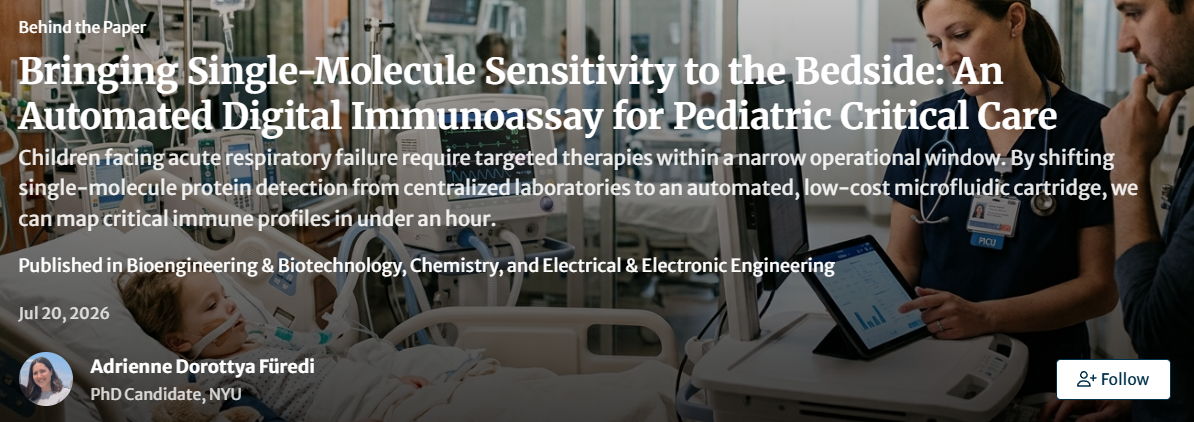
A faster route to personalised treatment for critically ill children
Children with acute respiratory failure can have very different underlying inflammatory responses, even when they present with similar symptoms. In this Behind the Paper post, @Adrienne Dorottya Füredi explains their Microsystems & Nanoengineering publication and the development of ADAPT (Automated Digital Assay for Precision Treatment), a microfluidic platform designed to bring highly sensitive protein detection directly to the bedside. By measuring three key inflammatory biomarkers in just 45 minutes, the system could help clinicians identify patient subtypes and make more timely, personalised treatment decisions.
This fantastic post takes us behind the engineering challenges involved in achieving uniform fluid flow, automating the assay and designing a platform with potential for large-scale manufacturing, and explores the team's vision for bringing this technology into paediatric intensive care units.
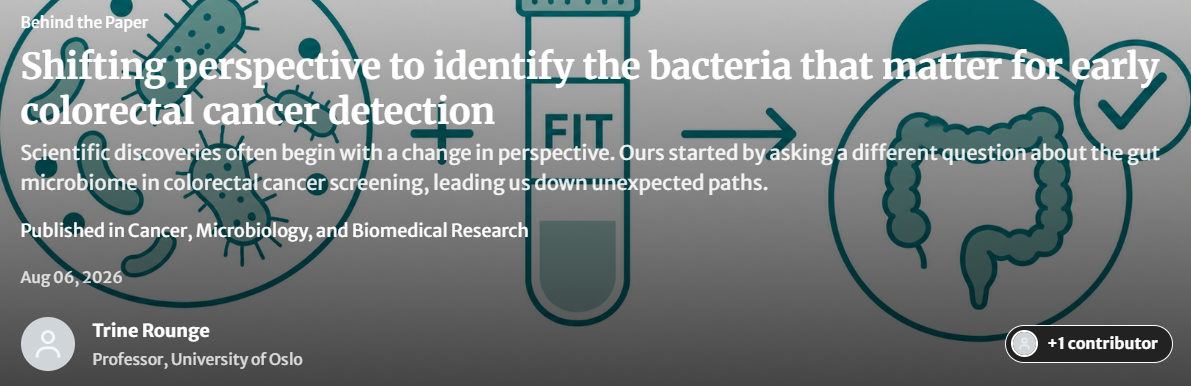
Gut bacteria offer new clues for early colorectal cancer detection
What if identifying the bacteria linked to colorectal cancer depends on who we compare them with? Professor @Trine Rounge shares how her team took a different approach to studying the gut microbiome, focusing on people who had tested positive for hidden blood in their stool during routine screening. Their recently publication in Nature Communications uses thousands of samples from a Norwegian screening trial to find that some bacteria previously associated with colorectal cancer may instead reflect broader gut health, while specific strains of E. coli showed contrasting associations with precancerous and cancerous lesions. Combining microbiome profiles with existing screening measurements also improved the identification of precancerous changes.
This Behind the Paper post explores how challenging established assumptions and choosing the right comparison groups can reveal new biological insights and help guide the development of more effective early detection methods.
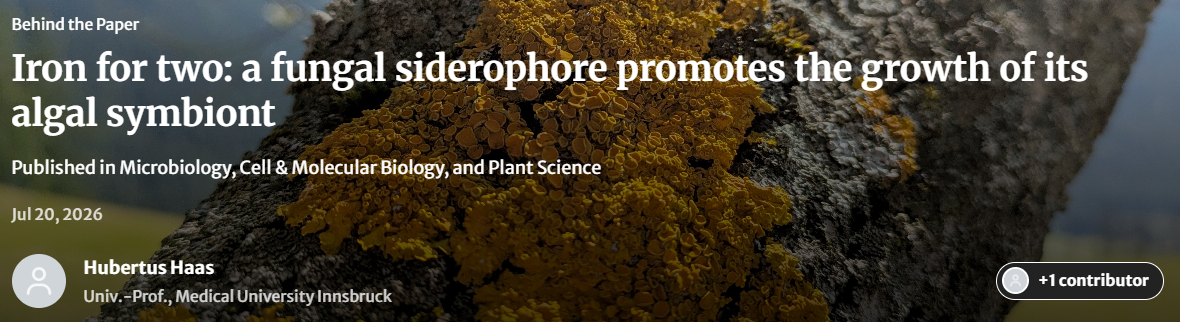
How a lichen fungus helps its algal partner thrive
How do lichens thrive in environments where essential nutrients are scarce? Professor @Hubertus Haas from the Medical University of Innsbruck discusses their Nature Communications paper and how a fungus and its algal partner cooperate to access iron, a vital nutrient for growth and photosynthesis. It explains how they found that the lichen-forming fungus Xanthoria parietina produces ferrichrome, a molecule that captures iron and promotes the growth of its algal partner, Trebouxia decolorans. This provides the first functional evidence of siderophore-mediated iron acquisition within lichens, revealing a previously unknown mechanism supporting their symbiotic relationship.
This Behind the Paper post explores how this discovery broadens our understanding of fungal siderophores, which can also play roles in microbial competition and fungal infections, and expertly highlights the complex nutrient exchanges that help lichens survive in challenging environments.
Engineering natural killer cells to fight cancer
Can immune cells be engineered to fight cancer while resisting the mechanisms tumours use to evade attack? In this Behind the Paper post, @Paola Vacca explains their recent publication in Signal Transduction and Targeted Therapy where they take a multifunctional approach to engineering natural killer (NK) cells for cancer immunotherapy. Paola and their team developed modified NK cells that simultaneously target two immune-inhibitory pathways, PD-L1 and HLA-E, while producing their own IL-15 to support survival and persistence. Amazingly, across preclinical models of several paediatric and adult cancers, including neuroblastoma, leukaemia and pancreatic cancer, the engineered cells showed enhanced anti-tumour activity and sustained tumour control.
This is a great post as it clearly explains how combining multiple functions in a single, potentially off-the-shelf cell therapy could help overcome tumour immune escape and pave the way for future treatments, while highlighting the work still needed before clinical application.
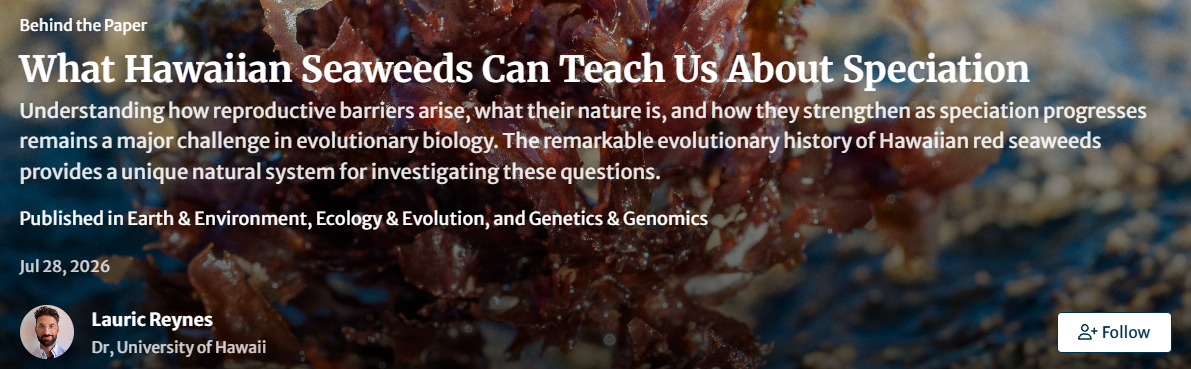
How do new species evolve, and what happens when diverging populations come back into contact?
In this Behind the Paper post, Dr @Lauric Reynes from the University of Hawaiʻi explores these questions through the evolutionary history of Amansia glomerata, a red seaweed found across the Hawaiian Archipelago. Using genomic data, the team discovered that two distinct lineages can coexist on Oʻahu while exchanging very little genetic material, despite evidence of past hybridisation and gene flow. Their groundbreaking findings suggest that the lineages evolved reproductive barriers while geographically separated, potentially as historical sea-level changes altered connectivity between islands.
I thoroughly enjoyed how this post took me from challenging coastal fieldwork to genomic analysis, revealing how Hawaii's geological history provides a unique natural laboratory for understanding speciation, genetic exchange and the evolution of biodiversity.
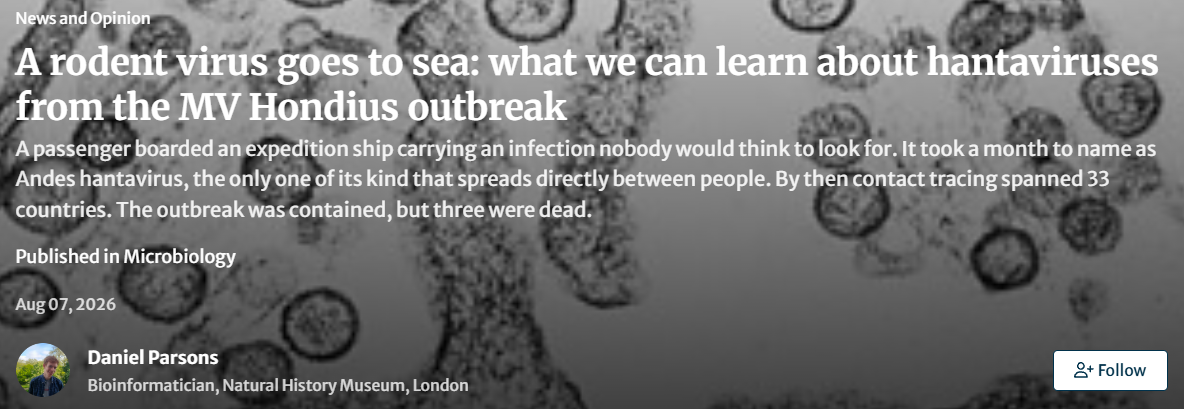
Lessons from the MV Hondius outbreak
The 2026 Andes hantavirus outbreak aboard the MV Hondius expedition ship highlights how quickly a rare infection can become an international public health challenge. Bioinformatician @Daniel Parsons explores how the virus, normally associated with rodents in South America, can also spread between people, and how an outbreak involving 13 cases and three deaths led to contact tracing across 33 countries. With no licensed vaccine or antiviral treatment for Andes virus, we learn the role of viral ecology, genomic analysis and outbreak response, and how the conditions in which people encounter a pathogen can matter just as much as the pathogen itself.
These most-viewed posts showcase the breadth of research being shared across our communities. If you haven’t read them yet, click through to explore the full stories and find out more about the research capturing the community’s attention.
Thank you to all the researchers who continue to share the stories behind their work!
Explore more:
- March to June 2026 - Quarterly Highlights from Health & Clinical Research and Life Sciences Communities
- August 2026 Highlights from the Health & Clinical and Life Sciences Research Communities
- September 2026 Highlights from the Health & Clinical and Life Sciences Research Communities
- September Highlights from the Humanities and Social Sciences Communities
Follow the Topic
-
Signal Transduction and Targeted Therapy
This is an international, peer-reviewed, open-access journal publishing articles related to signal transduction in physiological and pathological processes, alongside signal transduction-targeted therapeutics in the form of biological agents and small molecular drugs used to treat human diseases.
-
Nature Communications
An open access, multidisciplinary journal dedicated to publishing high-quality research in all areas of the biological, health, physical, chemical and Earth sciences.
-
Heredity
The official journal of the Genetics Society, covering a broad range of topics within the field of genetics.
-
Microsystems & Nanoengineering
This journal, with a target for a high-end journal for years to come, seeks to promote research on all aspects of microsystems and nanoengineering from fundamental to applied research.



Related Collections
With Collections, you can get published faster and increase your visibility.
Women's Health
A selection of recent articles that highlight issues relevant to the treatment of neurological and psychiatric disorders in women.
Publishing Model: Hybrid
Deadline: Ongoing
Data for AI, AI for Data: cross-disciplinary cleaning, processing and analysis approaches
Publishing Model: Open Access
Deadline: Dec 31, 2026