Behind the Paper: Silencing Pulmonary Inflammation to Fight Lung Disease
Published in Bioengineering & Biotechnology, Cell & Molecular Biology, and General & Internal Medicine



The problem that kept us up at night
If you've ever watched someone struggle through a severe asthma attack despite maximal therapy, you understand the urgency behind this work. For decades, the two pillars of asthma care have been bronchodilators (β-agonists) and corticosteroids that provide symptomatic relief but don't work for everyone. A substantial proportion of patients has so-called T2-low (neutrophilic or mixed inflammatory) asthma, which responds poorly to steroids and is not a good candidate for today’s biologics that target mostly eosinophilic or IgE-mediated pathways. Even the best current biologics are largely add-ons to, rather than replacements for, standard inhalers. In short, millions of people continue to struggle, and we knew we needed approaches that target inflammation upstream of current biologics.
The turning point: one receptor, many diseases
One such upstream control point is RAGE — the receptor for advanced glycation end-products. RAGE is a pattern-recognition receptor expressed on pulmonary epithelial cells that binds a remarkably broad set of “danger” signals (AGEs, HMGB1, S100 proteins, and complement components) and activates NF-κB, MAPK, and JAK/STAT-related inflammatory cascades. Several aspects of its biology stand out:
- RAGE is necessary for allergen-driven T2 inflammation (eosinophil recruitment, IL-33, IL-5, IL-13), for NLRP3 inflammasome activation, and for neutrophil recruitment in non-T2 disease, covering both major asthma phenotypes.
- RAGE and its ligands are elevated in chronic obstructive pulmonary disease (COPD), driving disease progression.
- RAGE is highly expressed on type I alveolar epithelial cells and also on airway epithelial cells, making the lung an unusually logical organ to target RAGE.
- Human genetic studies link RAGE polymorphisms with increased ligand affinity and lower circulating sRAGE, which is associated with reduced FEV1 and worse outcomes in COPD and cystic fibrosis (CF).
Yet RAGE's structural complexity has defeated every small-molecule drug attempt, and no biological approach has reached the clinic.
Demystifying the “how”: an inhaled genetic off-switch
We therefore turned to RNA interference. An siRNA targeting RAGE mRNA triggers its sequence-specific degradation via the RISC complex, preventing RAGE protein from being translated at the source. Inhaled drugs are notoriously difficult to direct to a specific cell type, and the inflamed airway is the last environment in which you want to inadvertently trigger an immune response.
Our partners at Arrowhead Pharmaceuticals addressed this by conjugating the siRNA to a targeting ligand that binds αvβ6 integrins, a heterodimer abundantly expressed on the pulmonary epithelium, especially in diseased tissue, but restricted in expression elsewhere. When nebulized and inhaled, ARO-RAGE hones specifically to the epithelium, limiting systemic exposure. Target engagement can be monitored using sRAGE, the proteolytically shed ectodomain of membrane-bound RAGE, measurable in both bronchoalveolar lavage (BAL) fluid and serum, an objective, non-invasive readout at every stage of the clinical development program.
The translational journey
This was a true bench-to-bedside effort, involving a remarkable team of preclinical and translational scientists across multiple institutions.
Rodent models
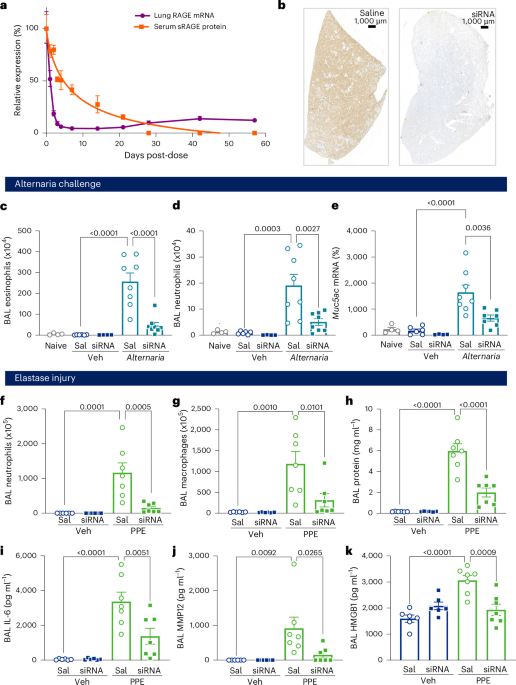
A single 0.5 mg/kg inhaled dose silenced >90% of pulmonary RAGE mRNA within days and maintained deep silencing for over eight weeks. Across three independent disease models (Alternaria-challenged allergic asthma, elastase-induced emphysema, and LPS-induced acute lung injury) RAGE silencing consistently reduced inflammatory cell infiltration, cytokine production (IL-6, IL-1β, MMP12, HMGB1), and tissue-injury markers. Importantly, heterozygous RAGE knockout mice showed intermediate protection, validating that partial silencing, achievable with siRNA, is sufficient for meaningful anti-inflammatory effects.
Non-human primates
We next moved into cynomolgus macaques–a critical de-risking step–given the anatomical and immunological similarities to human lungs. A single inhaled dose of ARO-RAGE (1 mg/kg) silenced >90% of RAGE mRNA uniformly across regionally diverse lung tissue two weeks post-dose. Dose-response confirmed proportional reductions in lung RAGE protein and serum sRAGE, with tissue silencing generally exceeding the circulating biomarker. A second dose at four weeks produced sustained sRAGE suppression lasting months. This was the evidence we needed to proceed with confidence to human studies.
First-in-human trial
In a phase 1/2a, randomized, double-blind, placebo-controlled study across 14 sites and six countries, ARO-RAGE was safe and well-tolerated in 77 healthy volunteers and 19 patients with mild-to-moderate eosinophilic asthma. No participant discontinued due to adverse events. Plasma ARO-RAGE concentrations were low, consistent with drug retention in the lung. A single 184 mg dose reduced BAL sRAGE by 90.2 ± 4.2% and serum sRAGE by 76.6 ± 6.5%, reductions that persisted for weeks. Two doses produced mean maximal serum knockdown of 88.7 ± 8.4%, with nadir occurring later and recovery being more protracted, supporting a repeat-dosing schedule.
What happened when sRAGE fell and what didn't
We were most interested in what would happen when sRAGE fell. The field has long debated whether sRAGE functions as a protective decoy receptor, competitively binding RAGE ligands and attenuating signaling through the membrane-bound form. Thus, deep suppression of RAGE and thus sRAGE might paradoxically worsen inflammation by removing an endogenous anti-inflammatory buffer: It didn’t! Circulating hsCRP and IL-6, and BAL inflammatory cell differentials, showed no consistent increase even as sRAGE dropped by >90%. There was no clinically significant imbalance in treatment-related adverse events. This is reassuring for the clinical program and challenges a prevailing assumption about RAGE biology.
Practical implications and what’s next
Because RAGE sits upstream of both eosinophilic and neutrophilic inflammatory pathways, ARO-RAGE could benefit patients who fall outside today’s biologic indications, particularly T2-low and treatment-resistant asthma. We have now launched a Phase 2 study (NCT07241546) in allergen-induced mild asthma to assess whether RAGE silencing blunts the early- and late-phase asthmatic response to a defined allergen challenge. We are particularly interested in the small-airway compartment, where conventional inhaled corticosteroids have limited penetration and where disease can progress despite treatment.
Beyond asthma, the delivery platform itself may prove equally significant. We have demonstrated that inhaled, αvβ6 integrin-targeted siRNA can reach the airway and alveolar epithelium, achieving durable gene silencing safely even in active disease. This opens the door to RNAi therapeutics for a range of pulmonary conditions with major unmet need, including idiopathic pulmonary fibrosis, COPD, and CF.
The lung has long been a notoriously difficult organ to drug with precision. We believe that is beginning to change. If you work on airway inflammation, RNA therapeutics, or pulmonary drug delivery, we would love to compare notes, share methods, and see these findings tested and extended. The road ahead is long, and we welcome company.
Follow the Topic
-
Nature Medicine
This journal encompasses original research ranging from new concepts in human biology and disease pathogenesis to new therapeutic modalities and drug development, to all phases of clinical work, as well as innovative technologies aimed at improving human health.

Related Collections
With Collections, you can get published faster and increase your visibility.
Clinical Research in Respiratory Medicine
Publishing Model: Hybrid
Deadline: Feb 18, 2027
Cancer Prevention and Control
Publishing Model: Hybrid
Deadline: Feb 19, 2027