Behind the Paper: Soil as a Battlefield and a Reservoir
Published in Ecology & Evolution, Microbiology, and Agricultural & Food Science


As plant pathologists, we’re often trained to think in terms of the disease triangle: a susceptible host, a virulent pathogen, and a favorable environment. Soil usually appears in that framework as part of the environment—a background condition rather than a central actor. Yet, the more I read about soilborne diseases, the harder it became to accept that view. Across different pathosystems, researchers repeatedly reported similar observations: some soils naturally suppress disease, even when pathogens are present. Others remain highly conducive despite management interventions. In many cases, disease outcomes could not be explained simply by pathogen abundance.
This review began with a straightforward objective: to understand how soil properties influence the epidemiology of soilborne pathogens. Written together with Florabelle Castañeda, Leny Galvez, and Mark Angelo Balendres, what followed was an exploration that took us far beyond traditional pathogen-centered thinking. One challenge quickly became apparent. The literature on soil suppressiveness is enormous, but it is often fragmented. Studies may focus on microbial diversity, organic amendments, soil structure, microbial networks, or disease epidemiology, yet these topics are rarely discussed together. We wanted to build a conceptual bridge between them. As we worked through the literature, a recurring pattern emerged: the same soil could either facilitate pathogen persistence or constrain it through intense biological interactions. Gradually, this led us to a simple metaphor: soil can function as both a reservoir and a battlefield. In some situations, soil acts as a reservoir where pathogens accumulate, persist, and await opportunities to infect plants. In others, it resembles a battlefield populated by competing microorganisms, predators, antagonists, and complex ecological interactions that limit pathogen establishment and spread. Of course, real soils are neither purely reservoirs nor purely battlefields. They exist somewhere along a continuum, shaped by biological, chemical, and physical processes. This idea became the organizing framework for the review (Figure 1).
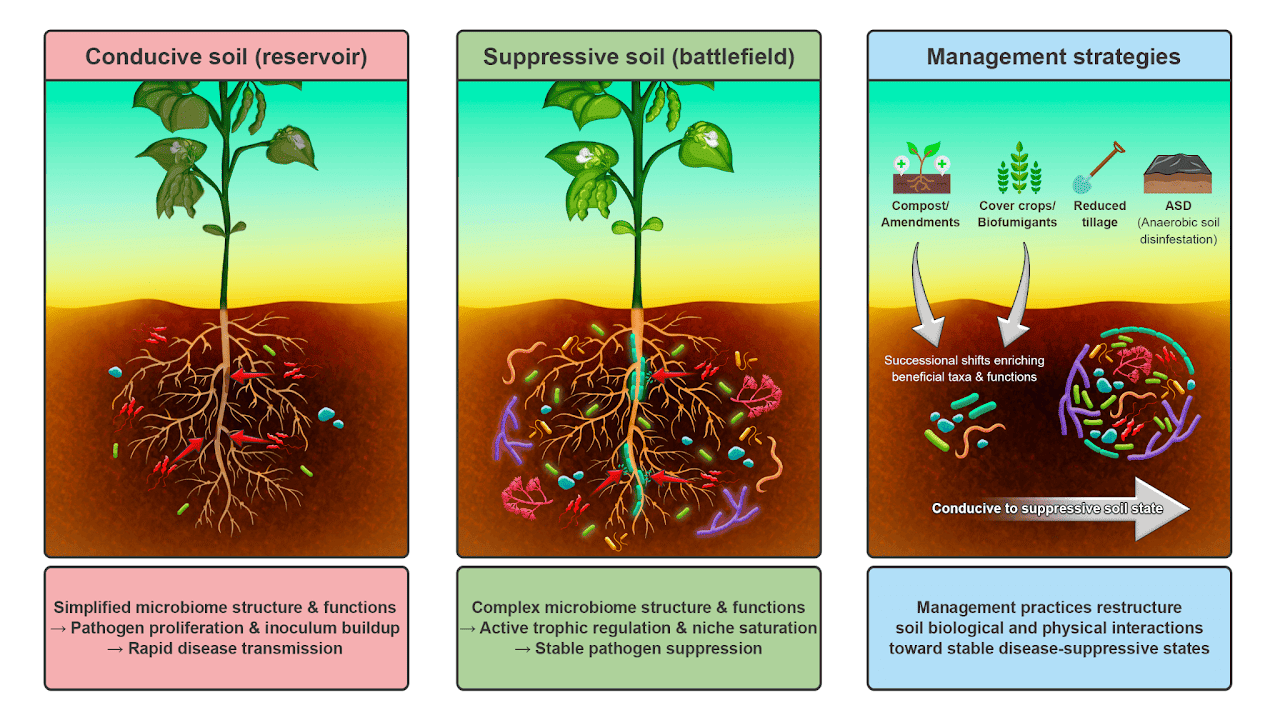
Three soil components emerged as the central focus: microbial diversity, soil organic matter, and soil structure. We chose these three deliberately. Unlike factors such as soil pH or parent material, they are highly dynamic, deeply interconnected, and directly responsive to agronomic management. They are, in practical terms, the levers available to those who want to shift soil conditions from reservoir to battlefield.
One of the most interesting lessons was how difficult it is to separate cause from consequence in soil microbial ecology. High microbial diversity is frequently associated with lower disease incidence, but diversity alone is not a magic solution. The composition of the community, the functions it performs, the structure of the soil, and the availability of organic matter all interact to influence disease outcomes. The same increase in microbial diversity can suppress disease in one context and fail to do so in another. In some cases, high background diversity can even prevent introduced biocontrol agents from establishing, outcompeted before they can act.
Another insight was the importance of viewing disease suppression as an ecological process rather than a property of individual organisms. Beneficial microbes do not operate in isolation. Their effects depend on food webs, resource competition, environmental filtering, and the physical architecture of the soil itself. Even pore networks and aggregate structure can influence how pathogens move, survive, and encounter hosts—a reminder that soil physical integrity is not merely an agronomic concern, but also an epidemiological one.
Perhaps the most exciting aspect of writing this review was seeing how rapidly the field is evolving. Advances in metagenomics, synthetic microbial communities, ecological modelling, and high-resolution imaging are beginning to move the discipline beyond descriptive studies towards predictive frameworks. Instead of simply cataloguing microbes associated with healthy or diseased plants, researchers are increasingly asking why these relationships emerge and whether they can be manipulated to improve plant health. This review reinforced a simple but powerful idea: soil is not merely the stage on which plant disease develops; it is an active participant in the process.
If we want to understand, predict, and manage plant diseases more effectively, we need to think of soil as a living ecosystem whose biological, chemical, and physical components jointly shape pathogen dynamics. The tools to do this are finally emerging—from functional metagenomics and synthetic community experiments to high-resolution imaging of soil pore networks. The next challenge is to integrate them into frameworks that can forecast disease risk before symptoms appear. Ultimately, the future of soilborne disease management may depend less on eliminating pathogens and more on understanding the ecological conditions that determine whether soil functions as a reservoir for disease or a battlefield that keeps it in check.
Pires, D., Castañeda, F., Galvez, L. & Balendres, M.A. (in press). Soil as a battlefield and a reservoir: linking soil components to the epidemiology of soilborne plant diseases. Microbial Ecology, 89: 162. https://doi.org/10.1007/s00248-026-02810-6
Follow the Topic
-
Microbial Ecology
This is a comprehensive open-access forum dedicated to presenting high-quality scientific investigations of how microorganisms interact with their environment, each other, and their hosts.

Related Collections
With Collections, you can get published faster and increase your visibility.
The Insect Microbiome – Behavior, Function, and Beyond
As a follow-up to our recent issue on the Insect Microbiome, this Phase 2 Special Collection focuses on how the insect microbiome influences behavior, including feeding preferences, mating, and social interactions, as well as its broader functional roles in insect biology. There is increasing acknowledgement of non-bacterial community members, including viruses, bacteriophages, and microbial eukaryotes, that shape host function. The composition and function of the insect microbiome can vary widely depending on diet, environment, developmental stage, and evolutionary history, underscoring the need for integrative approaches, including multi-omics, to study these systems.
We welcome submissions on topics including:
- Functional and multi-omics approaches, including metatranscriptomics, metabolomics, and proteomics, to uncover the metabolic capabilities of insect-associated microbes.
- Interplays between the microbiome and the insect immune system, as well as to the mechanisms that allow hosts to maintain beneficial symbionts while defending against pathogens.
- The microbiomes impact on insect neurobiology and behavior.
- Microbial metabolites and signaling in influencing insect behavior.
- The role of microbiome function in insect nutritional ecology, including nutrient provisioning, dietary specialization, and host–symbiont co-evolution.
- Microbiome contributions to insect adaptation under environmental stress, including temperature, pollutants, pesticides, and climate-driven habitat change.
- Manipulation of insect gut microbiota for environmentally sustainable pest control strategies.
- The impact of insect-associated microbes on plant health, soil ecosystems.
This collection supports and amplifies research related to SDG 15 (Life on Land).
Publishing Model: Open Access
Deadline: Feb 20, 2027
Biofilms and Surface-associated Microbial Communities
Surface associated microbial communities are often referred to as a biofilm. They can reside on both living and non-living surfaces and are held together through an extracellular matrix of polymers. Biofilms serve significant roles in the environment, in the development of antimicrobial resistance, as well as in causing infections of respiratory and urinary tracts, and those resulting from an association with medical implants. Biofilms can have both negative and positive associations, now being targeted for applications in bioremediation and wastewater treatment among other areas.
For this Special Issue, we are inviting novel contributions focused on Biofilms and Surface-associated communities. We welcome contributions that focus on the role biofilms play in infections, their role in the development of antimicrobial resistance, their mechanisms of action including adhesion and cell to cell communication, and emerging applications of biofilms in various processes.
This collection supports and amplifies research related to SDG 3 (Good Health and Well-being).
Publishing Model: Open Access
Deadline: Dec 31, 2026
