Behind the Research: Sex and Gender Medicine in Physician Training, a 10-Year Follow-Up at Cedars-Sinai
Published in Education




Why this study was necessary
In 2014, we surveyed physician trainees at Cedars-Sinai to assess how often topics related to sex (biological differences) and gender (socially constructed roles) were addressed in their clinical and didactic education. Despite growing awareness of sex and gender differences in disease patterns and treatment response, we found that most trainees reported little to no exposure.
In the years since, our institution made concerted efforts to bridge this gap. With support from the NIH-sponsored Specialized Center of Research Excellence (SCORE) and our Center for Excellence in Sex Differences in Medicine (CEC), Cedars-Sinai introduced new requirements for grand rounds, embedded sex-based decision tools in clinical practice, and launched educational workshops. A decade later, we wanted to evaluate whether these efforts had increased awareness and exposure in physician training.
What we did
In February 2024, we repeated the original survey with current residents and fellows at Cedars-Sinai. The instrument was nearly identical to the 2014 version, allowing us to directly compare trainee attitudes and perceived exposure over time.
We distributed the anonymous survey to 490 postgraduate trainees and received 62 responses, similar to the participation level in 2014.
What we found
While enthusiasm for sex and gender medicine remained strong, perceived exposure had changed little since 2014.
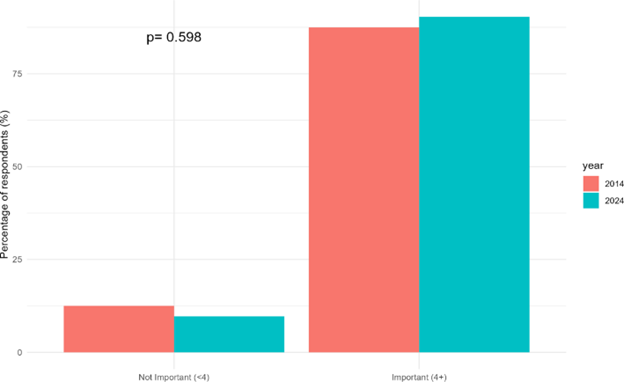
- 90% of respondents in 2024 said sex and gender medicine is important, virtually identical to the 88% from 2014.
- 53% supported a formal curriculum, comparable to 60% in 2014.
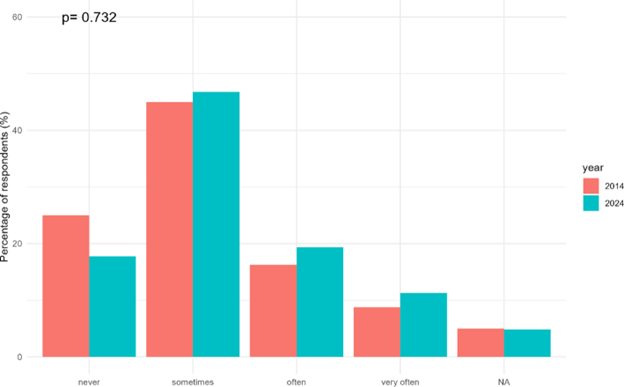
- Only 31% reported hearing about sex and gender concepts "often" or "very often" in clinical teaching, versus 25% in 2014.
- 95% said they incorporate sex into patient care.
- 82% believed additional training would help reduce bias and improve care.
These results suggest that while trainees recognize the importance of sex and gender in medicine, this content is still not consistently taught in clinical settings.
Institutional efforts and persistent challenges
Over the past ten years, Cedars-Sinai implemented several initiatives to advance sex and gender awareness in clinical education:
- Required all CME speakers to address sex as a biological variable
- Developed tools to integrate sex-based differences into diagnostic pathways
- Offered SCORE-supported workshops and mentorship for trainees
- Embedded sex and gender topics into select lectures and research projects
Despite these efforts, trainees still reported rare inclusion of sex and gender in their daily clinical learning. This suggests that occasional top-down interventions may be insufficient unless these concepts are routinely reinforced at the point of care by attending physicians and supervisors.
Reflections from the research team
One surprising and encouraging result was the continued increase in support from male trainees, whose endorsement of sex and gender medicine now closely matches that of female peers. This shift reflects broader cultural progress in medical education and highlights the universal relevance of these concepts to patient care.
Still, the dissonance remains: most trainees say sex and gender matter, but few report frequent exposure during their training. This gap between recognition and education underscores the need to make sex and gender medicine a consistent part of graduate medical education.
What this means for the future of medical training
To close this gap, we recommend a multi-pronged strategy:
- Integrate sex and gender content across all specialties, not just as optional lectures
- Provide structured training for faculty to help them incorporate these topics into everyday teaching
- Include sex and gender medicine as required competencies for board certification
- Develop and share clinical decision tools that normalize SABV (sex as a biological variable) in care delivery
Although this study was conducted at a single site with a modest response rate, it reinforces national findings that change has been slow. The consistent trainee support shows there is a clear appetite for better education.
Looking ahead
From our earliest survey in 2014 to this follow-up in 2024, the story has remained remarkably consistent: trainees care about sex and gender medicine and want more education, but they are not consistently receiving it. This study helped clarify how institutional efforts have helped—and where they fall short.
Our hope is that this research sparks renewed attention to how clinical training can better reflect what we know about biological and gender-related differences. We invite other institutions to replicate similar surveys and share their findings so we can accelerate progress together.

Follow the Topic
-
Discover Medicine
This is a fully open access, peer-reviewed journal that supports multidisciplinary research and policy developments across the fields of medical and clinical science.

Related Collections
With Collections, you can get published faster and increase your visibility.
Gut Microbiome and Human Well Being
The human gut microbiome plays a critical role in maintaining health and modulating disease processes. Its composition evolves across the lifespan under the influence of diet, lifestyle, aging, and environmental exposures. Disruption of gut microbial balance—known as dysbiosis—has been implicated in the pathogenesis of various chronic conditions, including autoimmune, metabolic, neurological, and inflammatory diseases.
This Collection welcomes submissions that explore the mechanistic, clinical, and translational aspects of gut microbiota in human health, with particular interest in:
The gut–brain, gut–heart, gut–cancer, and gut–joint axes
Gut dysbiosis and its immunological and metabolic consequences
Microbial metabolites and host-microbiome interactions
Microbiome-based diagnostics, therapeutic interventions, and biomarkers
We invite contributions including but not limited to:
Original research articles based on clinical, in vivo or in vitro studies
Reviews summarizing recent advances or proposing new frameworks
Perspective or opinion pieces that highlight emerging concepts or challenges
This Collection aims to enhance our understanding of the gut microbiome's contribution to health and disease and to inspire microbiome-based strategies for improving human well-being.
Keywords: Gut microbiome; Gut-organ-axis; chronic diseases; 16S rRNA; metagenomics
Publishing Model: Open Access
Deadline: Dec 31, 2026
Advances in Cardiovascular Diagnostics, Interventional Therapies, and Arrhythmia Management
Cardiovascular diseases remain a major global health challenge worldwide, continuing to be a leading cause of morbidity and mortality despite substantial advances in prevention and treatment. In recent years, progress in cardiovascular diagnostics, interventional techniques, and arrhythmia management has significantly improved patient care; however, important challenges persist, including timely diagnosis, individualized risk stratification, optimization of interventional strategies, and long-term outcome improvement. These unmet needs highlight the necessity for continued innovation and multidisciplinary research efforts in cardiovascular medicine.
This Collection aims to highlight recent advances in cardiovascular diagnostics, interventional therapies, and arrhythmia management, with a focus on clinically relevant and translational research. We welcome submissions addressing interventional cardiology procedures, catheter ablation techniques, three-dimensional electroanatomical mapping, mechanisms of cardiac arrhythmias, cardiovascular imaging, acute coronary syndromes, and hypertension. Contributions that enhance understanding of disease mechanisms, improve procedural outcomes, or inform clinical decision-making are particularly encouraged.
By bringing together high-quality experimental, clinical, and translational studies, this Collection seeks to advance scientific knowledge, support the development of improved therapeutic strategies, and foster global collaboration in the field of cardiovascular medicine.
Keywords:
Cardiology; Arrhythmia; Ablation; 3D mapping; Interventional cardiology; Hypertension; Acute coronary syndrome; Cardiovascular imaging; COVID-19
Publishing Model: Open Access
Deadline: Oct 12, 2026


Please sign in or register for FREE
If you are a registered user on Research Communities by Springer Nature, please sign in