Beyond Capital: The Seven Practices That Sustain Entrepreneurship in Complex Markets
Published in Business & Management and Economics



The Question That Wouldn’t Go Away
Over the past decades, I’ve worked with tens of thousands of entrepreneurs across African markets. Many of them have passed through accelerators such as the Cherie Blair Foundation for Women's Road to Growth program, Access Bank's YouThrive program and the African Women Entrepreneurship Cooperative. They completed rigorous and comprehensive training programmes, and, in some cases, even secured funding.
On paper, they were “ready.” They had business plans, market analyses, pitch decks and growth projections. And yet, many of these ventures struggled to sustain growth. Some plateaued. Others quietly disappeared. A few survived—but without scaling in meaningful ways, particularly in terms of employment.
This pattern raised a question that refused to go away:
What does it actually take to sustain a business in environments where uncertainty is the norm—not the exception?
The Limits of “Readiness” as We Know It
Most entrepreneurship support systems today are built around a familiar idea: investor readiness.
The logic is straightforward: If entrepreneurs can demonstrate market potential, articulate a clear strategy, and present themselves credibly to investors, then growth should follow. In certain contexts, this works—especially where capital markets are accessible, institutions are stable and growth pathways are relatively linear.
But in many emerging markets, these assumptions don’t hold. Firms operate in environments characterised by regulatory ambiguity, fluctuating demand, informal competition and fragmented value chains.
In such contexts, survival is not just about being evaluated well. It is about being able to adapt, coordinate, and persist over time.
This requires a different set of capabilities, which I term "change readiness" capabilities: customer orientation, collectivism, and commitment to impact. Customer orientation ensures clarity about the value being provided to the customer. Collectivism ensures mission-critical relationships with employees and partners endure. Commitment ensures value; not merely valuation drives growth and expansion.
A Different Lens: Entrepreneurship as Practice
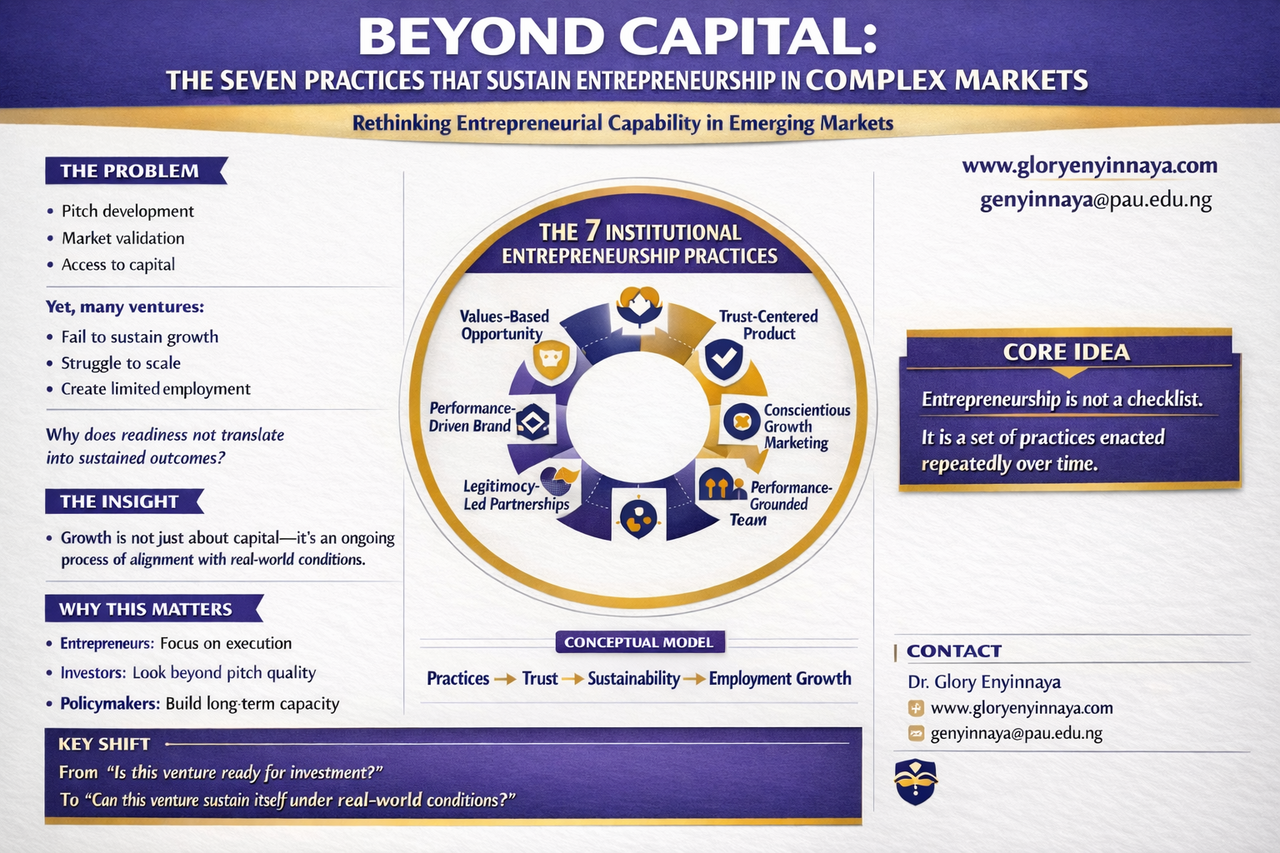
What began to emerge from my work is a different way of understanding entrepreneurship—not as a state of readiness, but as a set of practices.
These are not one-off capabilities or checklist items. They are ongoing ways of acting that enable entrepreneurs to interpret their environment, build trust, coordinate people and sustain effort under pressure. Across cases, contexts, and sectors, seven such practices appeared consistently.
The Seven Institutional Entrepreneurship Practices
These practices reflect how entrepreneurs align with—and operate within—complex institutional environments.
1. Values-Based Opportunity Recognition
Successful entrepreneurs do not simply chase opportunities—they interpret them through a values lens. They ask: ''Who does this serve? What problem truly matters? What trade-offs are acceptable?'' This shapes not only what they build, but how they build it. They move from calculating total addressable markets to total addressable voids.
2. Trust-Centered Product Development
In uncertain markets, adoption is not driven by functionality alone. It is driven by trust. Entrepreneurs who succeed emphasise reliability, transparency, and user confidence. They move beyond minimum viable products to what might be called minimum trustworthy products.
3. Performance-Driven Brand Identity
Brand is not just messaging—it is evidence. In contexts where scepticism is high, reputation is built through consistent delivery, visible results and word-of-mouth validation. A brand becomes a reflection of performance over time. Brand identity evolves beyond messaging and is backed up by proof.
4. Culture-Grounded Team Building
Teams are not just assembled—they are aligned. Entrepreneurs who sustain growth invest in shared norms, collective responsibilities, and mutual accountability. Especially in small firms, culture substitutes for formal structure. Institutional entrepreneurs hire not for fit alone but for posture.
5. Legitimacy-Led Partnerships
Partnerships are not only about access to resources. They are about legitimacy. Who you work with signals credibility, alignment and belonging in a broader ecosystem. Entrepreneurs navigate partnerships not just strategically, but institutionally. In forging strategic alliances, their decision criteria move beyond creating value to congruence of values.
6. Outcome-Verified Marketing
Marketing is not just persuasion—it is proof. Rather than relying solely on claims, effective entrepreneurs demonstrate results, show impact and let outcomes speak. This is particularly important where trust is fragile. Institutional entrepreneurs move from performance marketing to identifying and leveraging trust channels.
7. Conscientious Growth Strategy
Growth is not simply about scaling fast. It is about scaling responsibly and sustainably. This includes pacing expansion, managing risk and ensuring that growth does not outstrip capacity. In many cases, restraint—not acceleration—is what enables longevity. They eschew blitzscaling in favor of belonging.
From Readiness to Practice
Taken together, these practices suggest a shift in how we think about entrepreneurship.
Instead of asking:
“Is this entrepreneur ready for investment?”
We might ask:
“Is this entrepreneur able to initiate and sustain action under real-world conditions?”
This is a different question—and it leads to different answers.
Why This Matters
This shift is particularly important for development-oriented entrepreneurship.
If the goal is not just firm creation but also firm survival and employment growth, then we must pay attention to the practices that make sustained action possible. These practices are rarely captured in traditional metrics, are difficult to teach through templates alone and often develop through experience, reflection, and relational learning. Yet they may be precisely what determines whether a venture endures.
Rethinking What We Build For
Entrepreneurship support systems have made significant progress in expanding access—to training, to networks, and to capital.
The next frontier is not access. It is alignment. Alignment between what we teach, what we measure and what actually enables businesses to survive and grow
Because in the end, the question is not simply whether entrepreneurs can start businesses. It is whether they can sustain them—under pressure, over time, and in context.
Call to Reflection
For those designing programmes, investing in ventures, or building businesses:
Are we optimising for readiness to be evaluated…
or readiness to endure?

Dr. Glory Enyinnaya is a management scholar and strategy consultant whose work bridges theory and practice in entrepreneurship, fintech ecosystems, and inclusive economic growth. She is a faculty member at Pan-Atlantic University in Nigeria, where she leads research on change readiness, a theory she introduced in Harvard Business Review to explain how entrepreneurs in complex, low-trust environments gain legitimacy and scale. She is also the founder of Kleos Advisory, which has supported national entrepreneurship initiatives across Africa. Her forthcoming book, Institutional Entrepreneurship in African Fintech, will be published by Palgrave Macmillan in April 2026.


Please sign in or register for FREE
If you are a registered user on Research Communities by Springer Nature, please sign in