Beyond employment: what Finland’s 2025 integration reform builds into policy
Published in Law, Politics & International Studies




Why look behind the language of integration policy?
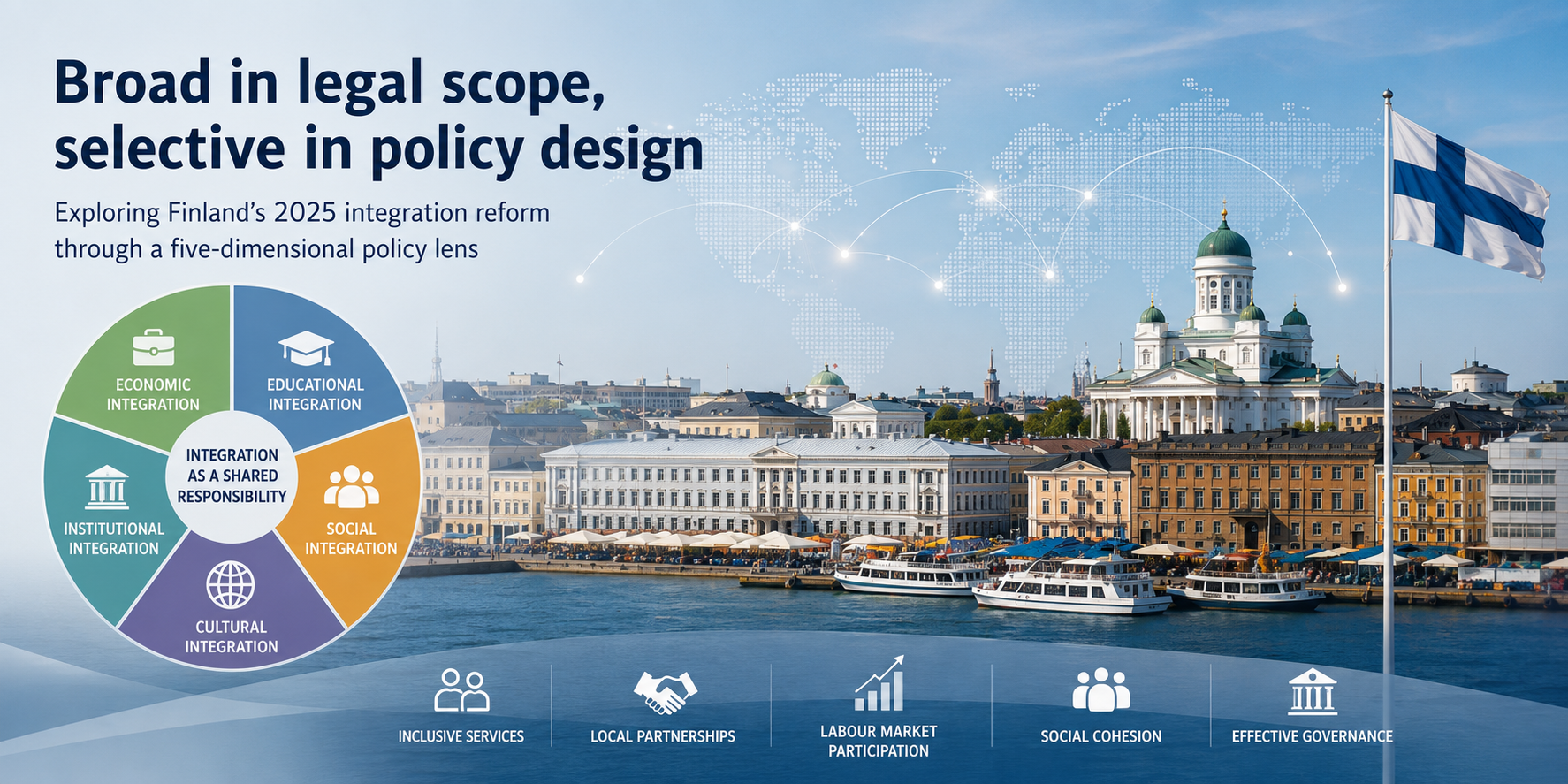
When Finland’s new integration legislation entered into force in 2025, much of the public discussion understandably focused on employment, language learning, municipal responsibility and the organisation of services. These are important issues. However, I became interested in a more basic question: when a policy describes integration as broad and multidimensional, does its practical design support all dimensions equally?
Integration is often discussed as though it were a single outcome. A person is described as either “integrated” or “not integrated". In reality, settlement involves several interconnected parts of life. Employment matters, but so do education, access to public services, social relationships, cultural participation, language, well-being and a sense of belonging.
This distinction became the starting point for my article, Broad in legal scope, selective in policy design: a five-dimensional document analysis of Finland’s 2025 integration reform, published in SN Social Sciences.
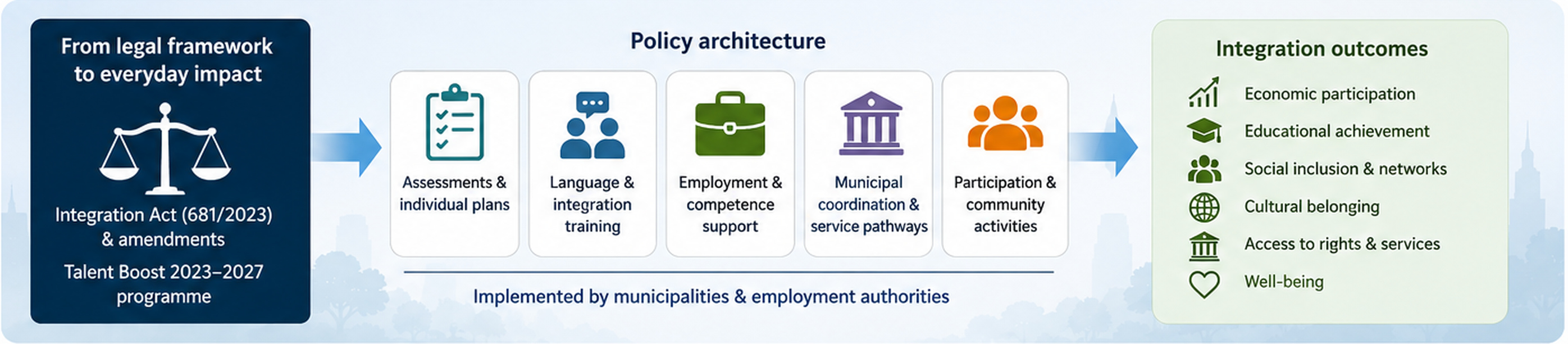
Rather than asking whether the reform is already successful, I asked how it has been designed. The reform was still too recent for a reliable evaluation of its implementation or long-term effects. What could be examined, however, was the architecture created by the legislation: the duties it establishes, the services it identifies, the institutions it assigns responsibility to and the activities it makes possible.
From broad objectives to concrete instruments
Policy documents often contain ambitious objectives. They may refer to equality, participation, well-being, inclusion, employment and good relations between population groups. These statements are important, but they do not by themselves show how an objective will be delivered.
For that reason, I focused on policy instruments. In practical terms, I looked for measures such as integration assessments, individual integration plans, language and integration training, multilingual civic orientation, employment support, guidance, municipal coordination and participation-related activities.
I analysed Finland’s Act on the Promotion of Immigrant Integration, the amendments that subsequently modified the system, and the Talent Boost 2023–2027 programme. Each legal duty, service measure, programme priority or institutional responsibility was examined according to the part of integration it supported.
One challenge was that the documents did not organise integration using a ready-made academic framework. Legal texts are structured around sections, duties, responsible authorities and service procedures. I therefore adapted existing integration theory into five policy dimensions:
economic, educational, social, cultural and institutional integration.
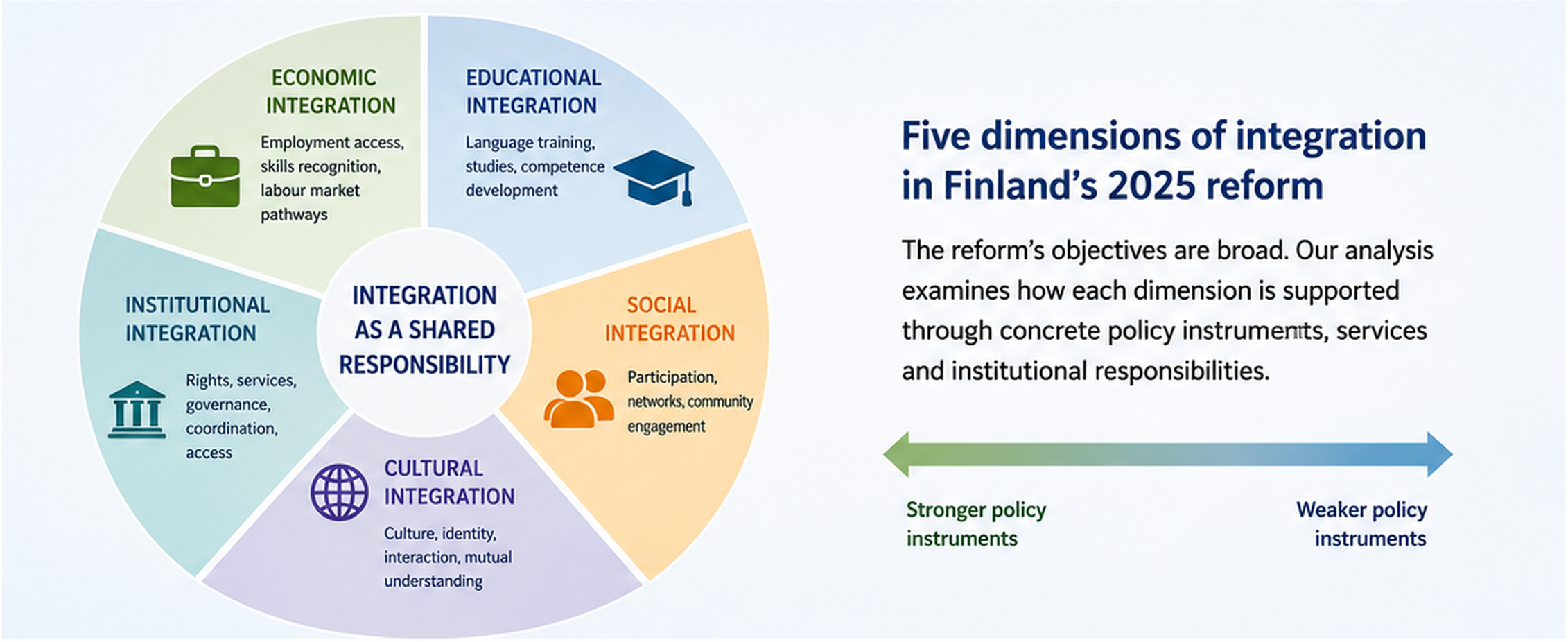
Well-being was treated as a cross-cutting condition because it can affect a person’s ability to study, work, use services and participate in society, even though the study did not test these relationships empirically.
A broad framework but uneven operational support
The most important finding was not that Finland’s reform defines integration narrowly. In fact, the legal objectives are quite broad. The selectivity becomes clearer when attention shifts from general aims to concrete instruments.
Economic integration is strongly supported through employment-related planning, competence assessment, entrepreneurship measures, labour-market services and the wider Talent Boost agenda.
Educational integration is also strongly embedded through language learning, civic orientation, integration training, literacy support and recognition of previous competences.
Institutional integration has become especially important because municipalities and employment authorities are responsible for assessment, planning, guidance and service pathways. Municipal coordination is not simply another part of integration policy; it is also the mechanism through which many other services are delivered.
Social and cultural integration are recognised, but they receive less standardised national support. Participation in associations, community activities, local networks and cultural life may be included in integration plans, but these areas depend more heavily on municipal choices, civil-society organisations and local partnerships.
This does not mean that social and cultural integration are absent. It means that they are less firmly built into the operational structure than employment, education and service coordination.
The most difficult analytical decision
One of the hardest parts of the research was deciding how to distinguish between a policy aim and a genuinely institutionalised measure.
A dimension was considered strongly institutionalised when it had several forms of support: a legal or programme basis, a named responsible actor, a standardised service or instrument, and a connection to assessment, planning, delivery or monitoring.
By contrast, a dimension was classified as indirectly supported when it appeared mainly through optional provisions, general objectives or locally organised activities.
This required conservative coding. The same instrument could also support several dimensions. Language training, for example, supports education and employment, but it can also contribute to institutional navigation and participation. An integration plan can include economic, educational, social, cultural and well-being-related elements, although not all receive the same degree of standardisation.
Creating a transparent framework for making these distinctions was one of the most demanding parts of the study. It was also one of the most rewarding because the framework may be useful beyond Finland. It provides a way to compare what integration policies promise with what they actually organise.
Why does this matter beyond legal analysis?
Migrants are not only workers, jobseekers or students. They are also family members, neighbours, service users and participants in local communities.
Employment and education are essential, and the article does not argue that Finland should reduce its attention to either. The issue is whether social participation, family settlement, cultural life, belonging and well-being are sufficiently visible within the same policy architecture.
This matters particularly in a decentralised system. Giving municipalities greater responsibility can bring services closer to local needs and make coordination easier. At the same time, municipalities differ in staffing, resources, labour markets, civil-society networks and experience of immigration. Areas that depend heavily on local partnerships may therefore be implemented less consistently than services defined through clearer national procedures.
The article does not measure such differences. It identifies them as questions that should now be studied empirically.
What comes next?
The next stage is to examine what happens when the legal framework meets everyday practice.
How do municipalities interpret their new responsibilities? Do migrants experience assessment and integration planning as coordinated and useful? Are social, cultural and well-being-related needs addressed consistently? Do services differ according to municipality, migration pathway, family situation, language background or employment status?
These questions require interviews, municipal comparisons, administrative data and research based on migrants’ own experiences.
The central lesson from this study is straightforward: a policy can be multidimensional in its stated goals while remaining selective in the instruments it provides. Looking at concrete duties, services and responsible actors helps reveal priorities that may remain hidden in broad policy language.
I hope the article encourages further discussion about how Finland—and other countries—can retain strong employment, education and service systems while giving social participation, cultural belonging and well-being a more visible place in integration policy.
Read the article:
Broad in legal scope, selective in policy design: a five-dimensional document analysis of Finland’s 2025 integration reform
https://doi.org/10.1007/s43545-026-01586-3

I am a senior researcher at the University of Turku, where I study how unreliable and retracted scientific information is communicated through news, social media, and other digital platforms and how this communication shapes public understanding, trust, and evidence-informed decision-making.
My broader research interests include science communication, media framing, misinformation, retraction awareness, information behaviour, digital literacy, immigrant health, and integration policy. I use qualitative content analysis, survey research, mixed methods, and computational and statistical approaches, including Python and multilevel modelling.
I hold a PhD in Information Studies from Åbo Akademi University. My doctoral research examined immigrant health information behaviour in Nordic welfare contexts. I am particularly interested in making research findings accessible and useful to academic, policy, and public audiences.
For more information: https://www.ahmadinia.fi/
Follow the Topic
-
SN Social Sciences
This is a multi- and interdisciplinary journal serving the Social Sciences community.

Related Collections
With Collections, you can get published faster and increase your visibility.
- SDG 10 - Reduce inequality within and among countries
We are calling for articles to our new Collection on Reduced inequalities, in support of the UN Sustainable Development Goal: SDG 10. This collection creates a cross-disciplinary space for researchers and stakeholders working across various disciplines to address this significant global issue. We bring together scholarship and policy that makes a difference to reducing inequalities for a sustainable future. SDG 10 aims to reduce inequality within and among countries. Inequality threatens long-term social and economic development, harms poverty reduction and destroys people’s sense of fulfillment and self-worth. The pandemic has caused the largest rise in between-country inequality in three decades. Reducing both within- and between-country inequality requires equitable resource distribution, investing in education and skills development, implementing social protection measures, combating discrimination, supporting marginalized groups and fostering international cooperation for fair trade and financial systems.
We are welcoming a range of perspectives including theoretical, methodological, quantitative and qualitative studies. Original Research and Review Papers are accepted. We are particularly interested in research that centers on the following topics:
- By 2030, progressively achieve and sustain income growth of the bottom 40 per cent of the population at a rate higher than the national average
- By 2030, empower and promote the social, economic and political inclusion of all, irrespective of age, sex, disability, race, ethnicity, origin, religion or economic or other status
- Ensure equal opportunity and reduce inequalities of outcome, including by eliminating discriminatory laws, policies and practices and promoting appropriate legislation, policies and action in this regard
- Adopt policies, especially fiscal, wage and social protection policies, and progressively achieve greater equality
- Improve the regulation and monitoring of global financial markets and institutions and strengthen the implementation of such regulations
- Ensure enhanced representation and voice for developing countries in decision-making in global international economic and financial institutions in order to deliver more effective, credible, accountable and legitimate institutions
- Facilitate orderly, safe, regular and responsible migration and mobility of people, including through the implementation of planned and well-managed migration policies
- Implement the principle of special and differential treatment for developing countries, in particular least developed countries, in accordance with World Trade Organization agreements
- Encourage official development assistance and financial flows, including foreign direct investment, to States where the need is greatest, in particular least developed countries, African countries, small island developing States and landlocked developing countries, in accordance with their national plans and programmes
- By 2030, reduce to less than 3 per cent the transaction costs of migrant remittances and eliminate remittance corridors with costs higher than 5 per cent
We are interested to hear your ideas for short commentary or a collection of articles, please contact the journal of your choice directly to discuss this before submitting.
Submission Procedure:
Submission is possible to one of the participating journals on the right, please select TC: SDG10 - Reduced Inequalities in the electronic submission portal. Accepted articles will be published in the respective journal, as well as highlighted on the Collection page.
Publishing Model: Hybrid
Deadline: Dec 31, 2030
- SDG 16 - Promote peaceful and inclusive societies for sustainable development, provide access to justice for all and build effective, accountable and inclusive institutions at all levels
We are calling for articles to our new Collection on Peace, Justice and Strong Institutions, in support of the UN Sustainable Development Goal: SDG 16. This collection creates a cross-disciplinary space for researchers and stakeholders working across various disciplines to address this significant global issue. We bring together scholarship and policy that focuses on the integral role of peace, justice and strong institutions in society.
Goal 16 is about promoting peaceful and inclusive societies, providing access to justice for all and building effective, accountable and inclusive institutions at all levels. People everywhere should be free of fear from all forms of violence and feel safe as they go about their lives whatever their ethnicity, faith or sexual orientation. Governments, civil society and communities need to work together to find lasting solutions to conflict and insecurity. Strengthening the rule of law and promoting human rights is key to this process, as is reducing the flow of illicit arms, combating corruption, and ensuring inclusive participation at all times.
We are welcoming a range of perspectives including theoretical, methodological, quantitative and qualitative studies. Original Research and Review Papers are accepted. We are specifically interested in research that advances understanding on:
- Significantly reducing all forms of violence and related death rates everywhere
- Ending abuse, exploitation, trafficking and all forms of violence against and torture of children
- Promoting the rule of law at the national and international levels and ensure equal access to justice for all
- By 2030, the significant reduction of illicit financial and arms flows, strengthening the recovery and return of stolen assets and combatting all forms of organized crime
- The substantial reduction of corruption and bribery in all their forms
- Developing effective, accountable and transparent institutions at all levels
- Ensuring responsive, inclusive, participatory and representative decision-making at all levels
- Broadening and strengthening the participation of developing countries in the institutions of global governance
- By 2030, the provision of legal identity for all, including birth registration
- Ensuring public access to information and protect fundamental freedoms, in accordance with national legislation and international agreements
- Strengthening relevant national institutions, including through international cooperation, for building capacity at all levels, in particular in developing countries, to prevent violence and combat terrorism and crime
- The promotion and enforcement of non-discriminatory laws and policies for sustainable development
We are interested to hear your ideas for short commentary or a collection of articles, please contact the journal of your choice directly to discuss this before submitting.
Submission Procedure:
Submission is possible to one of the participating journals on the right, please select TC: SDG16 - Peace, justice and strong institutions in the electronic submission portal. Accepted articles will be published in the respective journal, as well as highlighted on the Collection page.
Publishing Model: Hybrid
Deadline: Dec 31, 2030