Beyond Scraped Knees: What Does Risk Mean to a Five-Year-Old?
Published in Education






Much of the research on risk in early childhood has also been shaped by this physical perspective, particularly through the growing literature on risky play.
But children encounter many situations in everyday life in which there is nothing dangerous to climb and nowhere to fall.
What about raising a hand without knowing whether the answer is correct? Approaching a group of children and asking to join their game? Trying something new while knowing that failure is possible? Or saying something when there is a chance of being laughed at, rejected, or misunderstood?
These questions led us to look at risk from a broader perspective.
Looking beyond physical risk
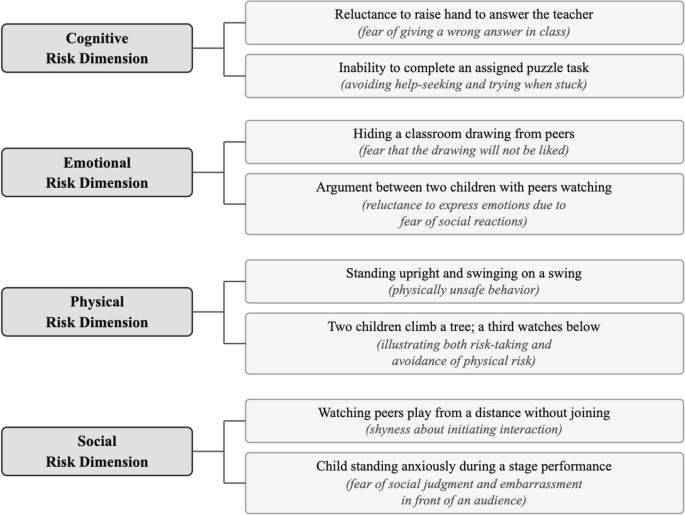
In our recently published study in Child Indicators Research, “What is Risk? An Examination of Risk Perceptions among Children Aged 60–72 Months and their Parents,” we explored how young children and their parents perceive risk across four interconnected dimensions: physical, emotional, social, and cognitive risk.
Our starting point was relatively simple: if risk is part of children’s everyday experience, then understanding risk requires listening to children themselves.
Rather than approaching children only through adult-defined categories of what is safe or unsafe, we wanted to learn how they made sense of situations involving uncertainty, possible failure, negative emotions, social judgment, and physical harm. At the same time, we wanted to place their perspectives alongside those of their parents, whose decisions inevitably shape how much uncertainty and autonomy children are allowed to experience.
The study included 17 children aged 60–72 months and 11 of their parents. We used semi-structured interviews and, when working with children, supported the interview process with AI-assisted visualisations. These visual materials helped make relatively abstract situations more accessible and provided concrete prompts around which children could express their ideas.
Risk looks different through a child’s eyes
One of the most striking aspects of listening to children was seeing how clearly the meaning of risk changed depending on its form.
Physical risks were comparatively visible and concrete. Potential injury can be imagined: falling, getting hurt, encountering something dangerous. Other forms of risk, however, require a different kind of awareness. Social risk involves anticipating how another person might respond. Emotional risk involves recognising the possibility of embarrassment, rejection, or other uncomfortable feelings. Cognitive risk involves accepting that an attempt may result in an error or failure.
Our findings suggested a pattern in which children’s awareness became less pronounced as risk moved from more concrete toward more abstract dimensions.
This matters because childhood risk-taking is often discussed as though children either “take risks” or “avoid risks.” Our findings point toward a much more differentiated picture. A child may be highly cautious about physical danger yet willing to risk making a mistake. Another may confidently explore a physical environment but hesitate when entering an unfamiliar social situation.
In other words, there may be no single risk-taking child.
There are children navigating different kinds of uncertainty.
Parents face a different dilemma
The interviews with parents revealed another important part of this story: protection.
Wanting to protect a child is, of course, one of the most understandable aspects of parenting. Yet protection and development do not always point in exactly the same direction.
Parents in our study frequently expressed protective tendencies, but the point at which they drew the boundary between acceptable risk and unacceptable danger differed considerably. This variation is important because everyday decisions made by adults can either expand or restrict the space children have to assess situations, make decisions, make mistakes, recover, and try again.
The question, therefore, may not simply be whether adults should protect children from risk.
A more useful question may be: Which risks require adult protection, and which risks provide children with opportunities to develop the ability to manage uncertainty themselves?
That distinction becomes especially important when we move beyond physical safety. Preventing a dangerous fall and preventing a child from ever experiencing failure, embarrassment, disagreement, or uncertainty are developmentally very different forms of protection.
Making room for manageable uncertainty
This is where we believe the broader concept of risk can contribute to conversations in early childhood education.
Learning itself contains risk.
Answering a difficult question means risking being wrong. Beginning a friendship means risking rejection. Expressing an unconventional idea means risking disagreement. Attempting a challenging task means accepting the possibility of failure. Increasing independence means gradually entering situations in which outcomes cannot be completely controlled.
If adults remove every such possibility in the name of protection, children may also lose opportunities to practise evaluating situations and responding to them.
This does not mean romanticising risk or overlooking children's safety. Nor does it mean that every risk should be encouraged. Rather, our findings reinforce the importance of distinguishing risk from hazard and of thinking carefully about developmentally appropriate, manageable experiences of uncertainty.
The developmental goal is not to produce children who are fearless. It is to help children become increasingly capable of recognising, evaluating, and managing different forms of risk.
What we hope comes next
Our study involved a relatively small group of children and parents, and the meanings attached to risk are inevitably influenced by family, culture, gender expectations, temperament, previous experiences, and educational environments. These factors open several directions for further research.
We would particularly like to see more studies examining how children understand non-physical forms of risk, how these perceptions change developmentally, and how adults’ beliefs shape children's opportunities to practise risk management.
We also believe that listening directly to children should remain central to this work.
Young children may not use the theoretical vocabulary of cognitive, emotional, social, or physical risk. But when provided with developmentally appropriate ways to communicate, they can tell us a great deal about what feels uncertain, frightening, challenging, or worth attempting in their worlds.
Perhaps that is the most important idea we take from this study.
When adults ask, “Is this safe for the child?”, we are asking an essential question.
But sometimes another question deserves to follow:
“What might the child learn by navigating this uncertainty?”
Follow the Topic
-
Child Indicators Research
This journal presents a range of research on children’s well-being.