Beyond the Code: Why Feelings Are the Missing Link in AI Education
Published in Computational Sciences, Education, and Arts & Humanities





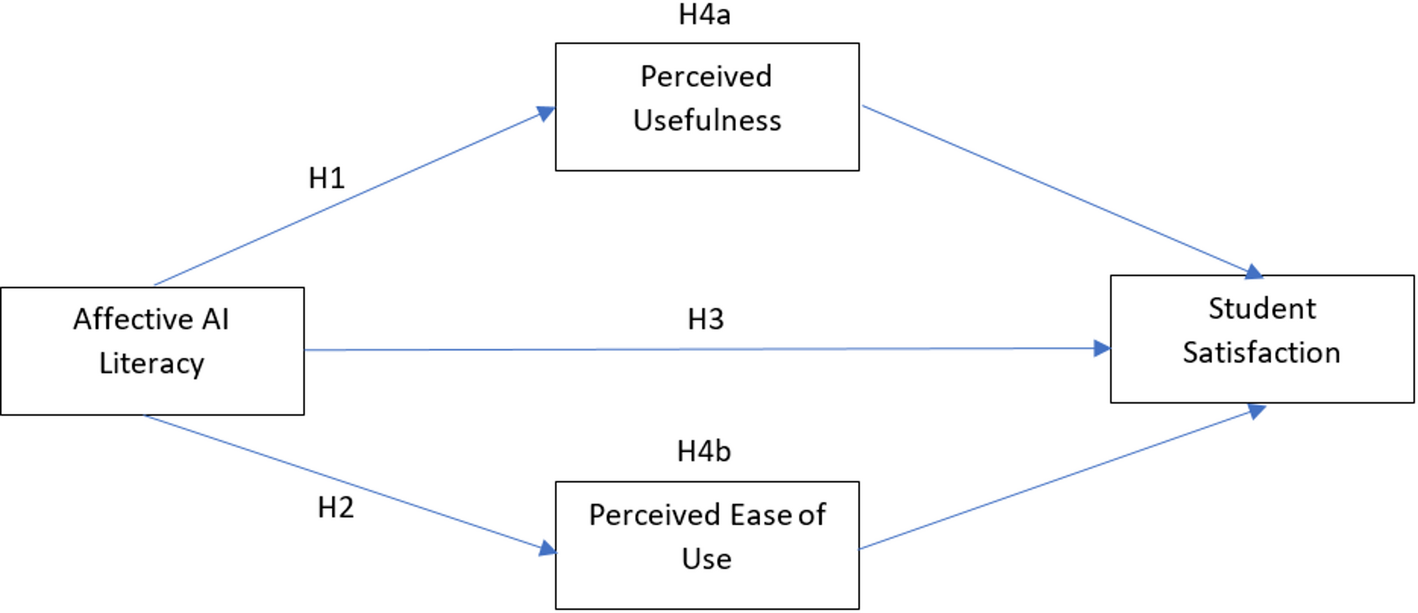

The AI wave has hit higher education hard. From intelligent tutoring systems to personalised learning environments, universities are scrambling to catch it — mostly by teaching the mechanics: the algorithms, the code, the data pipelines. But a new study of 237 computer science undergraduates across three campuses of COMSATS University Islamabad argues that’s only half the story. The other half is affective: how students feel about AI. And, as it turns out, that half may matter more.
What is Affective AI Literacy?
The ABCD model frames AI literacy as four-dimensional: Affective (emotions and attitudes), Behavioural (usage), Cognitive (knowledge), and Digital/ethical. Most curricula fixate on the cognitive. This study zooms in on the affective — a student’s emotional and motivational readiness to engage with technology. It’s intrinsic motivation, curiosity, and self-efficacy rolled into one: the quiet internal voice that says “I can do this,” and “this is interesting to me.” The researchers wanted to know whether that inner readiness actually shifts how useful and how easy AI feels in practice.
Confidence shapes reality
Using structural equation modelling, the researchers found a robust positive link between affective AI literacy and perceived usefulness. Emotionally ready students see AI as a partner, not a hurdle — and that perception drives productivity.
The ease-of-use bridge
The more practical finding: emotional engagement also raises perceived ease of use. Fear and anxiety make tasks feel harder; self-efficacy makes them feel intuitive. A positive attitude lowers the mental tax of learning a new tool, creating a virtuous loop of reduced resistance and deeper integration.
The real secret to satisfaction
Affective literacy does nudge satisfaction directly — but the magic is mediation. Perceived ease of use acts as a bridge:
- Student builds affective AI literacy (confidence, motivation)
- Confidence makes the AI tool feel easier to use
- Ease of use translates into genuine satisfaction
The model explains roughly 62% of the variance in student satisfaction. Ease of use isn’t a design nicety — it’s the psychological hinge connecting attitude to outcome.
What this means for educators
Dropping AI tools into classrooms isn’t enough, especially in resource-constrained settings like Pakistan’s universities. Curricula need to reach beyond technical training into emotional design — hands-on workshops that demystify the technology, reflective assignments that humanise human–AI interaction, and teaching that makes AI feel emotionally intuitive rather than merely functional. Confidence, in short, deserves the same lesson plan as code.
The technology is artificial. The learning, still, is deeply human.
Follow the Topic
-
Discover Artificial Intelligence
This is a transdisciplinary, international journal that publishes papers on all aspects of the theory, the methodology and the applications of artificial intelligence (AI).

Related Collections
With Collections, you can get published faster and increase your visibility.
Transforming Education through Artificial Intelligence: Opportunities, Challenges, and Future Directions
Artificial Intelligence (AI) is rapidly changing the educational field by enabling personalized learning, intelligent tutoring systems, automated assessments, learning analytics, and administrative automation.
This collection invites original research, systematic reviews, and visionary perspectives on the transformative impact of AI in education. It aims to explore how AI technologies can enhance equity, inclusion, and efficiency in educational settings across different contexts, including higher education, K-12, vocational training, and lifelong learning. This collection will address technical, pedagogical, ethical, and policy aspects, fostering interdisciplinary perspectives and evidence-based insights.
This Collection supports and amplifies research related to SDG 4 and SDG 9.
Keywords: Artificial Intelligence, AI in Education, Educational Technology, Data Analytics, AI Ethics
Publishing Model: Open Access
Deadline: Nov 30, 2026
Advanced AI Methods for Personalized Healthcare
The advancement of Artificial Intelligence (AI) technologies, especially Reinforcement Learning (RL) and Deep Learning (DL), is transforming healthcare, enabling innovative solutions for patient monitoring, diagnostics, and personalized treatment. These technologies facilitate the effective use of healthcare data and intelligent analytics, enhancing clinical decision-making and improving patient outcomes. AI is revolutionizing how healthcare is delivered, making it more proactive, efficient, and accessible. This Collection explores new methods and applications of AI for healthcare such as personalized healthcare. Contributions in this Collection showcase novel frameworks, case studies, and interdisciplinary approaches that drive the future of personalized healthcare, fostering innovations that bridge technology and patient care.
In this context, we are inviting original research articles, reviews, and perspective papers addressing (but not limited to) the following themes:
- Personalized medicine
- IRL for dynamic treatment regimes
- Wireless sensor networks for patient monitoring
- Identification and prevention of critical condition
- Monitoring systems within the medical devices contest
- Methodologies and tools for the rapid integration of WSNs, IoT and AI in health monitoring
- Behavior analysis of patients
- Personalized health-promoting interventions
- Ambient assisted living and active assisted living
- AI security and privacy models for healthcare applications
- AI methods for rehabilitation
Publishing Model: Open Access
Deadline: Feb 27, 2027