Beyond the Score: What Dental Infection Prevention in Somaliland Taught Us About Safe Care
Published in Healthcare & Nursing and General & Internal Medicine
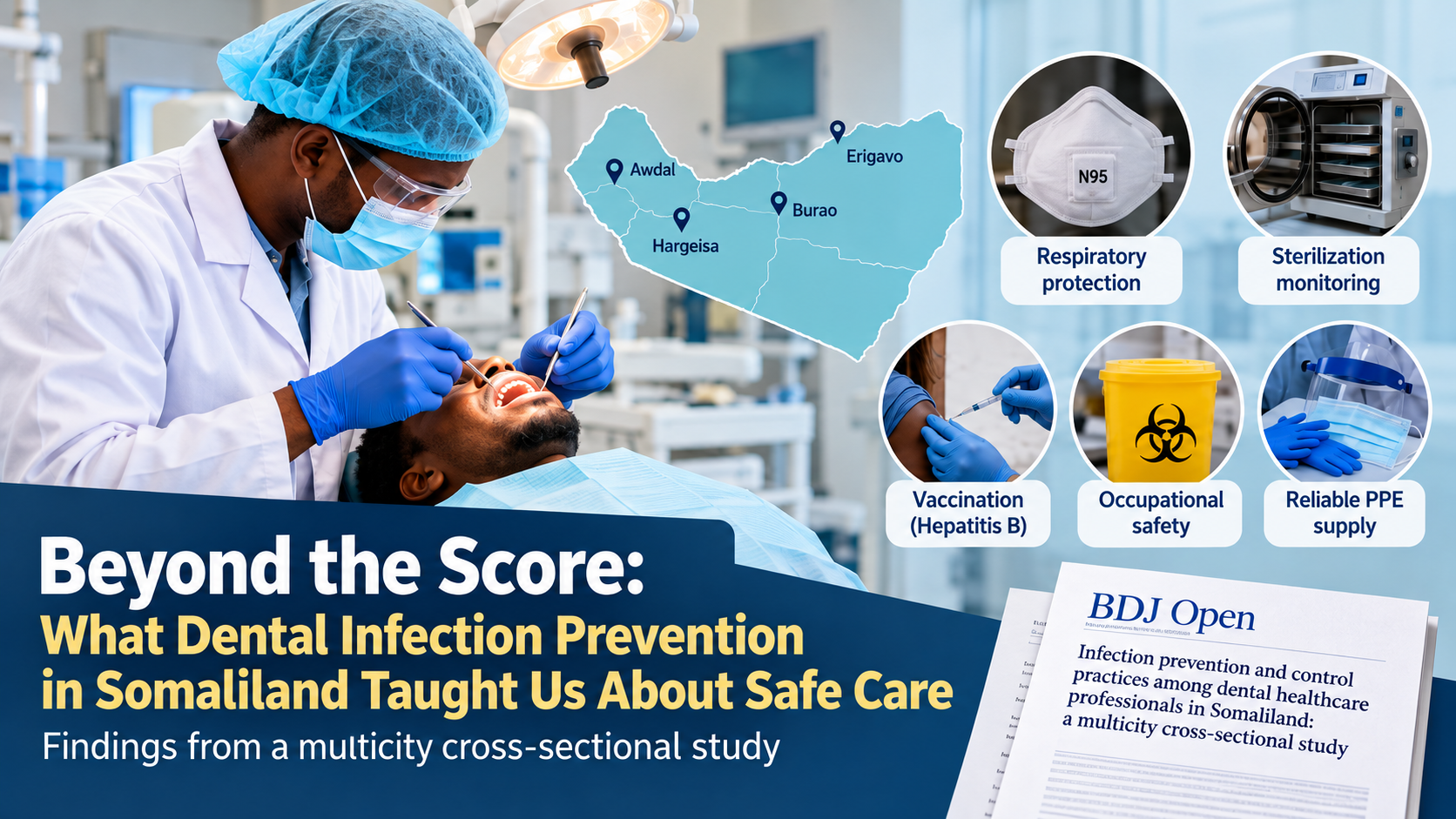

At first glance, one number from our study seemed to tell a very encouraging story: 96.7% of the dental healthcare professionals we surveyed reached our prespecified threshold for good infection-prevention practice.
But that number was not the whole story.
When we looked beyond the overall score and examined individual practices, a more important picture emerged. Routine behaviours such as glove use, changing gloves between patients, hand hygiene and surface disinfection were commonly reported. Yet several components of infection prevention that depend heavily on training, equipment, monitoring and institutional systems remained incomplete.
That contrast became one of the most valuable lessons from our study.
Our paper, “Infection prevention and control practices among dental healthcare professionals in Somaliland: a multicity cross-sectional study,” was recently published in BDJ Open. We conducted the study because surprisingly little empirical evidence was available on infection prevention and control IPC in dental services in Somaliland.
Why dental infection prevention matters
Dental professionals work in an environment where exposure to saliva, blood, sharp instruments, contaminated surfaces and procedure-generated aerosols is part of everyday clinical practice. Infection prevention therefore protects two groups simultaneously: the patient receiving care and the healthcare professional providing it.
Standard precautions may sound straightforward clean hands, use appropriate protective equipment, sterilize reusable instruments, dispose of sharps safely and manage occupational exposures correctly.
In practice, however, these behaviours do not occur in isolation.
A clinician may know the correct procedure but lack the necessary equipment. A facility may own a sterilizer but have no routine system for verifying its performance. A healthcare worker may experience a needle-stick injury but have no clear post-exposure pathway. Training may be provided without continuing reinforcement or supervision.
We wanted to understand this broader picture in Somaliland dental settings.
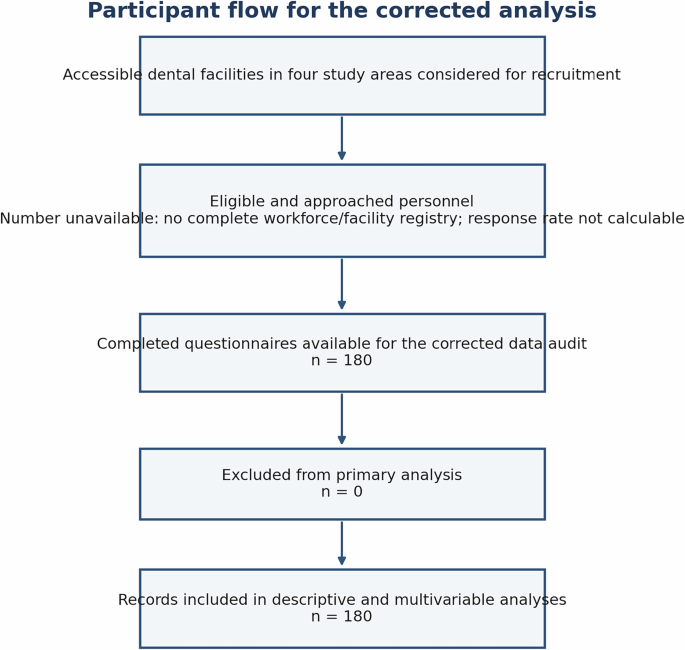
Our study included 180 dental healthcare professionals from accessible facilities across four study areas. Rather than asking only whether participants followed infection-prevention precautions, we examined knowledge, reported practices, vaccination, occupational exposure, IPC training, PPE availability, sterilization monitoring, facility systems and perceived barriers.
The overall result looked impressive
Several routine behaviours were reported at high levels.
Almost all participants 96.7% reported always using gloves during procedures and changing gloves between patients. More than four in five reported always performing hand hygiene before and after each patient, and a similar proportion reported always disinfecting chairs or clinical surfaces between patients.
The mean practice score was 25.73 out of 28, and 174 of the 180 participants reached the prespecified 75% threshold used to describe good practice.
It would have been easy to stop there and conclude that infection prevention was uniformly strong.
But individual items showed why we should be careful when interpreting a composite score.
What the overall score could hide
Respiratory protection was one example.
When participants were asked which PPE they selected for aerosol procedures, 83.9% selected a surgical mask, while only 21.7% selected an N95 respirator. Fewer than half selected a face shield or protective eyewear.
Knowledge showed a related gap. Only 22.2% correctly answered the item indicating that surgical masks do not provide full airborne-pathogen protection.
Sterilization monitoring told another interesting story.
Autoclaving was the most frequently reported sterilization method. Yet only 22.2% reported using biological indicators to monitor sterilization, even though 81.7% correctly identified biological indicators as the gold standard for sterilization monitoring.
For us, this difference was particularly revealing.
Knowing what should be done and being able to implement it are not necessarily the same thing.
The gap may involve equipment, cost, procurement, workflow, assigned responsibility or institutional systems. Our cross-sectional study cannot determine exactly why this occurred, but it shows why infection prevention should not be viewed only as an individual knowledge problem.
Safe practice depends on the system around the professional
This idea became even clearer in our adjusted analysis.
Participants who had not received IPC training during the previous two years had lower practice scores than those who had received recent training.
PPE availability showed an even stronger pattern.
Compared with participants who reported that PPE was always adequate, those reporting supplies as only sometimes adequate had lower practice scores. Participants reporting that PPE was rarely adequate showed a substantially larger reduction.
This finding carries a simple message with important implications:
Healthcare professionals cannot consistently use protective equipment that is not consistently available.
It is easy to frame infection prevention as a question of whether individual workers comply with guidelines. But compliance occurs within a health system.
Training matters. Knowledge matters. Professional responsibility matters.
So do procurement, reliable supplies, workplace organisation, supervision and occupational-health support.
Interestingly, the knowledge score itself was not independently associated with the overall practice score after adjustment. We do not interpret this to mean that knowledge is unimportant. Instead, it suggests that a short knowledge assessment cannot capture all the factors that shape real-world practice.
Protecting healthcare workers as well as patients
Another result deserves particular attention.
Nearly one-third of participants 32.2% reported a needle-stick injury during the previous 12 months.
Among those who experienced an injury, approximately one-quarter did not report it.
At the same time, 72.8% reported hepatitis B vaccination, meaning vaccination was not complete in this occupationally exposed group. Only 66.1% reported that a post-exposure protocol was available.
These findings remind us that IPC is also an occupational-safety issue.
A healthcare worker exposed to a contaminated sharp needs more than general advice to be careful. An effective system should include prevention, vaccination, immediate reporting, confidential assessment, clear post-exposure procedures and appropriate follow-up.
Protecting patients and protecting healthcare workers are not separate goals. They are part of the same safety system.
What should happen next?
Our findings suggest that improvement efforts should focus on the specific weaknesses that can be hidden by a high overall practice score.
Facilities need dependable supplies of appropriate protective equipment, recurrent competency-based training, clear written procedures, responsible IPC personnel and practical systems for monitoring performance.
Sterilization quality assurance deserves particular attention. Having an autoclave is not the end of instrument reprocessing. Cleaning, packaging, monitoring, documentation, storage and corrective action all need to function together.
Occupational-health systems should also strengthen hepatitis B vaccination, needle-stick reporting and post-exposure management.
These measures should support healthcare professionals rather than simply judge them. Safe behaviour becomes more sustainable when the health system makes the correct action practical and consistently possible.
What we still need to learn
Our study also has important limitations.
We did not have a comprehensive registry of every dental facility and eligible dental professional in the study areas. The total eligible population and response rate therefore could not be verified.
Practices were also self-reported rather than directly observed. Social desirability and recall may have influenced some responses.
For these reasons, our results should not be interpreted as showing that 96.7% of all dental care in Somaliland meets every IPC standard, nor should the findings automatically be generalized to every dental professional or facility in the country.
The next generation of studies should combine verified sampling with direct clinical observation, facility audits, sterilization records and prospective evaluation of interventions.
Beyond the paper
Perhaps the most important lesson we took from this work was not contained in a single percentage.
It was the importance of looking beyond averages and composite scores.
A high overall score can coexist with specific weaknesses that have real consequences for patients and healthcare workers.
Recognizing those weaknesses makes intervention more precise. If glove use is already commonly reported, simply repeating messages about gloves may achieve little. If respiratory protection, sterilization monitoring, vaccination, reliable PPE supply or post-exposure systems are weaker, resources can instead be directed toward those specific gaps.
This is why locally generated evidence matters.
It allows us to move beyond assumptions, identify practical weaknesses within the health system and ask what can realistically be improved.
We hope our study helps strengthen infection prevention in dental services in Somaliland and encourages further research that measures not only what healthcare professionals know, but also whether the systems around them enable them to practise safely.
Because behind every infection-prevention score are two people who matter:
a patient who deserves safe care, and a healthcare professional who deserves to provide that care safely.
Read the published article:
https://doi.org/10.1038/s41405-026-00483-4

I am a researcher and academic specializing in One Health, epidemiology, infectious diseases, neglected tropical diseases, and public health. My work focuses on disease surveillance, outbreak research, implementation science, laboratory diagnostics, and data analysis, with experience in Somaliland and Ethiopia. I am particularly interested in translating research evidence into practical solutions for infectious disease control and stronger health systems.
Follow the Topic
-
BDJ Open
This is an international, peer-reviewed, open-access, online-only journal publishing dental and oral health research from all disciplines. The journal is owned by the British Dental Association (BDA) and is the sister journal of the British Dental Journal.