Beyond Tradition: What Camel Milk Handling in Somaliland Taught Us About Food Safety
Published in Microbiology, Public Health, and Agricultural & Food Science

Camel milk is more than a food product in Somaliland. It is part of daily life, local identity, nutrition and household income. In Burao City, it moves from producers to families and markets every day, linking pastoral traditions with a growing urban food system.
That importance is precisely why food safety matters.
Our paper, “Demographic characteristics and camel milk production and handling practices in Burao City, Somaliland: implications for food safety,” published in Discover Food, examined how camel milk is produced, handled, transported and stored, and what these practices may mean for consumer safety.
We studied 384 camel milk producers in Burao City using questionnaires and direct observation of milking, storage and transport practices. What we found was not a simple story of “good” or “bad” practice. Instead, it revealed a combination of strong cultural value, important hygiene gaps and clear opportunities for improvement.
Why we studied camel milk safety
Camel milk plays an important nutritional and economic role in Somaliland. In our study, 90.1% of participants viewed camel milk as an important part of their dietary habits.
But milk is also highly perishable. Its safety depends on what happens at several stages: before milking, during milking, when containers are used, during transportation, and while the milk is stored before sale or consumption.
In settings where refrigeration, training, appropriate containers or food-safety awareness may be limited, these stages can become points where contamination risk increases.
Despite the importance of camel milk in Somaliland, there had been limited local evidence describing these practices in detail. We wanted to generate evidence from Burao itself rather than relying only on findings from other settings.
The hygiene gaps were striking
Some of the clearest findings involved basic hygiene.
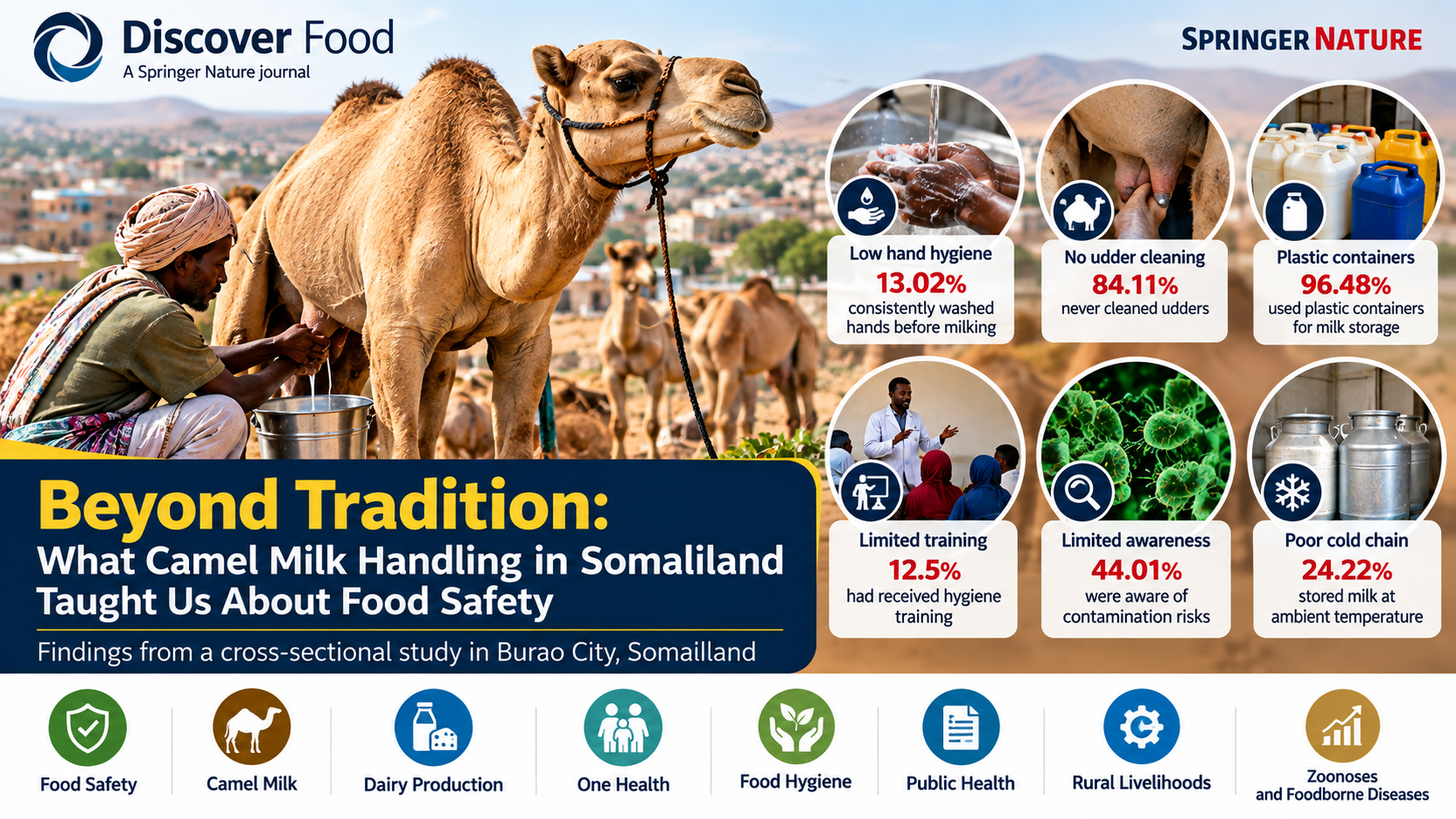
Only 13.02% of participants consistently washed their hands before milking.
Even more concerning, 84.11% reported never cleaning the camel’s udder before milking.
Almost all participants 96.48% used plastic containers for milk handling and storage.
These practices matter because contamination can begin before milk ever reaches the market. Hand hygiene, udder cleaning, equipment sanitation and appropriate containers all influence how safely milk is handled.
Training was another major issue.
Only 12.5% of producers had received hygiene training, and only 44.01% were aware of the food-safety risks associated with contaminated milk.
This suggests that improving food safety cannot simply mean telling producers to “be more careful.” Safer practice also requires accessible training, practical knowledge and realistic options for equipment and storage.
Tradition and modern practice exist side by side
One of the most interesting findings was the coexistence of traditional and modern preservation methods.
Most producers 75.78% reported prompt refrigeration, which is encouraging. However, 24.22% stored milk at ambient temperature.
Traditional preservation was also common. About 34.9% reported smoking milk containers, while refrigeration was used by 65.1%.
This is important because traditional practices are not just technical choices. They are connected to local knowledge, culture and experience.
For that reason, food-safety interventions should not be designed as if tradition itself is the problem.
A better approach is to identify which practices may increase risk, understand why they persist, and introduce safer alternatives in ways that producers can realistically adopt.
Storage conditions matter
Our statistical analysis also pointed to storage and preservation as important factors.
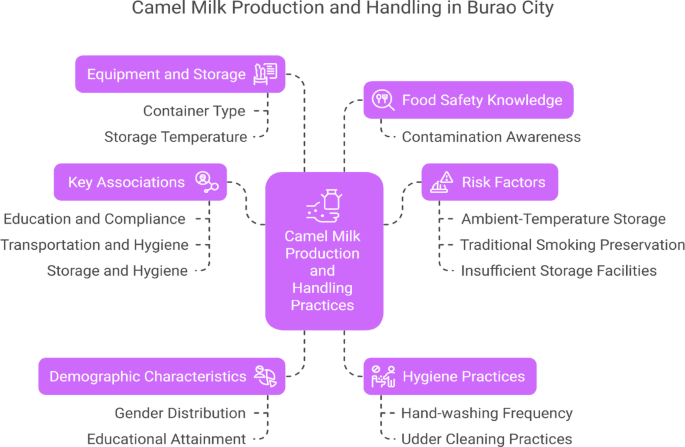
Milk stored at ambient temperature was associated with poorer hygiene outcomes compared with refrigerated storage. Traditional smoking preservation was also associated with poorer hygiene in the multivariable analysis.
These findings highlight an important reality: food safety is partly an infrastructure issue.
A producer may understand the importance of refrigeration, but that knowledge is difficult to act on without reliable electricity, cooling facilities or affordable storage options.
Likewise, recommending better containers is only useful if safer alternatives are available and affordable.
Improving food safety therefore requires attention not only to individual behaviour, but also to the conditions that make safer behaviour possible.
There was also an encouraging side
The picture was not entirely negative.
Overall, 56% of producers were classified as having good hygiene practices, while 44% were classified as having poor practices.
This means safer handling is already being achieved by many producers within the same local context.
The strong cultural importance of camel milk may also provide an opportunity. Improvements in hygiene can be framed not as a rejection of tradition, but as a way of protecting the quality, reputation and future of a highly valued food.
That distinction matters.
Interventions are more likely to succeed when they respect the cultural and economic importance of the system they are trying to improve.
What should happen next?
Our findings suggest several practical priorities.
Producers need culturally appropriate training on hand hygiene, udder cleaning, container sanitation, safe storage and contamination risks.
Cold-chain capacity also deserves attention. Expanding access to cooling and encouraging rapid refrigeration could reduce the time milk spends at temperatures that favour bacterial growth.
Safer containers should also be promoted in ways that consider cost and local availability.
Importantly, improvement efforts should involve producers themselves, together with veterinary services, public-health professionals, local authorities and community leaders.
Peer-to-peer learning may be especially useful. Producers already practising safer methods can help demonstrate that improvement is achievable within the same social and economic environment.
What our study could not answer
Our study also has limitations.
Because it was cross-sectional, it cannot prove that a specific handling practice directly caused a specific food-safety outcome.
Some information was self-reported and may have been affected by recall or social-desirability bias.
Most importantly, we did not conduct microbiological testing of the milk. This means we identified practices and conditions that may influence food safety, but we did not directly measure bacterial contamination in the milk itself.
Future research should combine behavioural observation with microbiological testing, longitudinal follow-up and evaluation of practical food-safety interventions.
Beyond the paper
For us, the broader lesson is that food safety and tradition do not need to be opposing ideas.
Camel milk is already an important part of life and livelihood in Burao.
The goal is not to remove that tradition.
The goal is to make the journey from camel to consumer safer.
That means improving hygiene, strengthening training, expanding access to safe storage and cooling, and designing interventions that respect local knowledge and economic realities.
Locally generated evidence helps make that possible.
It allows us to move beyond assumptions and identify where practical improvement is most needed.
We hope this study contributes to a safer camel-milk value chain in Somaliland one that protects consumers, supports producers and preserves the cultural importance of a food that has sustained communities for generations.
Read the published article:
https://doi.org/10.1007/s44187-025-00595-0

I am a researcher and academic specializing in One Health, epidemiology, infectious diseases, neglected tropical diseases, and public health. My work focuses on disease surveillance, outbreak research, implementation science, laboratory diagnostics, and data analysis, with experience in Somaliland and Ethiopia. I am particularly interested in translating research evidence into practical solutions for infectious disease control and stronger health systems.
Follow the Topic
-
Discover Food
This is a transdisciplinary, open access journal that provides a leading platform for the rapid dissemination of knowledge and advances covering the research and innovation that is taking place across the food sector.

Related Collections
With Collections, you can get published faster and increase your visibility.
Advancing the Understanding of Food Structure and Processing in Sensory Perception, Eating Behaviour, and Nutrient Retention
The structure and processing of food are critical in shaping sensory perception, influencing satiety, guiding eating behaviour, and determining nutrient retention. As global food systems evolve, understanding these complex interactions is crucial for developing products that are not only appealing to consumers but also promote health and well-being. This area of study is increasingly significant in the context of personalised nutrition, where tailoring food structures and processing techniques can optimise health outcomes.
This topical collection invites researchers, scholars, and industry professionals to contribute their latest findings on the interplay between food structure, oral processing, and their effects on sensory perception, eating behavior, and nutrient retention. To differentiate this collection and ensure it provides fresh and valuable insights, we encourage submissions that focus on specific emerging trends, innovative approaches, and cutting-edge methodologies. Topics of interest include, but are not limited to:
• The potential use of artificial intelligence and machine learning to optimise food structure and processing for enhanced sensory experiences, satiety, and nutrient retention.
• Application of state-of-the-art imaging (e.g., MRI, CT, and electron microscopy) and analytical methods to study food microstructures and their transformations during food processing as well as oral processing.
• Novel approaches to creating food matrices that modulate sensory properties, digestion, and nutrient release.
• Exploration of the role of texture and rheology in oral processing and its impact on sensory perception and satiety.
• Investigations into how emerging processing methods (e.g., pulsed electric field, high-pressure processing) influence nutrient retention, bioaccessibility, and functional properties of foods.
• Research focused on food structures and formulations tailored for demographic groups with unique nutritional needs, such as elderly populations or individuals with specific metabolic conditions.
Through highlighting novel approaches and innovative technologies in the study of food structure and processing, this collection aims to provide a platform for groundbreaking research that pushes the boundaries of current knowledge. We encourage contributions that explore these cutting-edge areas and offer new perspectives that are not widely covered in existing literature.
Keywords:
• Food structure
• Sensory perception
• Oral processing
• Nutrient bioavailability
• Satiety
• Eating behaviour
• Food matrix design
• Texture and rheology
Publishing Model: Open Access
Deadline: Dec 31, 2026
Innovations in Food Fermentation for Nutrition, Sustainability and Health
Fermentation is a cornerstone of food innovation, now revitalized by cutting-edge science and technology. This Collection will showcase advances in precision fermentation, novel microbial consortia, and omics-driven design, with a strong focus on health, nutrition, and sustainability. Particular emphasis will be given to innovations linking fermentation to microbiome modulation, valorization of agricultural by-products, and the exploration of underutilized substrates such as new legumes, mushrooms, and alternative protein sources. Together, these perspectives highlight how fermentation can contribute to resilient food systems and global health.
Keywords:
Fermentation; Precision fermentation; Microbiome; Sustainable proteins; Food innovation; Valorization; Functional foods; Omics technologies; Alternative substrates; Nutrition and health
This Collection supports and amplifies research related to SDG 2, SDG 3, and SDG 12.
Publishing Model: Open Access
Deadline: Feb 28, 2027