Biomimetic Gradient Lubrication Hydrogel Contrived by Self-Reinforced MOFs Nanoparticle Network
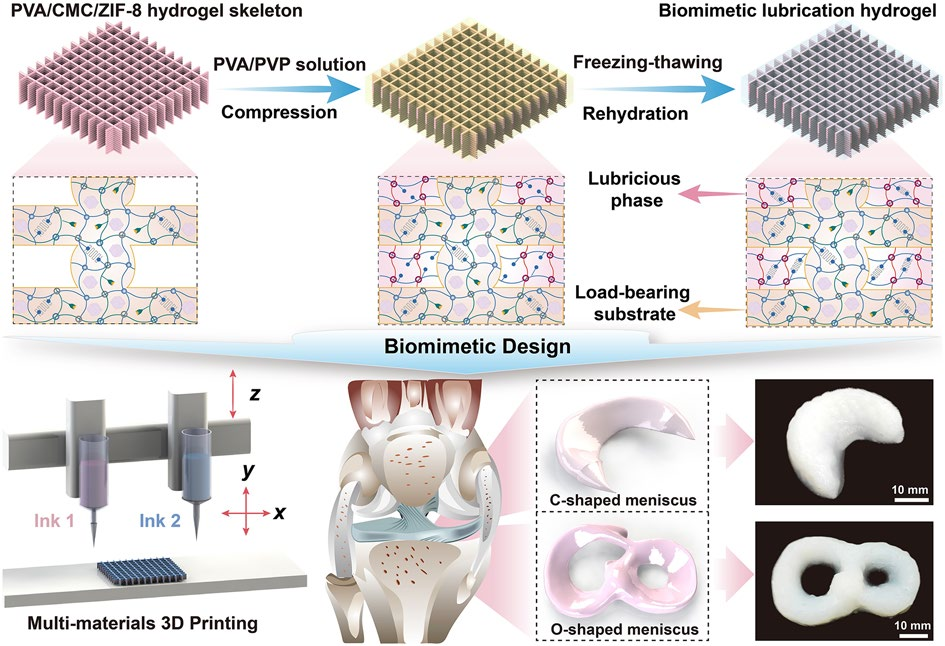
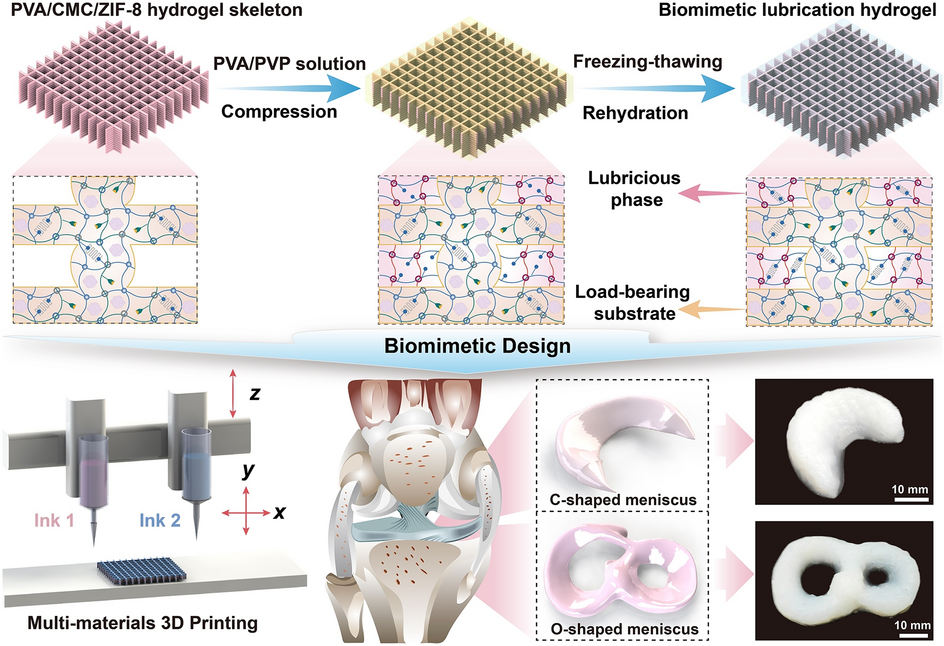

The development of gradient lubrication materials is critical for numerous biomedical applications, particularly in magnifying mechanical properties and service longevity. Herein, we present an innovative approach to fabricate biomimetic gradient lubrication hydrogel through the synergistic integration of three-dimensional (3D) printed metal–organic frameworks (MOFs) nanoparticle network hydrogel skeletons with bio-inspired lubrication design. Specifically, robust hydrogel skeletons were engineered through single or multi-material 3D printing, followed by the in situ growth of MOFs nanoparticles within this hydrogel network to create a reinforced, load-bearing architecture. Subsequently, biomimetic lubrication capability was enabled by mechanically coupling another lubricating hydrogel within 3D-printed MOFs nanoparticle network hydrogel skeleton. The superficial layer is highly lubricious to ensure low coefficient of friction (~ 0.1141) and wear resistance (40,000 cycles), while the deeper layer is stiffer to afford the obligatory mechanical support (fracture strength ~ 2.50 MPa). Furthermore, the gradient architecture stiffness of the hydrogel can be modulated by manipulating the spatial distribution of MOFs within the 3D-printed hydrogel skeleton. As a proof-of-concept, biomimetic gradient hydrogel meniscus structures with C- and O-shaped configurations were constructed by leveraging multi-material 3D printing, demonstrating exceptional lubrication performance. This innovative biomimetic design opens new avenues for creating implantable biomedical gradient lubricating materials with reinforced mechanical and lubrication performance.

Editor of Nano-Micro Letters, which is an Open-Access, peer-reviewed journal reported papers that have at least one dimension ranging from a few sub-nanometers to a few hundreds of micrometers. The journal is published by Springer Nature and indexed by SCI, EI, SCOPUS, Pubmed, etc. The 2025 JCR Impact Factor is 38.5. The 2025 CiteScore is 58.9.
Follow the Topic
-
Nano-Micro Letters
Nano-Micro Letters is a peer-reviewed, international, interdisciplinary and open-access journal that focus on science, experiments, engineering, technologies and applications of nano- or microscale structure and system in physics, chemistry, biology, material science, and pharmacy.