Octopus‑Inspired Self‑Adaptive Hydrogel Gripper Capable of Manipulating Ultra‑Soft Objects
Published in Bioengineering & Biotechnology and Materials
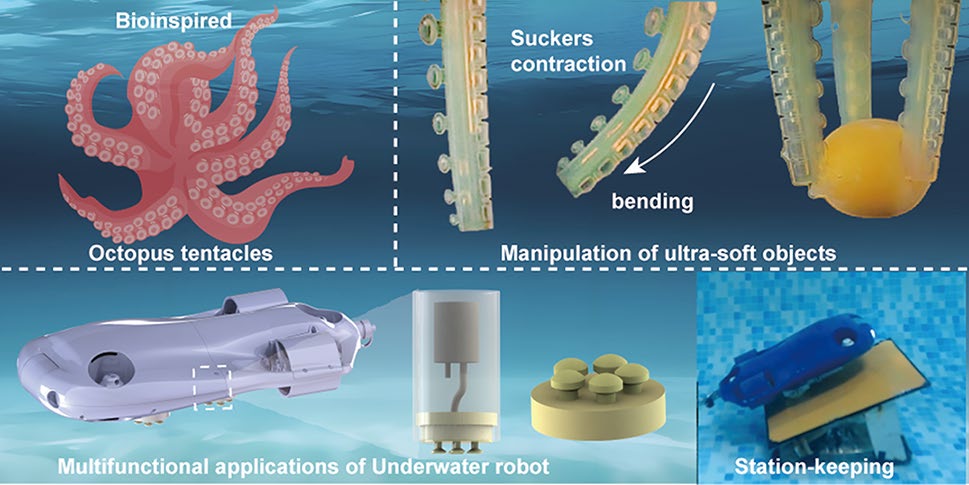
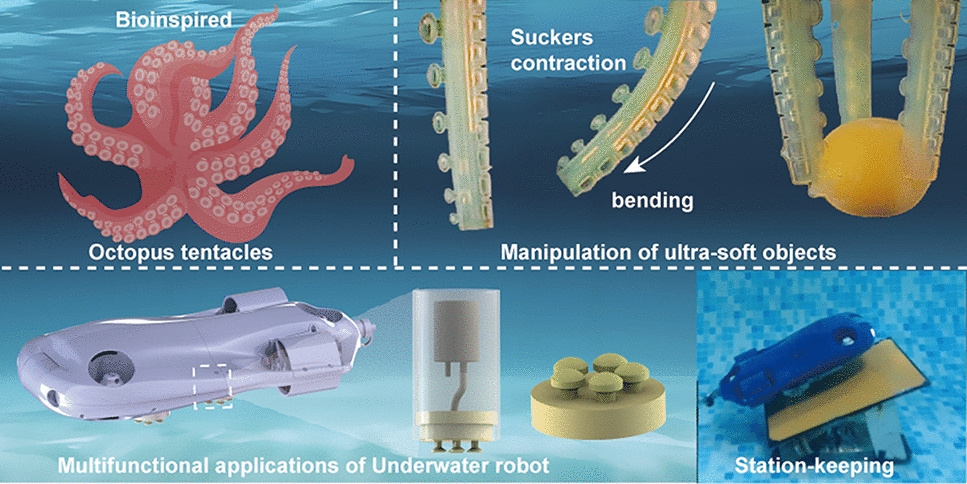

As the need for gentle, shape-adaptive handling of fragile matter grows, conventional rigid and silicone-based grippers still struggle to grasp ultra-soft foods, biological tissues or curved devices in wet environments without damage. Now, a multi-institute team led by Prof. Desheng Liu (Lanzhou Institute of Chemical Physics, CAS) and Prof. Xiaolong Wang presents a comprehensive study on an octopus-inspired, hydraulically actuated hydrogel gripper that achieves switchable, damage-free adhesion for complex underwater manipulation. This work offers a transformative blueprint for next-generation soft robotic grippers that can overcome the limitations of existing technologies.
Why Octopus-Inspired Hydrogel Grippers Matter
- Underwater Adaptability: Hydrophilic supramolecular hydrogels provide inherent lubrication, swelling resistance and mechanical compliance, enabling reliable performance in seawater, PBS or de-ionized water.
- Nondestructive Switchable Adhesion: A curvature-tunable membrane integrated with a negative-pressure cavity allows rapid transition between firm grasping (∆P < 0) and gentle release (∆P = 0), preventing rupture of fragile items such as egg yolks or tofu.
- Scalable 3D Printing: Vat photopolymerization produces high-resolution bionic suckers and multi-finger tentacles in one step, paving the way for mass customization of soft end-effectors.
Innovative Design and Features
- Material Tunability: Strong (NASC–AAc) and weak (NASC–AAm) hydrogen-bond networks are cooperatively engineered to yield soft yet tough hydrogels (E ≈ 0.24 MPa, fracture energy ≈ 0.65 kJ m-2) that survive > 100 cyclic loadings without leakage.
- Sucker Architecture: Each 10-mm sucker combines an active curvature membrane, a sealed negative-pressure lumen and a pneumatic chamber; curvature (K > 0, K = 0, K < 0) is modulated to maximize contact on flat, curved or folded surfaces.
- Hydraulic Actuation: Low-pressure water inflation (< 40 kPa) drives > 60-fold volume expansion or 150° bending within seconds, outperforming conventional silicone actuators in energy efficiency and deformation range.
Applications and Future Outlook
- Food & Biomedical Handling: Single-, two- and multi-finger grippers successfully grasp, transfer and release ultra-soft tofu blocks, raw egg yolks and curved glass/plastic ware without visible damage, demonstrating potential for automated food processing or minimally invasive surgery.
- Underwater Robotics: Arrays of hydrogel suckers mounted on unmanned underwater vehicles (UUV) and hexapod crawling robots enable station-keeping on inclined or horizontal planks and ceiling locomotion, hinting at applications in marine archaeology, pipeline inspection or deep-sea sampling.
- Challenges & Opportunities: Long-term fatigue life, rapid large-scale printing, and integration with real-time feedback control remain key hurdles. Future research will focus on hybrid hydrogel-elastomer composites, embedded sensing, and AI-driven shape optimization to broaden adoption in extreme aqueous environments.
This comprehensive study establishes an adaptable, low-cost route to fabricate soft grippers that marry the gentle touch of hydrogels with the intelligent adhesion of octopus suckers, opening new avenues for safe manipulation in robotics, biomedicine and ocean engineering.

Editor of Nano-Micro Letters, which is an Open-Access, peer-reviewed journal reported papers that have at least one dimension ranging from a few sub-nanometers to a few hundreds of micrometers. The journal is published by Springer Nature and indexed by SCI, EI, SCOPUS, Pubmed, etc. The 2025 JCR Impact Factor is 38.5. The 2025 CiteScore is 58.9.
Follow the Topic
-
Nano-Micro Letters
Nano-Micro Letters is a peer-reviewed, international, interdisciplinary and open-access journal that focus on science, experiments, engineering, technologies and applications of nano- or microscale structure and system in physics, chemistry, biology, material science, and pharmacy.