Dual Interlocked Mediators Enable Single‑Ion‑Conducting Quasi‑Solid‑State Electrolytes for Ultrafast‑Charging Long‑Life Sodium Metal Batteries
Published in Materials
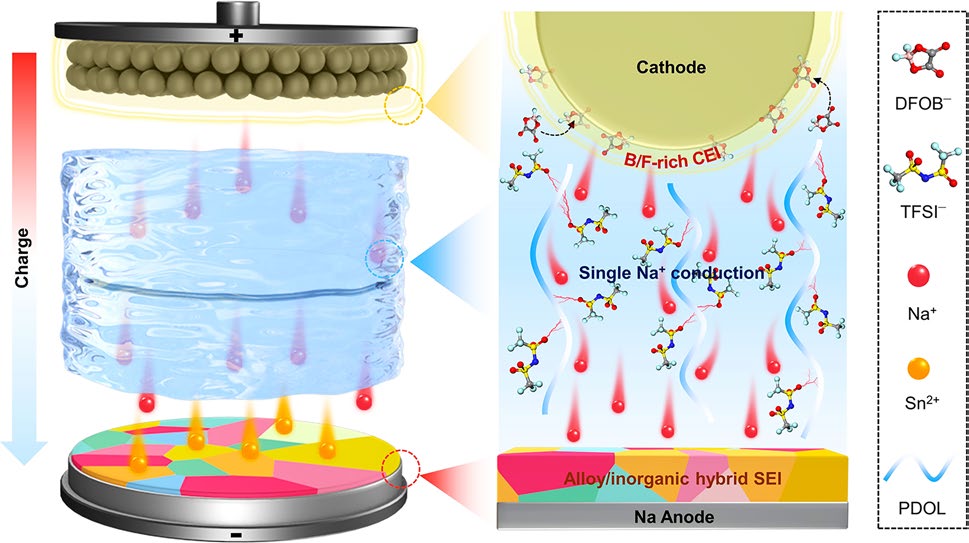

As the global demand for cost-effective energy storage intensifies, sodium metal batteries (SMBs) are emerging as a compelling alternative to lithium-ion systems, leveraging earth-abundant sodium resources and a supply chain less vulnerable to price volatility. Yet realizing ultrafast charging (≥3C) while maintaining long cycle life and intrinsic safety has remained a formidable challenge. Conventional quasi-solid-state electrolytes (QSEs) suffer from two critical bottlenecks: sluggish Na⁺ transport in the bulk due to anion-dominated conduction and poor ion diffusion at bilateral interfaces, leading to dendrite formation and rapid degradation. Now, researchers from Southeast University, led by Professor Long Pan, Professor Yang Zhou, and Professor ZhengMing Sun, in collaboration with HiNa Battery Technology Co., Ltd. and Yangzhou University, have presented a breakthrough dual interlocked mediator engineering strategy that transcends conventional independent approaches and redefines the performance ceiling for practical SMBs.
Why This Electrolyte Matters
Traditional QSE designs typically achieve Na⁺ transference numbers (tNa⁺) of merely 0.4–0.7, indicating substantial anion participation and severe concentration polarization that intrinsically limits ultrafast-charging capability. Mainstream single-ion-conducting strategies rely on cumbersome polymer-chain functionalization that trades diminished ionic conductivity for tNa⁺ gains. The novel Sn-FB QSE overcomes this fundamental trade-off by achieving a near-unity tNa⁺ of 0.94 alongside high conductivity of 1.3 mS cm-1—without complex polymer modifications—through a synergistic dual-mediator architecture that simultaneously regulates bulk ion transport and bilateral interface chemistry.
Innovative Design and Mechanism
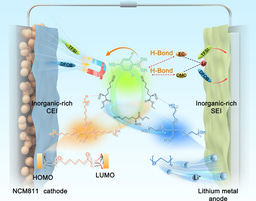
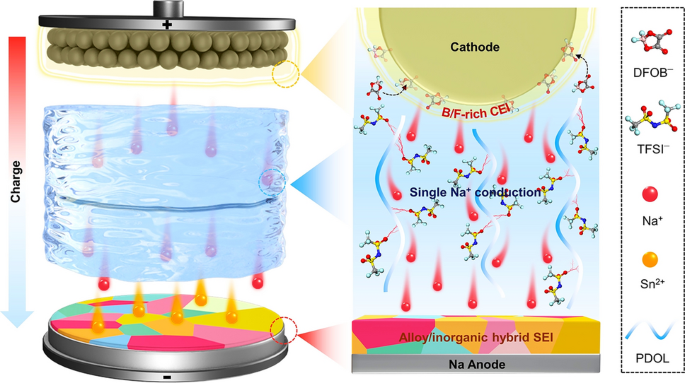
The material is synthesized through a dual interlocked mediator system coupling cationic Sn2+-containing salt with anionic difluoro(oxalato)borate (DFOB⁻). During QSE preparation, the first interlocking effect operates in the bulk: Sn2+ initiates in situ cationic polymerization of 1,3-dioxolane (PDOL), while DFOB⁻ functions as a polymerization retarder to suppress runaway polymerization. This yields a uniform, mechanically reinforced amorphous network with a low polydispersity index (PDI = 1.6 versus 4.5 for Sn-only QSE), enabling robust puncture strength of 8.5 kPa. Molecular dynamics simulations reveal that DFOB⁻ preferentially coordinates with Na⁺, weakening Na⁺–O(PDOL) interactions and reducing the coordination number from 4.87 to 2.81, thereby liberating free Na⁺ ions and accelerating diffusion coefficients to 16.8 Å2 ns-1—sixfold faster than conventional liquid electrolytes.
During cell operation, the second interlocking effect creates highly adaptable bilateral interphases. Sn2+, possessing the lowest LUMO energy level (−4.87 eV), is preferentially reduced at the sodium anode to form a hybrid NaSn alloy/inorganic-rich solid-electrolyte interphase (SEI). This sodiophilic alloying layer homogenizes electric fields and lowers nucleation overpotential to merely 50 mV, while the inorganic-rich component sustains uniform ion transport and mechanical stability. Simultaneously, DFOB⁻, with its high HOMO energy level (−8.12 eV), sacrificially oxidizes at the cathode to generate a thin yet robust cathode–electrolyte interphase (CEI) of only 14 nm thickness—less than half that of conventional systems—with an average Young's modulus of 8.9 GPa, ten times higher than Sn-only QSE. This dual interfacial engineering suppresses electrolyte degradation while maintaining rapid Na⁺ diffusion across both electrodes.
Outstanding Performance
The Sn-FB QSE delivers exceptional electrochemical metrics that surpass most reported works across all key dimensions. Na||Na symmetric cells exhibit unprecedented 6000 h stability without dendrite formation at 0.1 mA cm-2—equivalent to over eight months of continuous operation—with low polarization of merely ~0.1 V. The critical current density reaches 3.0 mA cm-2, and the exchange current density hits 10 μA cm-2, both dramatically exceeding conventional systems. Coupled with Na3V2(PO4)3 (NVP) cathodes, full cells retain 80.1 mAh g⁻¹ at an ultrafast-charging rate of 15C and achieve 90% capacity retention after 2000 cycles at 3C. Even at 5C, the system maintains 53.4 mAh g-1 after 800 cycles. The electrochemical stability window extends to 4.7 V (vs. Na⁺/Na), broadening application possibilities to high-voltage cathode chemistries.
Practical Viability and Scalability
Beyond laboratory coin cells, the team demonstrated real-world practicality through high-mass-loading full cells (5 mg cm-2 NVP, 75% retention after 500 cycles at 1C) and pressure-free pouch cells (4 × 5 cm2) that retain 93.3 mAh g-1 with 84% capacity retention after 19 cycles. The pouch cell successfully powers a smartphone even under repeated full folding, underscoring superior flexibility and mechanical resilience. Compatibility extends to high-loading NaNi1/3Fe1/3Mn1/3O2 (NFM) cathodes (17.54 mg cm-2), delivering 129.9 mAh g-1 initially and 108.9 mAh g-1 after 17 cycles, confirming broad cathode versatility.
Applications and Future Outlook
This work establishes dual interlocked mediator engineering as a transformative paradigm for next-generation battery electrolytes. By transcending the conventional independent optimization of bulk transport and interfacial stability, the strategy achieves simultaneous single-ion conduction, mechanical robustness, and adaptive bilateral interphases—three properties historically considered mutually exclusive. The approach is inherently scalable through in situ polymerization, compatible with existing manufacturing infrastructure, and applicable beyond sodium systems to lithium and potassium metal batteries. Future directions include extending this mediator engineering to solid-state configurations, integrating with high-capacity conversion-type cathodes, and exploring AI-guided frontier-orbital screening for next-generation mediator discovery.
This breakthrough opens promising avenues for practical ultrafast-charging, long-life energy storage systems combining high safety, low cost, and earth-abundant materials—positioning sodium metal batteries as a genuine contender for mainstream commercial deployment.
Stay tuned for more groundbreaking research from this collaborative team at Southeast University, HiNa Battery Technology, and Yangzhou University!

Editor of Nano-Micro Letters, which is an Open-Access, peer-reviewed journal reported papers that have at least one dimension ranging from a few sub-nanometers to a few hundreds of micrometers. The journal is published by Springer Nature and indexed by SCI, EI, SCOPUS, Pubmed, etc. The 2025 JCR Impact Factor is 38.5. The 2025 CiteScore is 58.9.
Follow the Topic
-
Nano-Micro Letters
Nano-Micro Letters is a peer-reviewed, international, interdisciplinary and open-access journal that focus on science, experiments, engineering, technologies and applications of nano- or microscale structure and system in physics, chemistry, biology, material science, and pharmacy.