Biomimetic Gradient Porous Core–Shell Fibers with Enhanced Gas Sensing for CO‑Temperature Dual‑Mode Early Fire Warning
Published in Materials
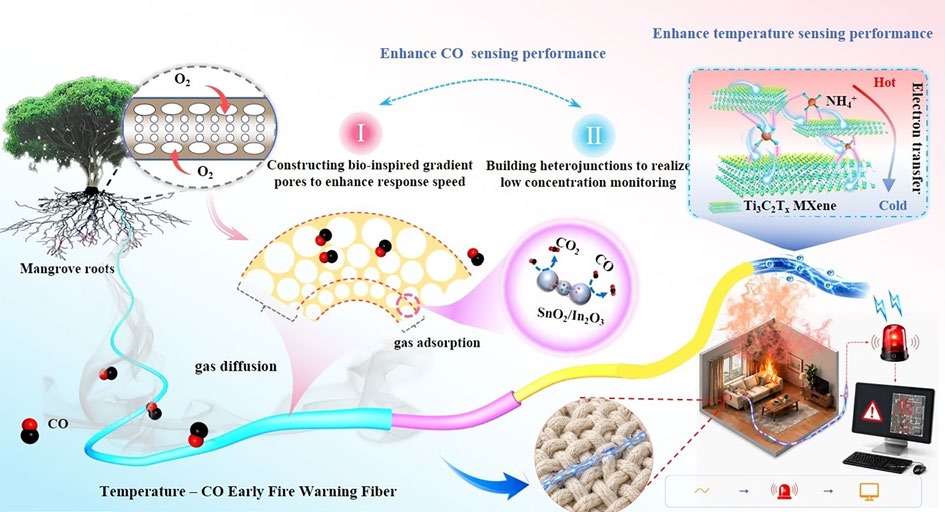

As demand grows for smarter and faster fire-safety technologies, early warning systems need to detect not only abnormal temperature but also toxic gases such as carbon monoxide before visible flames emerge. Conventional fire sensors typically monitor a single parameter, while fiber-based gas sensors can suffer from slow diffusion, limited sensitivity, and signal interference between different sensing functions. Researchers from Wuhan Textile University, Donghua University, and the University of Southern Queensland, led by Professors Hualing He, Siqi Huo, and Zhicai Yu, have developed a biomimetic gradient porous core–shell fiber that simultaneously detects CO and temperature. By integrating hierarchical gas-transport pathways, a SnO₂/In₂O₃ heterojunction, and a thermoelectric MXene core, the fiber enables rapid dual-mode fire warning in a lightweight and flexible format.
Why This Fire-Warning Fiber Matters
Early fire detection requires rapid recognition of both rising temperature and combustion gases. Conventional sensors often monitor only one signal, while dense fiber structures can restrict gas diffusion and reduce the utilization of active sensing sites. The researchers address these limitations by mimicking hierarchical biological porous structures, creating a fiber capable of simultaneously monitoring CO concentration and temperature while minimizing electrical interference between the two sensing channels.
Innovative Design and Mechanism
The resulting self-interference all-mode (SIAM) fiber features a three-layer core–sheath architecture fabricated by coaxial wet spinning. The outer sheath contains a SnO2/In2O3 heterojunction/aramid nanofiber (ANF)/silver nanowire composite with biomimetic gradient pores, while an ANF isolation layer separates it from an NH₄⁺-crosslinked MXene temperature-sensing core. The gradient-induced phase separation process creates pores that gradually decrease from >10 μm on the outer surface to <3 μm toward the interior, allowing rapid CO diffusion while providing abundant internal adsorption sites. Meanwhile, NH4⁺ crosslinking suppresses MXene restacking and forms a stable conductive network, while the ANF layer prevents signal crosstalk between gas and temperature sensing.
Outstanding Performance
The gradient porous structure increases the CO response by approximately 15% compared with non-gradient fibers, delivering a sensitivity of 0.95%/ppm, a detection limit of 10 ppm, and a response time of only 19.28 s. The MXene core provides precise temperature sensing from 50–300 °C, with a high Seebeck coefficient of 20.6 μV K-1 and an excellent linearity of R2 = 0.99. The fiber also maintains temperature-sensing performance after repeated bending, demonstrating its mechanical adaptability for flexible applications.
Applications and Future Outlook
The researchers integrated the SIAM fiber into a wireless early fire-warning system capable of simultaneously monitoring temperature and CO concentration. When exposed to an alcohol-lamp flame, the system triggers an alarm in approximately 3 s, while 10 ppm CO can be detected within 19 s. Wireless transmission through Bluetooth or Wi-Fi enables remote monitoring, allowing potential fire hazards to be identified even when occupants are absent. The fiber also exhibits a limiting oxygen index of 41.5%, supporting its fire-safe application.
Overall, this work combines biomimetic pore engineering, multifunctional core–shell fiber design, and dual-parameter sensing to provide a promising platform for ultrafast early fire-warning systems, with potential applications in smart buildings, firefighting textiles, industrial safety monitoring, and wearable fire-protection technologies.

Editor of Nano-Micro Letters, which is an Open-Access, peer-reviewed journal reported papers that have at least one dimension ranging from a few sub-nanometers to a few hundreds of micrometers. The journal is published by Springer Nature and indexed by SCI, EI, SCOPUS, Pubmed, etc. The 2025 JCR Impact Factor is 38.5. The 2025 CiteScore is 58.9.
Follow the Topic
-
Nano-Micro Letters
Nano-Micro Letters is a peer-reviewed, international, interdisciplinary and open-access journal that focus on science, experiments, engineering, technologies and applications of nano- or microscale structure and system in physics, chemistry, biology, material science, and pharmacy.