Breaking the sugar shield: targeting immunosuppressive sialoglycans in prostate cancer
Published in Cancer, Cell & Molecular Biology, and Immunology


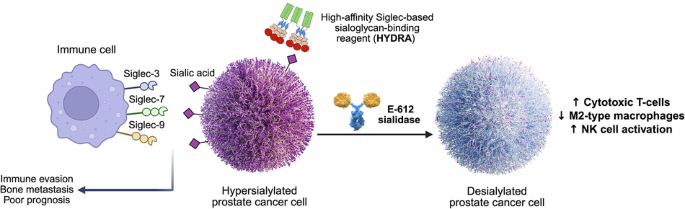

The sweet escape: how sialic acids help prostate cancer spread to bone
Prostate cancer most commonly spreads to the bone where it remains incurable, highlighting the urgent need for new and effective treatments. One way cancer cells can behave differently from healthy cells is by altering the ‘glycan coat’ on their surface. Glycans are essential sugar molecules found on all cells and most secreted proteins, and aberrant glycosylation plays a role in all hallmarks of cancer. One of the key changes includes an overexpression of sialoglycans, which are glycan structures terminating in sialic acid. These altered sialoglycans can help cancer cells survive, spread and evade the immune system. They can also engage with receptors called Siglecs (sialic acid-binding immunoglobulin-like lectins) on immune cells to dampen anti-tumour immune responses.
Previous studies, including work from our group (Hodgson et al., 2024), have linked abnormal sialylation (the addition of sialic acids to glycans) with prostate cancer bone metastasis and shown that sialic acid blockade can inhibit the metastatic spread of prostate cancer to bone. However, little was known about the expression profile of Siglec-engaging sialoglycans and whether the Siglec-sialoglycan axis could be therapeutically targeted in prostate cancer, which became the starting point of our study.
Uncovering the Siglec-sialoglycan landscape in prostate cancer
We used a panel of high-affinity Siglec-based sialoglycan-binding reagents (HYDRA-3, HYDRA-7 and HYDRA-9) developed by Palleon Pharmaceuticals to map Siglec-engaging sialoglycans across multiple tissue microarrays representing the clinical diversity of prostate cancer. Our analyses revealed that sialoglycan ligands of Siglec-3, -7 and -9 were all significantly more abundant in primary prostate cancer tissue relative to matched normal tissues. Their expression was further enriched in treatment-resistant prostate tumours growing in bone (collected from rapid autopsy) compared with untreated primary prostate tumours. We also found that higher levels of Siglec-7 and Siglec-9 ligands were associated with poorer patient survival.
We then wanted to understand where these Siglec-sialoglycan interactions might be taking place within the prostate tumour microenvironment. By combining published single-cell RNA sequencing data with dual-immunofluorescence, we showed that Siglec receptors are expressed by multiple tumour-associated immune cell populations in both primary and bone metastatic prostate cancer. Importantly, we confirmed that Siglec-3, -7 and -9 co-localise with their corresponding sialoglycan ligands in tumour tissues, providing evidence for Siglec-sialoglycan ligand interactions within the prostate tumour immune microenvironment. Together, these findings provide a comprehensive map of Siglec-engaging sialoglycans across prostate cancer progression and highlight their association with advanced disease.
Stripping away the sialic acids to suppress prostate cancer bone metastasis
Having established that Siglec-engaging sialoglycans are enriched in prostate cancer, we next asked: could removing these sialic acids provide a new way to treat prostate cancer? To answer this, we investigated E-612, a proprietary engineered bisialidase developed by Palleon Pharmaceuticals that removes sialic acids from cell surfaces. Engineered sialidase therapy has already been shown to be well tolerated in clinical trials of patients with advanced cancers other than prostate cancer, providing a strong rationale for exploring this approach in prostate cancer.
In both human and mouse prostate cancer cell lines, E-612 effectively removed sialic acids from the cell surface, as demonstrated using lectins, Lectenz and HYDRA reagents. We then moved into mouse models of prostate cancer bone metastasis. Treatment with E-612 significantly slowed tumour growth, reduced tumour burden and prolonged median survival by more than 50% with no signs of acute toxicity.
But did removing sialic acids actually change the prostate tumour immune microenvironment? Analysis of circulating white blood cells and tumour samples confirmed effective removal of sialic acids following E-612 treatment. We also observed a remodelled tumour immune microenvironment, featured by increased infiltration of myeloid cells and CD8+ cytotoxic T-cells, together with reduced abundance of M2 macrophages.
These findings suggest that removing sialic acids may help shift the prostate tumour microenvironment towards anti-tumour immune responses.
Looking ahead
Our study provides a comprehensive map of Siglec-engaging sialoglycans in prostate cancer and shows that these immunosuppressive glycans are highly enriched in advanced disease, particularly in bone metastases. More importantly, we demonstrate that therapeutically removing sialic acids using an engineered bisialidase can remodel the tumour immune microenvironment and suppress prostate cancer bone metastasis in pre- clinical models. Looking ahead, we plan to investigate E-688, a B7-H3-targeted sialidase designed to selectively remove sialic acids from B7-H3-positive cancer cells. We will evaluate this approach for prostate cancer using human immune cell co-culture systems and additional pre-clinical models. Ultimately, we hope this work will help advance glycoimmunology as a new avenue for developing treatments for patients with advanced prostate cancer.
Follow the Topic
-
British Journal of Cancer
This journal is devoted to publishing cutting edge discovery, translational and clinical cancer research across the broad spectrum of oncology.