Bright Sparks of Single-Atom and Nano-Islands in Catalysis: Breaking Activity-Stability Trade-Off
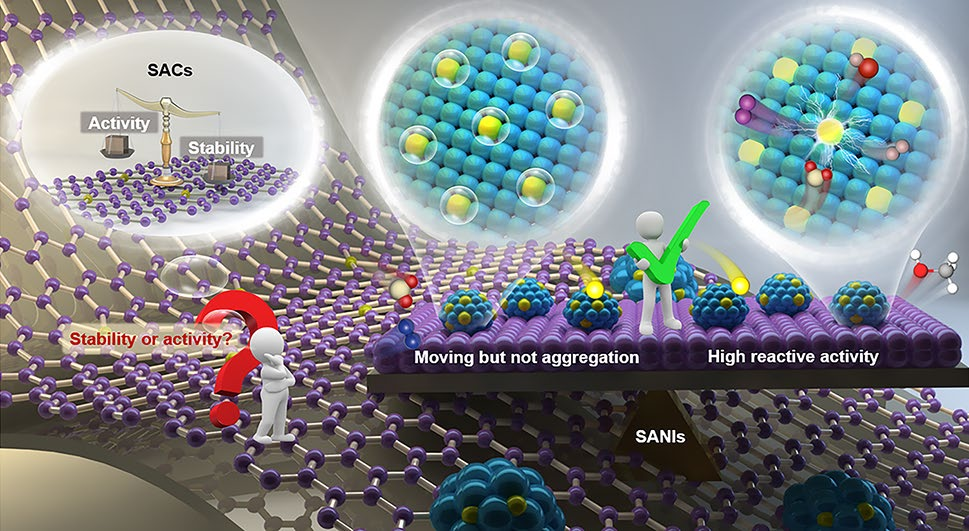
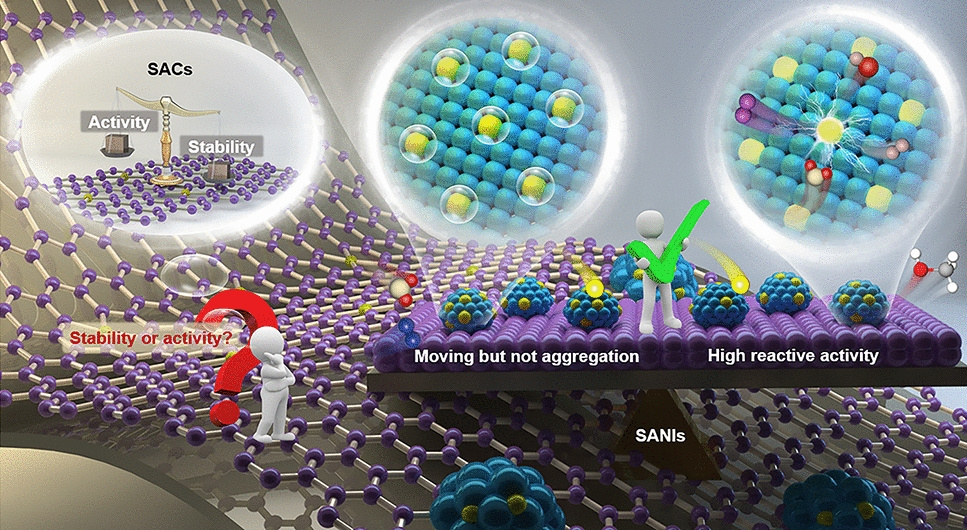

Single-atom catalysts (SACs) are among the most cutting-edge catalysts in the multiphase catalysis track due to their unique geometrical and electronic properties, the highest atom utilization efficiency, and uniform active sites. SACs have been facing an unresolved problem in practical applications: the opposing contradiction of activity-stability. The successful development of single-atom nano-islands (SANIs) cleverly combines the ultra-high atom utilization efficiency of SACs with the confinement effect and structural stability of nano-island structures, realizing the “moving but not aggregation” of SACs, which fundamentally solves this inherent contradiction. Although research on the precise loading of single atoms on nano-islands continues to advance, existing reviews have not yet established a closed-loop cognitive framework encompassing “models-synthesis-high stability mechanisms-high activity essence-applications.” This work fills this critical gap by systematically integrating the basic conceptual models and cutting-edge synthesis strategies of SANIs, focusing on revealing the underlying mechanisms by which SANIs overcome the stability bottleneck of SACs, elucidating the role of nano-islands and their synergistic mechanisms to clarify the high activity essence, and establishing the structure–activity relationship between atomic confinement effects and macroscopic performance, ultimately achieving breakthrough validation across catalytic systems. This review aims to open new perspectives, drive a paradigm shift in understanding the multi-dimensional advantages of SANIs, and thereby spur breakthrough progress in this frontier field.

Editor of Nano-Micro Letters, which is an Open-Access, peer-reviewed journal reported papers that have at least one dimension ranging from a few sub-nanometers to a few hundreds of micrometers. The journal is published by Springer Nature and indexed by SCI, EI, SCOPUS, Pubmed, etc. The 2025 JCR Impact Factor is 38.5. The 2025 CiteScore is 58.9.
Follow the Topic
-
Nano-Micro Letters
Nano-Micro Letters is a peer-reviewed, international, interdisciplinary and open-access journal that focus on science, experiments, engineering, technologies and applications of nano- or microscale structure and system in physics, chemistry, biology, material science, and pharmacy.