Building a Modern Data Platform for the Artificial Intelligence Era
Published in Computational Sciences, Mathematical & Computational Engineering Applications, and Statistics






Artificial Intelligence without data is just Artificially! Having all those recent AI breakthroughs without proper data management would be impossible. Since across various domains, data is the first gate to all data-driven activities, such as Artificial Intelligence, Machine Learning, and Business Intelligence. Effectively managing data to support AI was the main goal of the paper “Building a modern data platform based on the data lakehouse architecture and cloud-native ecosystem”, published on 22 February 2025 (just after the Love Data Week 2025, isn’t it lovely?)
Paper Highlights
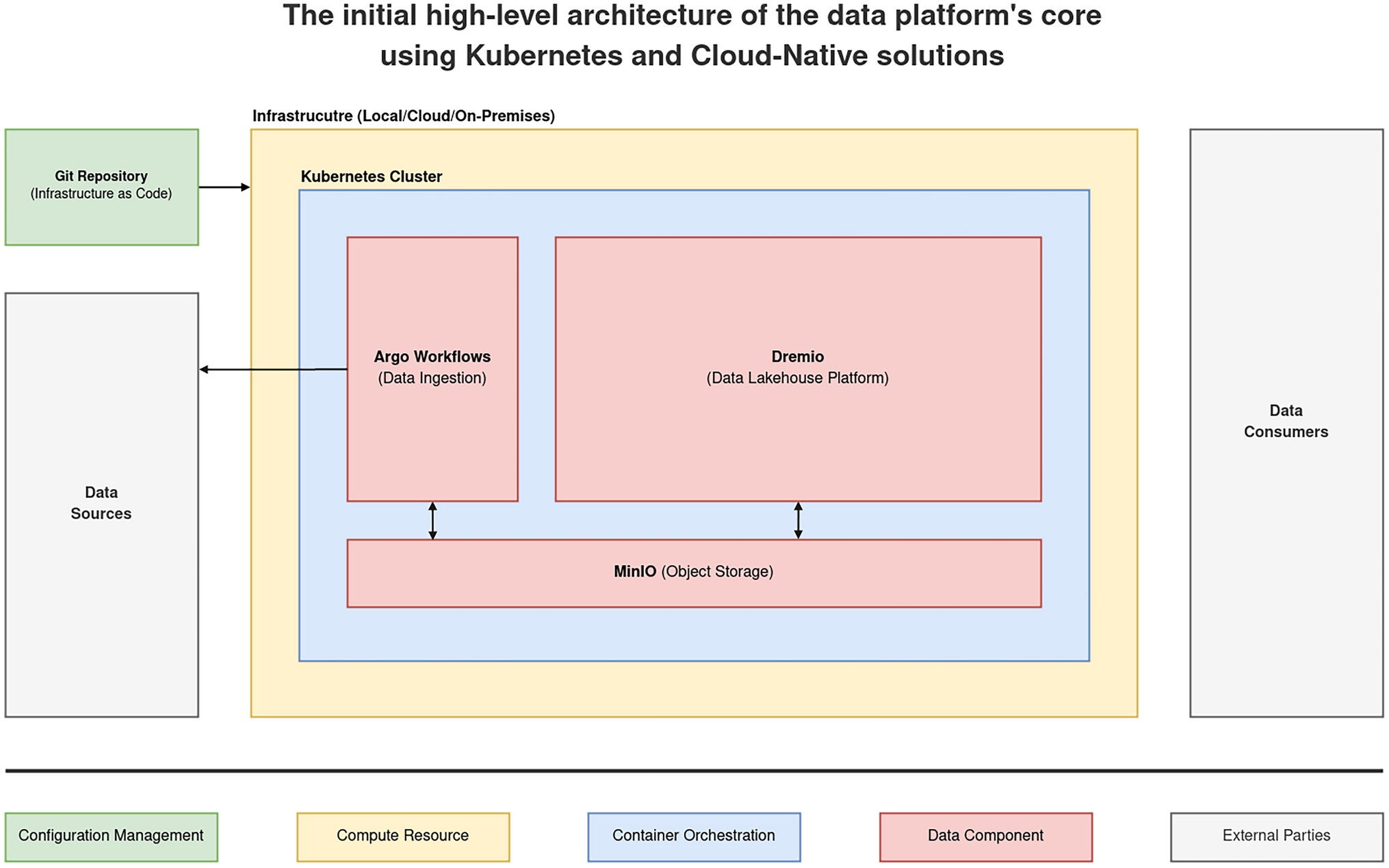
- The research creates a blueprint using DataOps, Kubernetes, and a Cloud-Native ecosystem to build a resilient Big Data platform following the Data Lakehouse architecture, providing the base for Machine Learning and Artificial Intelligence.
- Using an iterative approach, we architectured and implemented the core of the platform, which is composable and cloud-agnostic. This avoids vendor lock-in and enables seamless deployment across environments from any Cloud provider or on-premises.
- The initial benchmarking showed that the platform could efficiently handle massive amounts of records, benefitting from Apache Iceberg format features.
Personal Background
This paper is based on my dissertation for the Master of Science degree in Data Engineering at Edinburgh Napier University, which was a unique learning experience on many levels.
My intention to enrol in a master’s program was not recent; it began in my final college year. In 2010, I heard that a university-wide research competition had started; hence, I formed and led a research group of three members and participated in the competition. Our research achieved third place, with only four marks behind the project in first place.
At that time, I knew I wanted to have a similar experience again, but I decided first to gain hands-on experience in the technology industry. Later, in 2020, after a decade, I enrolled in the Data Engineering master's program at Edinburgh Napier University, where I experienced significant growth in my personal, academic, and professional skills. During the dissertation, Dr. Peter J. Barclay, the supervisor of my dissertation, suggested creating a peer-reviewed paper based on it.
Later, in 2024, I started working with Dr. Peter J. Barclay, Dr. Christos Chrysoulas, and Dr. Nikolaos Pitropakis on a peer-reviewed paper summarizing the dissertation findings to create a blueprint using DataOps, Kubernetes, and the Cloud-Native ecosystem to build a resilient Big Data platform following the Data Lakehouse architecture, for use as a base for Machine Learning and Artificial Intelligence.
In that journey, I faced many challenges, however, it presented a chance to step up and be a better version of myself. At this point, I persevered and achieved my goals. Therefore, the research group chose these quotes from our respective languages/cultures to emphasize the importance of perseverance and diligence:
“عِندَ الصَّباحِ يَحمَدُ القومُ السُّرَى”
(In the morning, the people praise the night’s journey)
- Arabic Proverb
“Αρχή ήμισυ παντός”
(The beginning is half of everything)
- Greek Proverb
“Is obair latha tòiseachadh”
(Beginning is a day's work)
- Scottish Gaelic Proverb
Motivation
Data sizes and types have changed dramatically in recent years, and the old methods and architectures cannot cope with that kind of data, which is different in both quantity and quality. Data Warehouses started in the 1980s, Data Lakes started around 2010, and finally, the Data Lakehouse, a relatively new hybrid architecture shown for the first time in 2020, combines the capabilities of a Data Warehouse and a Data Lake.
Still, based on the reviewed related work, no prior study covered building a generic data platform focusing on specific aspects like openness, portability, averting vendor lock-in (cloud-agnosticism), and emphasising flexibility and extensibility. Hence, our paper fills this gap by proposing and evaluating a data platform that leverages modern practices and technology and helps to create a data-centric business, where different personas smoothly interact with the data platform while managing and benefitting from Big Data.
In short, the motivation for this work was the lack of any reference for building a data platform that uses state-of-the-art technology to handle AI and Big Data challenges.
Challenges
The main challenges could be narrowed down to:
- Fast-paced changes in the data landscape.
- Massive dataset size.
First, writing an academic paper in a highly paced domain like Data Engineering and Artificial Intelligence is challenging as the landscape shifts quickly all the time. Staying ahead requires continuous monitoring of emerging trends, preprints, and cutting-edge developments. This dynamic environment makes impactful academic papers an uphill battle; however, with the industrial and academic skills available within the research team, it was possible to produce a high-quality paper.
Second, another Big Data challenge is handling massive datasets, which is challenging for academic research as it requires powerful computational resources. Also, working with that kind of data requires different types of systems to deal with storage, processing, and scalability, all while ensuring accuracy and reproducibility, which limits the ability to iterate quickly. Leveraging Cloud Computing capabilities and a Cloud-Native ecosystem helped to optimize costs and speed up the processing time by accessing computational resources on demand.
Conclusion
Undoubtedly, “data is the new gold” as everything now revolves around data. Therefore, modern data platforms must prioritize openness, portability, agility, and extensibility, while avoiding vendor lock-in through a cloud-agnostic approach to keep up with the dynamic changes in the data landscape.
Resources
All technical resources are available on the paper's GitHub repository, “modern-data-platform-research-paper”. This repository includes but is not limited to: Cloud infrastructure as code, Kubernetes manifests, data pipelines, TPC-DS data generation scripts, and a benchmarking Jupyter Notebook.

Tech Lead with Agility | M.Sc. in Data | Cloud-Native at Core | DevOps Transformation Advisor and Mentor
Find more at: aabouzaid.com
Follow the Topic
-
Discover Applied Sciences
This is a multi-disciplinary, peer-reviewed journal for the disciplines of Applied Life Sciences, Chemistry, Earth and Environmental Sciences, Engineering, Materials Science and Physics, fostering sound scientific discovery to solve practical problems.

Related Collections
With Collections, you can get published faster and increase your visibility.
Engineering: Artificial Intelligence and Internet of Things for Smart Healthcare and Well-Being
This Collection explores the integration of Internet of Things (IoT) technologies with Artificial Intelligence (AI) and Machine Learning (ML) methods for advancing healthcare, remote monitoring, rehabilitation, and assistive systems. With the rapid expansion of wearable devices, sensing platforms, and connected infrastructures, IoT-driven healthcare provides unique opportunities for early diagnosis, personalized therapy, and improved quality of life. The Collection aims to bring together research on novel algorithms, sensing technologies, system architectures, and clinical applications that leverage IoT and AI to address challenges in scalability, data security, usability, and clinical validation. It seeks to highlight both theoretical advances and practical implementations across diverse medical and health-related domains.
This Collection supports and amplifies research related to SDG 9, SDG 11 and SDG 13.
Keywords: Rehabilitation technology; Wearable Sensors; Assistive devices; Machine Learning; Rehabilitation; Data Security; Artificial Intelligence (AI); Internet of Things (IoT)
Publishing Model: Open Access
Deadline: Feb 28, 2027
Engineering: Machine Learning, AI, and Deep Learning Applications in Microwave Engineering: Devices and Communication
This Topical Collection is dedicated to highlighting the application of Machine Learning (ML), Artificial Intelligence (AI) and Deep Learning (DL) in the field of Microwave Engineering: Devices and Communication. It will concentrate on AI/ML/DL approaches in Microwave Engineering, which includes new breakthroughs, design and performance techniques of various Microwave Devices like Antennas, Filters, Couplers etc. Starting with single/multiband antennas, this topical collection will showcase the application of AI/ML/DL in the design and/or performance features of wideband to super wideband antennas including Multiple-Input-Multiple-Output (MIMO) antenna structures suited for wireless communication.
It will also focus on the use of AI/ML/DL in various aspects of Terrestrial and/or Satellite-based Microwave Communication: Processes, Algorithms and Protocols.
Publishing Model: Open Access
Deadline: Dec 31, 2026