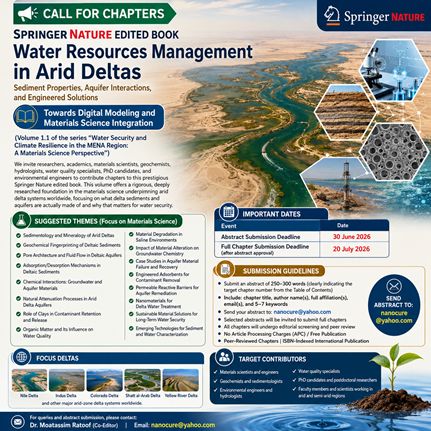
CALL of CHAPTERS...Water Resources Management in Arid Deltas Subtitle: Sediment Properties, Aquifer Interactions, and Engineered Solutions Towards Digital Modeling and Materials Science Integration
Published in Earth & Environment, Materials, and Mathematics

Target Audience
Materials scientists, geochemists, sedimentologists, environmental engineers, PhD candidates, and water quality specialists working in arid and semi-arid regions. This volume speaks directly to those who want to understand what delta sediments and aquifers are actually made of and how that matters.
Description
This book offers a rigorous, deeply researched foundation in the materials science that underpins every arid delta system. While companion volumes address digital modeling, this work stays grounded in the stuff itself, the sediments, minerals, pores, and particles. It explores the chemical dance between water and rock that determines whether an aquifer can sustain a city or a farm.
Arid deltas: the Nile, Indus, Colorado, Shatt al-Arab, and Yellow River are not just hydrological systems. They are material systems. Their sands carry specific mineral signatures. Their clays adsorb and release contaminants according to rules written in their crystal structure. Yet these material properties have often been treated as an afterthought. This volume puts materials science front and center.
The book opens with the geological and geochemical context of arid deltas: how they form, what they are made of, and why composition matters for water security. It then moves systematically through porosity, permeability, adsorption, desorption, and the complex chemical interactions between water and aquifer materials. A substantial portion addresses material degradation the slow, invisible breakdown of aquifer integrity alongside natural attenuation processes and engineered solutions.
What makes this book different is its insistence on the real world. Every concept is grounded in data from actual deltas. Every mechanism is explained in terms of what it means for water security. This is not optional reading it is the foundation.
Table of Contents
Chapter 1: Arid Deltas as Material Systems: An Introduction
Chapter 2: Sedimentology and Mineralogy of Major Arid Deltas ⇒ (Booked)
Chapter 3: Geochemical Fingerprinting of Deltaic Sediments
Chapter 4: Pore Architecture and Fluid Flow in Deltaic Aquifers
Chapter 5: Adsorption and Desorption Mechanisms in Deltaic Sediments ⇒ (Booked)
Chapter 6: Chemical Interactions Between Groundwater and Aquifer Materials
Chapter 7: Natural Attenuation Processes in Arid Delta Aquifers
Chapter 8: The Role of Clays in Contaminant Retention and Release ⇒ (Booked)
Chapter 9: Organic Matter and Its Influence on Water Quality ⇒ (Booked)
Chapter 10: Mechanisms of Material Degradation in Saline Environments ⇒ (Booked)
Chapter 11: Impact of Material Alteration on Groundwater Chemistry
Chapter 12: Case Studies in Aquifer Material Failure and Recovery
Chapter 13: Engineered Adsorbents for Contaminant Removal ⇒ (Booked)
Chapter 14: Permeable Reactive Barriers for Aquifer Remediation ⇒ (Booked)
Chapter 15: Nanomaterials and Their Applications in Delta Water Treatment ⇒ (Booked)
Chapter 16: Sustainable Material Solutions for Long-Term Water Security ⇒ (Booked)
Chapter 17: Emerging Technologies for Sediment and Water Characterization ⇒ (Booked)
Chapter 18: Research Priorities for Materials-Based Water Security
IMPORTANT DATES
|
Event |
Date |
|
Abstract Submission |
30 July 2026 |
|
Full Chapter Submission Deadline (after abstract approval) |
30 August 2026 |
SUBMISSION GUIDELINES
- Submit an abstract of 250–300 words (clearly indicating the target chapter number from the Table of Contents)
- Include: chapter title, author name(s), full affiliation(s), email(s), and 5–7 keywords
- Send your abstract to: nanocure@yahoo.com
- Selected abstracts will be invited to submit full chapters
- All chapters will undergo editorial screening and peer review
- No Article Processing Charges (APC) / Free Publication
- Peer‑Reviewed Chapters | ISBN‑Indexed International Publication

Materials scientist and inventor with a PhD from Alexandria University and research training at imec, Belgium (a leading European nanoelectronics center). I specialize in smart coatings, polymer science, nanomaterials, and water treatment technologies. I hold multiple US and Saudi patents in self-healing and degradable materials. Currently, I am the Co-Editor of a Springer book series on water security and climate resilience in the MENA region.