Can generative AI really improve language learning? What 51 studies tell us
Published in Computational Sciences and Education






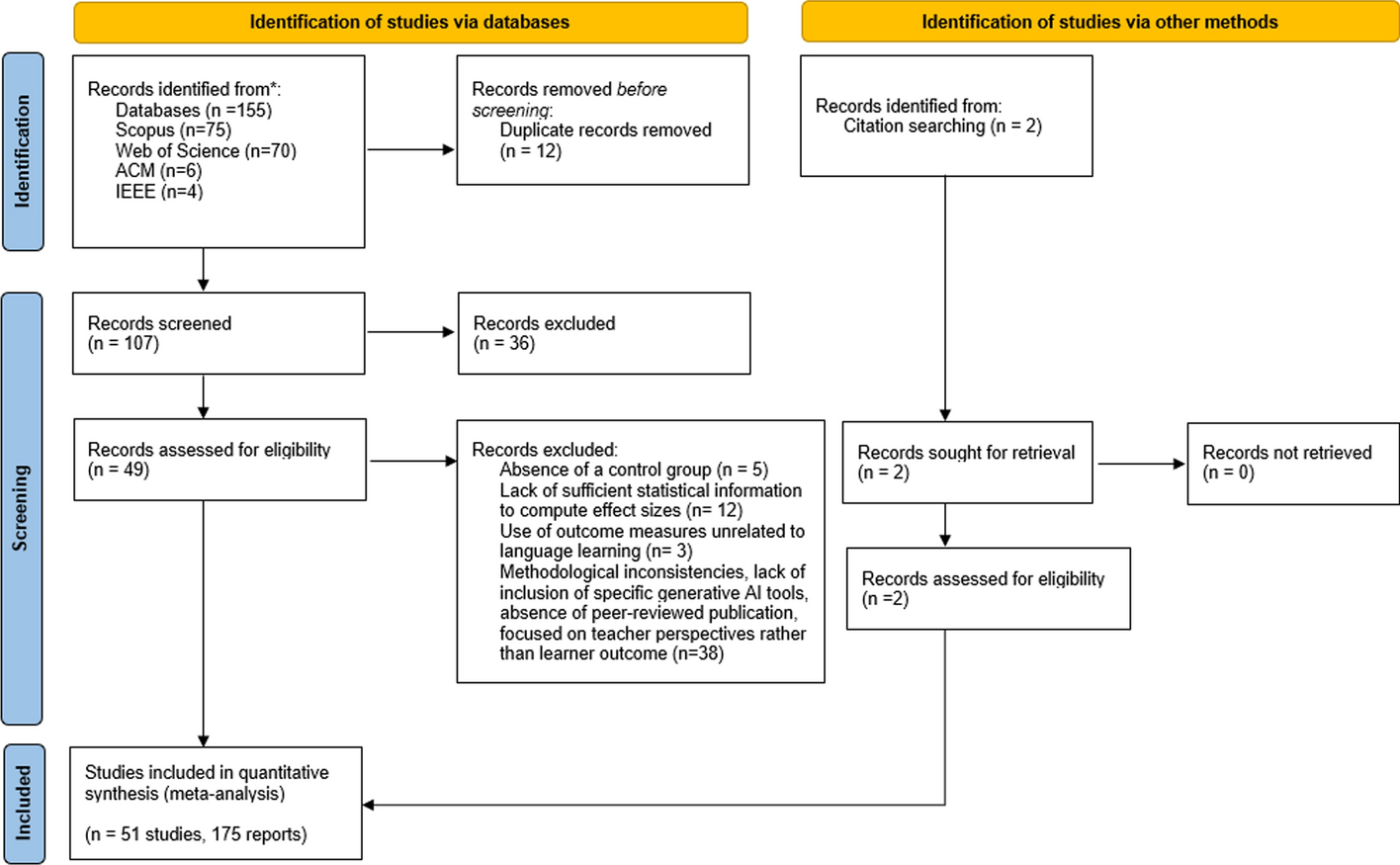

Generative Artificial Intelligence (GenAI) tools have rapidly entered language classrooms, study groups, and self-study routines around the world. Students use them to practice writing, simulate conversations, receive instant feedback, and even brainstorm ideas in a new language. Teachers experiment with them as tutors, feedback providers, and lesson design assistants.
But amid the excitement, a crucial question remains: Do these tools actually improve language learning?
In our recent meta-analysis, we set out to answer that question systematically. Rather than focusing on one classroom or one tool, we synthesized evidence from 51 empirical studies, representing 175 independent effect sizes, to evaluate the overall impact of GenAI on second and foreign language learning.
Our goal was simple: move beyond anecdotes and isolated case studies, and provide a clear, evidence-based picture of what GenAI is doing in language education.
What we found: Large and meaningful effects
Across studies, we found that GenAI tools produce large, statistically significant positive effects on language learning outcomes.
These benefits were visible in two broad areas:
- Language proficiency outcomes, such as writing quality, vocabulary acquisition, speaking performance, and grammar.
- Affective–cognitive outcomes, including learner confidence, reduced anxiety, and self-regulated learning.
In other words, GenAI tools appear to help learners not only perform better, but also feel more capable and engaged.
However, the story does not end there. The effects were not identical across contexts. One of the strengths of a meta-analysis is that it allows us to explore why results differ from one study to another.
When does GenAI work best? The role of context
We examined several “moderator” variables—factors that might influence how effective GenAI tools are. Four patterns stood out.
1. Informal settings show especially strong effects
GenAI tools were particularly powerful in informal learning environments, such as self-directed study outside the classroom. In these contexts, learners often use AI as a conversational partner, writing assistant, or on-demand tutor.
This finding suggests that GenAI may be especially effective when learners have autonomy and can integrate it flexibly into their own routines.
2. Productive skills benefit more than receptive skills
The strongest gains were observed in productive skills, such as writing and speaking. This makes sense: GenAI excels at generating language, modeling responses, and providing feedback. These features naturally support output-focused practice.
3. Less commonly taught languages may benefit disproportionately
Interestingly, we observed stronger effects in studies involving less commonly taught languages. In many traditional contexts, learners of these languages have limited access to conversation partners or learning materials. GenAI tools may help close that gap by providing scalable, always-available interaction.
4. Intervention duration and learner characteristics matter
Not all interventions were equally long, and not all learners were the same. The impact of GenAI varied depending on how long it was used, who the learners were, and how the intervention was structured. This highlights that technology alone is not a magic solution—design and context still matter enormously.
Why might GenAI be so effective?
From a theoretical perspective, our findings align with sociocultural and interactionist theories of language learning. These frameworks emphasize that language develops through meaningful interaction, feedback, and scaffolded practice.
GenAI tools offer several affordances that support this process:
- Immediate, adaptive feedback
- Interactive dialogue simulation
- Low-pressure practice environments
- Opportunities for repeated output and revision
For many learners, practicing with AI can reduce anxiety compared to speaking in front of peers. This reduction in anxiety may partially explain the positive affective outcomes we observed.
At the same time, it is important to note that most existing studies focus on relatively short-term interventions. We still know less about the long-term developmental impact of sustained GenAI use.
What surprised us
As researchers, one striking pattern was the heavy concentration of studies on writing and short experimental designs. While the results are encouraging, the field is still developing.
Many studies rely on:
- Short interventions
- Self-reported measures
- Single skill focus (often writing)
This means that although the overall effects are strong, we must interpret them carefully. The field would benefit from:
- Longitudinal research
- More diverse language skills (especially speaking and listening)
- More rigorous experimental designs
- Research in varied cultural and educational contexts
What does this mean for teachers and learners?
Our results suggest that GenAI tools can be powerful complements to language instruction. They are not replacements for teachers, but they can expand opportunities for practice, feedback, and engagement.
For teachers, this means:
- Thoughtful integration matters more than mere adoption.
- Design choices (how long, how structured, for which skill) shape outcomes.
- Informal and autonomous uses can be particularly fruitful.
For learners, it suggests that using GenAI strategically (for example, drafting and revising writing, practicing conversations, or exploring vocabulary in context) can support both skill development and confidence.
Where do we go from here?
The rapid rise of GenAI in education presents both opportunity and responsibility. The technology is evolving quickly, often faster than research can keep up.
Our meta-analysis provides encouraging evidence that GenAI can meaningfully support language proficiency and affective development. Yet it also highlights the need for:
- More longitudinal evidence
- Greater methodological rigor
- Clear pedagogical frameworks for responsible use
As researchers, our hope is not only to measure impact but to contribute to a deeper understanding of how and why GenAI works in language learning. The next phase of research should move beyond “Does it work?” to “Under what conditions does it work best—and for whom?”
Language learning has always been deeply human. What GenAI appears to offer is not a replacement for that humanity, but a new interactive space where learners can experiment, make mistakes, receive feedback, and grow.
The challenge now is to ensure that this powerful tool is used thoughtfully, equitably, and in ways that truly support learners around the world.
Reference:
Saarela, M., Gunasekara, S. & Kumarage, P. A meta-analysis of generative AI effects on language proficiency and affective–cognitive outcomes in language learning. Discov Computing 29, 116 (2026). https://doi.org/10.1007/s10791-026-10015-1
Follow the Topic
-
Discover Computing
Previously Information Retrieval Journal. Discover Computing is an open access journal publishing research from all fields relevant to computer science.

Related Collections
With Collections, you can get published faster and increase your visibility.
Advances in Knowledge-Driven Artificial Intelligence: Methods and Applications
As AI systems are increasingly deployed in information access, decision support, and personalized learning, their ability to incorporate, reason over, and update structured and unstructured knowledge has become critical. Knowledge-driven methods provide a promising pathway to improve accuracy, explainability, personalization, robustness, and trustworthiness, especially in scenarios where data are heterogeneous, dynamic, sparse, or domain-specific. This Collection aims to bring together high-quality research on knowledge-driven artificial intelligence for recommendation systems, question answering, knowledge graphs, and knowledge tracing.
The Collection welcomes original research and review articles on theories, models, algorithms, systems, and applications related to knowledge-enhanced recommendation systems, knowledge graph construction and reasoning, knowledge graph question answering, retrieval-augmented generation, large language models with external knowledge, explainable and trustworthy AI, user modelling, learner modelling, and knowledge tracing. Topics of interest also include graph neural networks, neuro-symbolic reasoning, causal and counterfactual methods, multimodal knowledge representation, dynamic and continual knowledge learning, learning analytics, educational intelligence, and real-world knowledge-intensive applications. The goal is to promote interdisciplinary advances in knowledge-centered intelligent systems and foster robust, interpretable, and adaptive AI technologies.
This Collection supports and amplifies research related to SDG 9.
Keywords: Knowledge-driven AI; Knowledge graph; Recommender systems; Question answering; Knowledge tracing; Retrieval-augmented generation; Large language models; Graph neural networks; Learning analytics
Publishing Model: Open Access
Deadline: Feb 28, 2027
Trustworthy and Explainable Intelligent Systems for Real-World Computing
This Collection focuses on trustworthy and explainable intelligent systems designed for real-world computing applications. As artificial intelligence and data-driven systems are increasingly deployed in critical domains such as healthcare, smart cities, industrial automation, and digital infrastructure, concerns related to transparency, robustness, fairness, and accountability have become central challenges.
The aim of this Collection is to bring together recent advances in explainable artificial intelligence (XAI), trustworthy machine learning, and responsible computing, with a strong emphasis on practical deployment and system-level perspectives rather than purely theoretical contributions. The Collection seeks to highlight methods, models, and frameworks that enhance human understanding, trust, and control over intelligent systems operating in real-world environments.
Specific areas of interest include, but are not limited to: interpretable and explainable models, robustness and reliability of intelligent systems, human-centered and human-in-the-loop computing, evaluation methodologies for trustworthy AI, ethical and responsible computing practices, and application-driven case studies demonstrating real-world impact. By providing a focused yet interdisciplinary forum, this Collection aims to foster high-quality contributions that bridge the gap between advanced computational methods and trustworthy deployment in practice.
This Collection supports and amplifies research related to SDG 9.
Keywords: Explainable Artificial Intelligence (XAI); Trustworthy Computing; Responsible AI; Interpretable Machine Learning; Human-Centered Computing; Robust Intelligent Systems; Ethical Computing; Real-World AI Applications
Publishing Model: Open Access
Deadline: Nov 20, 2026