Can Manufacturing Employment Reduce Income Inequality? Evidence from the United States
Published in Economics

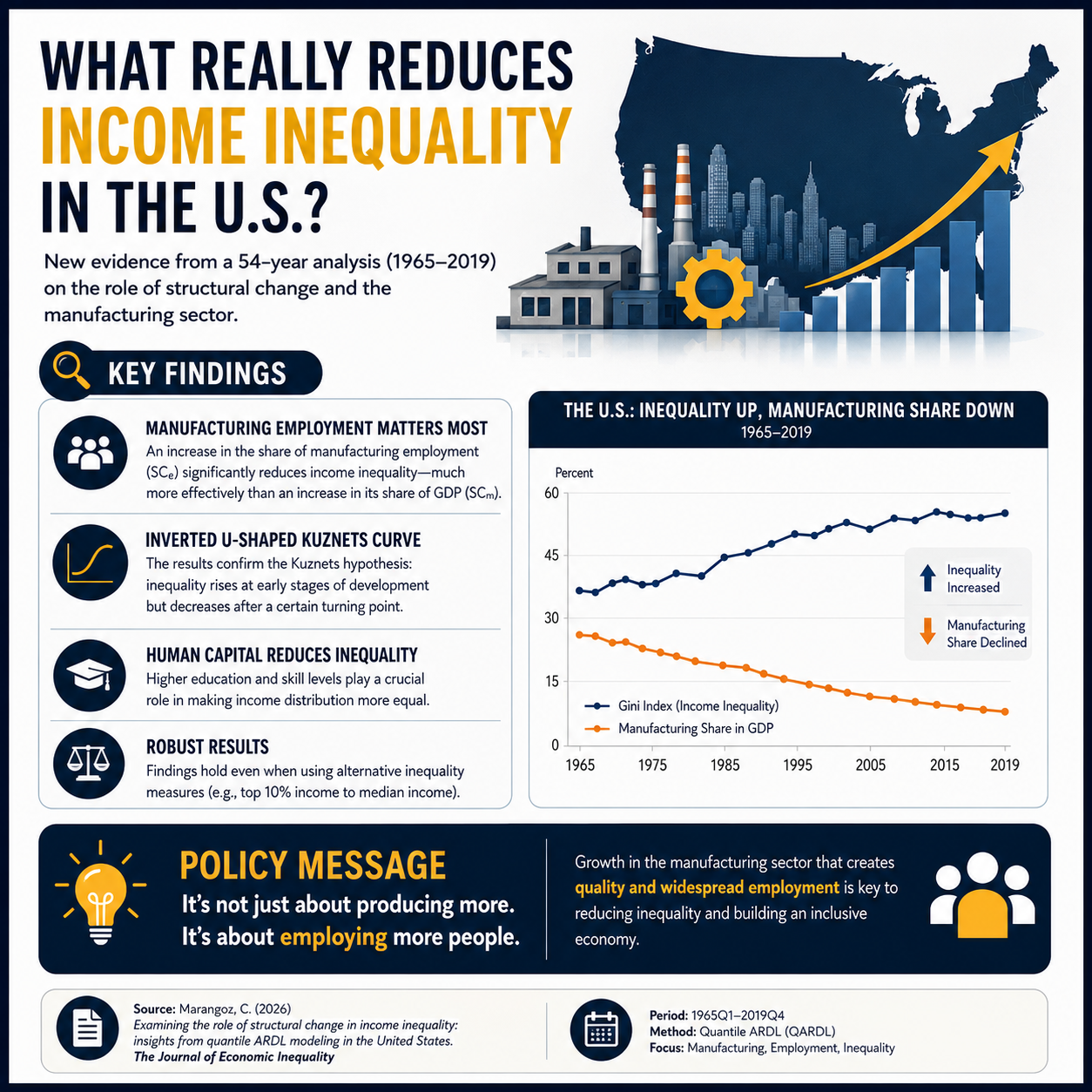
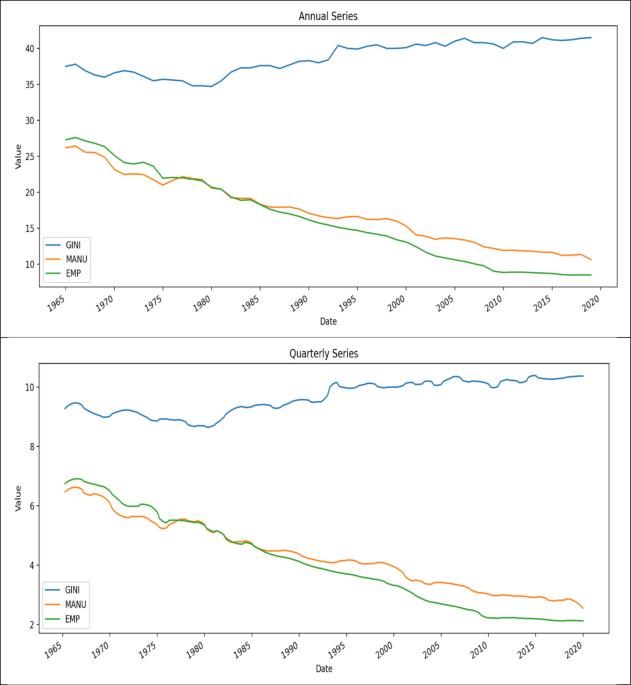

Over the last several decades, the United States has experienced a steady rise in income inequality alongside a declining share of manufacturing in the economy. This parallel trend raises an important question: does structural transformation contribute to growing inequality?
In my recent article published in The Journal of Economic Inequality, I investigate the relationship between structural change and income inequality in the United States over the period 1965–2019. The study uses Quantile Autoregressive Distributed Lag (QARDL) modeling to capture how these relationships vary across different levels of inequality.
A key contribution of the paper is that structural change is measured in two different ways:
• Manufacturing value added as a share of GDP
• Manufacturing employment as a share of total employment
The findings suggest that manufacturing employment plays a much stronger role in reducing income inequality than manufacturing output alone. In other words, it is not simply the growth of manufacturing production that matters, but the sector's capacity to generate jobs and distribute income more broadly across society.
The results also provide support for the Kuznets hypothesis, showing a non-linear relationship between economic growth and inequality. Furthermore, human capital contributes to reducing inequality, whereas urbanization tends to increase inequality in many parts of the income distribution.
These findings highlight the importance of employment-oriented industrial policies and inclusive growth strategies. As advanced economies continue to confront rising inequality, the employment dimension of structural transformation deserves greater attention from both researchers and policymakers.
I am an assistant professor of economics at Ağrı İbrahim Çeçen University. My research focuses on macroeconomics, economic development, environmental economics, financial markets, geopolitical risk, and applied econometrics. I have published in international peer-reviewed journals on topics including sustainable development, income inequality, structural change, financial markets, and energy economics.
I am passionate about evidence-based research, data analysis, and sharing knowledge with academic and professional communities. Through my work, I aim to contribute to a better understanding of economic and social challenges and to promote informed policy discussions.
Follow the Topic
-
The Journal of Economic Inequality
This journal provides a forum for analysis and measurement of economic and social inequalities, using theoretical and empirical approaches.