Can Reformist Politics Open the Door to Radical Freedom? Lessons from Iceland, Mondragón, and the Situationist International
Published in Economics and Law, Politics & International Studies

Explore the Research
 Springer Nature Switzerland
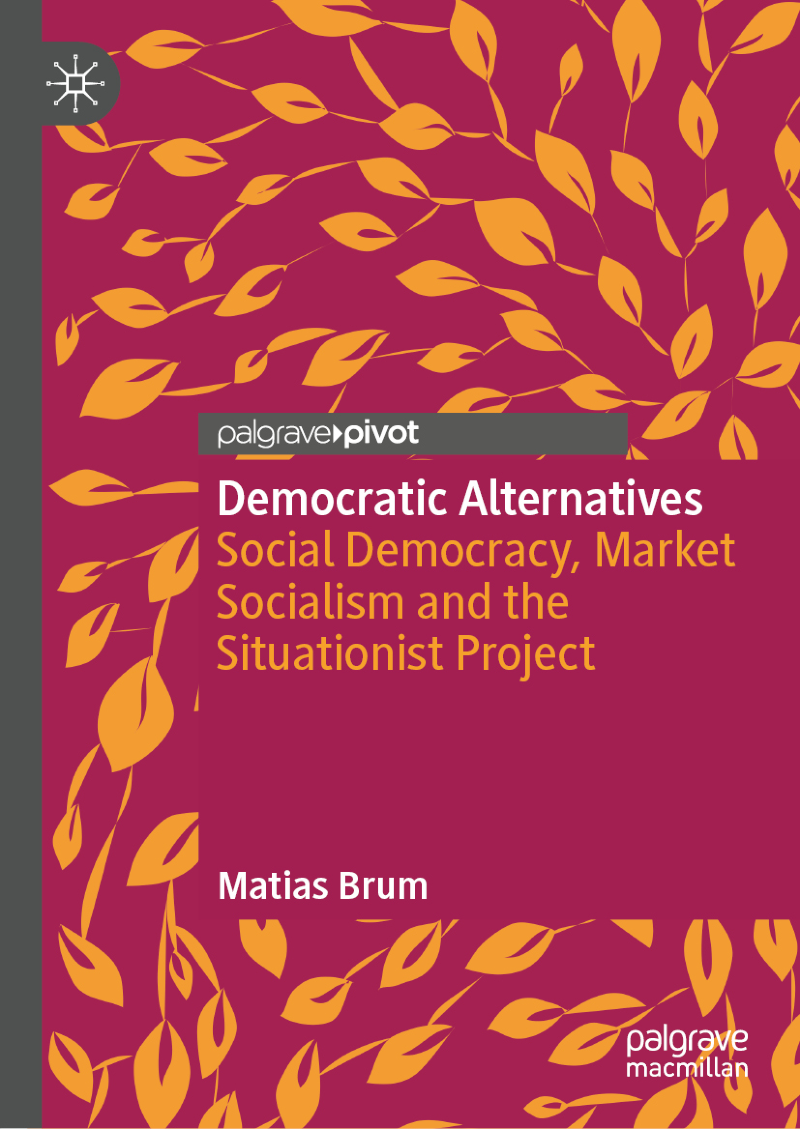
Democratic Alternatives
This book explores Situationist theory and social democracy to assess reforms like work-time reduction and cooperatives.
What would it mean for a four-day work week or a worker cooperative to count as a revolutionary act? At first glance, the question seems absurd. Social democracy and market socialism have always been the targets of the radical left's most cutting critiques — accused of patching up a broken system rather than dismantling it. The Situationist International, the avant-garde Marxist collective responsible for much of the intellectual energy behind May 1968, was perhaps the sharpest voice in that chorus: no reform, however well-designed, could liberate everyday life from the grip of what Guy Debord called "the spectacle."
My new book, Democratic Alternatives: Social Democracy, Market Socialism and the Situationist Project, takes that accusation seriously — and then asks what we can still salvage from it.
The Spectacle Is Not Just the TV
Debord's concept of the spectacle is frequently misread as a theory of media manipulation. It is something far more unsettling. The spectacle, as he formulated it in La Société du Spectacle (1967), is a fundamental restructuring of social relations: a system in which human beings encounter each other not directly, but through representations, images, and commodities. It is "not a collection of images, but a social relationship among people, mediated by images."
This means the spectacle does not merely distort our view of the world — it colonises our desires, our time, our cities, and our sense of what is possible. And it follows from this that ownership reforms alone, however radical, cannot automatically produce liberated subjects. You can change who owns the factory without changing the texture of everyday life.
This is what a Situationist lens adds to standard political economy: it forces us to ask not only who controls the means of production, but whether people's lived experience — their time, their activity, their relationships — is becoming freer, more creative, more self-determined. That is a harder and more honest question.
Situationism as Compass, Not Blueprint
To be clear: this book does not propose a "Situationist social democracy" — that would be an oxymoron, and not a productive one. The Situationists were constitutively anti-reformist, and they were largely right to be suspicious of how institutions absorb and neutralise radical demands. The risk of co-optation — of a shorter working week being repackaged as a productivity tool, of cooperatives gradually mimicking corporate governance — is not a theoretical abstraction. It is a historical pattern.
But the Situationist critique, precisely because it is so uncompromising, makes an excellent diagnostic instrument. It helps us see when reforms reinforce alienation and when they open cracks — spaces of experiment, autonomy, and collective creativity that exceed the logic of the system they emerge from. The goal of this book is to use Situationist concepts such as decommodification, spatial reappropriation, and temporal liberation as evaluative categories, and to apply them to two empirical cases where reform has shown genuine transformative potential.
Iceland: When Time Becomes Yours
Between 2015 and 2019, the Icelandic government ran the largest trial of reduced working hours in history. Roughly 2,500 public sector workers moved to a 35–36 hour week with no reduction in pay. The headline results — maintained or improved productivity, higher worker wellbeing, a rapid expansion of the model across the economy — have been widely reported.
What interests me more is the framing. Icelandic advocates did not sell the reform as a business efficiency measure. They presented it as a re-evaluation of the role of work in human life — connecting the liberation of time to gender equality, to environmental sustainability, and to democratic participation. Workers reported not just greater rest but qualitatively different uses of free time: more care work, more community involvement, more creative activity.
Through a Situationist lens, Iceland's experiment is instructive precisely because it illustrates the conditions under which a reform can start to function as something more than adjustment. The reduction of working time disrupts the temporal architecture of spectacular society — the colonisation of time by the imperatives of accumulation. When workers use reclaimed hours to strengthen social bonds and collective capacities rather than consuming more spectacle, the reform begins to do something the Situationists would have recognised, even if they would never have initiated it themselves.
The risks are real too. Shorter hours can be captured by a logic of productivity — justified to employers as reducing burnout to extract more value over fewer hours. The lesson is that the design, framing, and political articulation of the reform determines whether it opens emancipatory space or reproduces the same logic in a new form.
Mondragón: Democracy in the Factory
The Mondragón Cooperative Corporation in the Basque Country is the most studied worker cooperative complex in the world. Founded in 1956 with a single cooperative and a radical pedagogy rooted in Catholic social thought, it grew into a network encompassing manufacturing, retail, finance, and education, employing tens of thousands of worker-owners.
What Mondragón demonstrates is that democratic ownership is possible at scale — that there is no iron law forcing large enterprises to be organised hierarchically around capital. Worker-members vote on governance structures, elect their management, and share in surplus according to rules they collectively set.
The Situationist analysis of Mondragón is, however, genuinely ambivalent. At its best, the cooperative experience fosters exactly what the SI valued: non-alienated labour, collective deliberation, economic self-determination. Workplace democracy is not merely a formal change in ownership; it transforms the subjective experience of work.
But Mondragón's contradictions are equally instructive. Under competitive market pressure, the corporation has expanded internationally through subsidiaries that are not cooperatives — their workers are employees, not members. Competitive imperatives have pushed some cooperatives toward managerial forms that closely resemble those they were meant to replace. The risk of what I call spectacularisation from within — absorbing the institutional form of cooperation while evacuating its emancipatory content — is not hypothetical at Mondragón. It has happened in specific domains.
This does not invalidate the cooperative model. It tells us something important about the relationship between institutional design and the broader social ecology in which institutions are embedded. Worker ownership without broader social movement support, without an articulation with non-market values, and without ongoing democratic vigilance tends to drift toward reproducing capitalist social relations under collective management.
The Concept of Non-Reformist Reform
The analytical key to reconciling these findings is André Gorz's concept of the non-reformist reform: a policy that does not merely improve existing conditions but structurally challenges the dominant logic, creating conditions in which new forms of social action become possible.
The distinction matters because it refuses both naive reformism (the idea that any improvement is progress) and unproductive purism (the idea that any engagement with institutions is betrayal). A reform is non-reformist when it expands collective capacity, when it opens rather than closes space for further transformation, and when it generates the social mobilisation and democratic consciousness that are preconditions for more ambitious change.
Iceland's working time experiment, when articulated with feminist movements and democratic culture, moves in this direction. So does Mondragón at its best — when its cooperative principles generate genuine solidarity, a culture of participation, and a counter-hegemonic institutional presence in its region.
Neither exhausts the Situationist demand. Both are worth fighting for.
A Personal Note
This book brings together different stages of my own political and intellectual life. The teenage anarcho-punk who discovered Situationist ideas as a language for naming everyday alienation; the younger adult forced to reckon with the uncomfortable realities of political choice and imperfect compromise; the later researcher and technocrat trying to push social democracy and market socialism as incomplete but necessary tools for change.
What ties these moments together is not conversion or disillusionment, but a long journey — roughly twenty-five years — of learning what it means to carry radical commitments into institutions, into decisions with real consequences for real people, where ideals must meet trade-offs and where refusing to choose is itself a choice.
The Situationist critique is not something I left behind. I carry it with me, as a compass. This book is an attempt to show why that compass remains useful, even — especially — for those of us working within the institutions the Situationists would have refused.

Follow the Topic
-
Palgrave Macmillan
Palgrave Macmillan is a world-class publisher of books and journals with more than 175 years’ experience in the Humanities and Social Sciences.




Please sign in or register for FREE
If you are a registered user on Research Communities by Springer Nature, please sign in