Can sending different combinations of breast screening invitation letters improve screening attendance?
Published in Cancer and Public Health


Breast screening can only work if women are able to attend. Over the last 15 years I have been passionate about doing research that explores how women who have decided to attend breast screening can be supported, both in their decision and in the process of attending their screening appointment.
Nearly one in three women did not attend their recent breast screening appointment because they found it difficult to find a convenient appointment. Furthermore, women have told us about difficulties getting through by phone to the screening services to make an appointment over the phone. We know that breast screening saves lives, so how can we help women, who want to go, to attend?
Why breast screening attendance matters
Anyone registered female in the UK will be invited to breast screening every 3 years between ages 50 to 71. These appointments are free to attend. Before the pandemic, attendance rates were above 70%, but since then, attendance has been lower, and only slowly reaching pre-Covid levels. Attendance also varies across England. For example, it is lowest in London, where about one in three women do not attend their breast screening appointment. Lower screening attendance in more deprived areas also contributes to health inequalities.
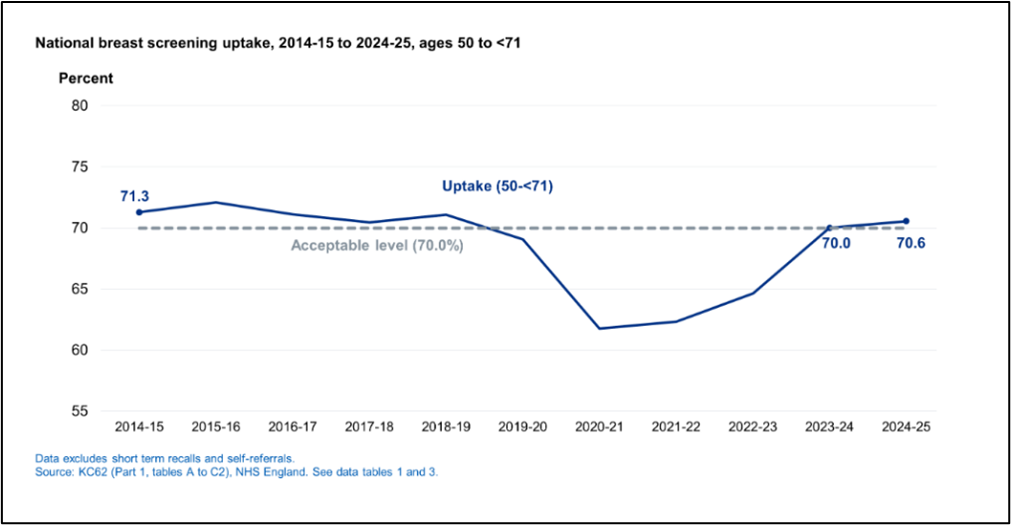
Why does it matter if women attend screening? We know that for every 1,500 women screened one life is saved.
What we set out to do
Working as academics, we always hope that the findings from our research will eventually change clinical practice. For this project, however, we had the opportunity to work directly within the UK NHS Breast Screening Programme. This allowed us to test which combination of invitations would result in the highest attendance, knowing that our findings would be implemented for the 2.75 million women invited to screening each year across England. Collaborating closely with colleagues in the screening programme allowed us to test all options very robustly.
In England, women have always received their invitation letter to breast screening with a place, date, and time, including a phone number in case they wanted to change their appointment (‘timed appointment’). If a woman did not attend her appointment, she was sent a second invitation letter. These were either timed or ‘open’ invitation letters asking women to call to make an appointment rather than giving them a scheduled time. This changed during the pandemic to open invitation letters only. After the pandemic, breast screening attendance was much lower, so the NHS Breast Screening Programme wanted to understand the best invitation strategy to achieve highest attendance. The aim of the study was to determine which combination of first and second invitation letters would result in highest attendance, overall and in specific subgroups. We were particularly interested in exploring the impact on more deprived areas.
Collaborating directly with colleagues in the NHS Breast Screening Programme allowed us to identify the most suitable screening services for this study. We chose services with a range of current uptake and from different parts of England, which also had the capacity to carry out this study.
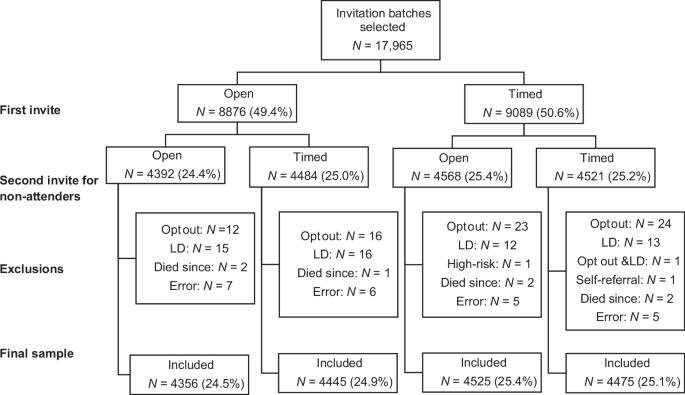
First, we allocated 17,965 women to two groups to receive either an invitation letter with a place, date and time, or an open invitation letter asking them to phone to make an appointment. Any women were then again divided into two groups allocated to receive either a second invitation letter with a timed appointment, or just a letter asking them to call and book, in case they did not attend after their first invitation.
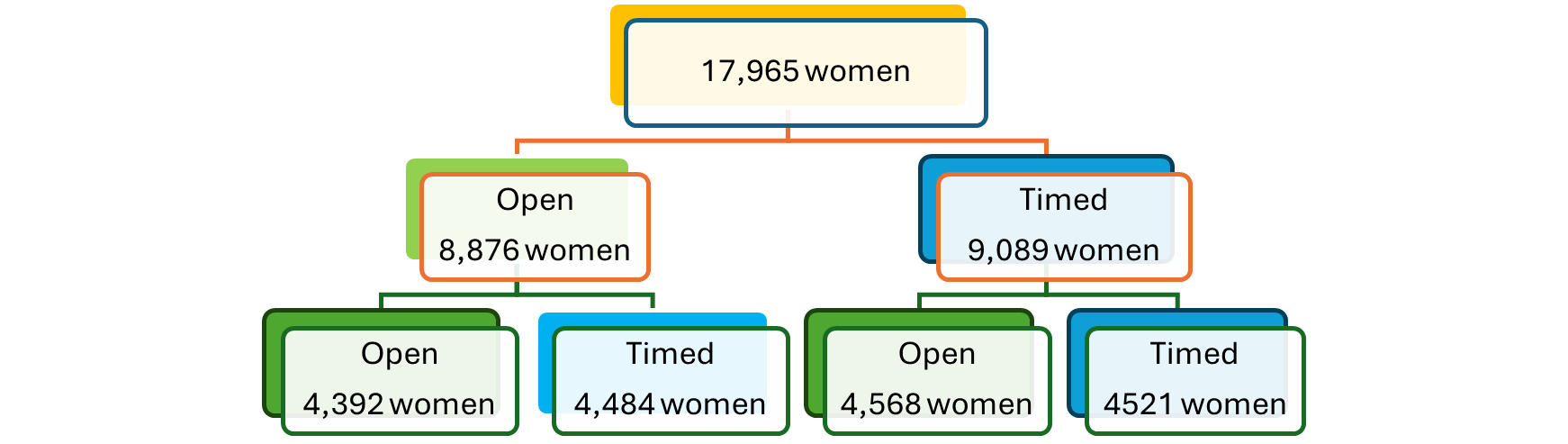
Study participant allocation
What this study showed
Our findings showed that when we sent women two invitation letters with a place, time and date of their appointment (‘timed’) compared with invitations to call to make an appointment (‘open’), screening attendance increased by nearly 20%. We also observed a trend of increasing attendance with the more timed invitations we sent: Two open invitations resulted in the lowest attendance compared with two timed invitations resulting in the highest attendance.
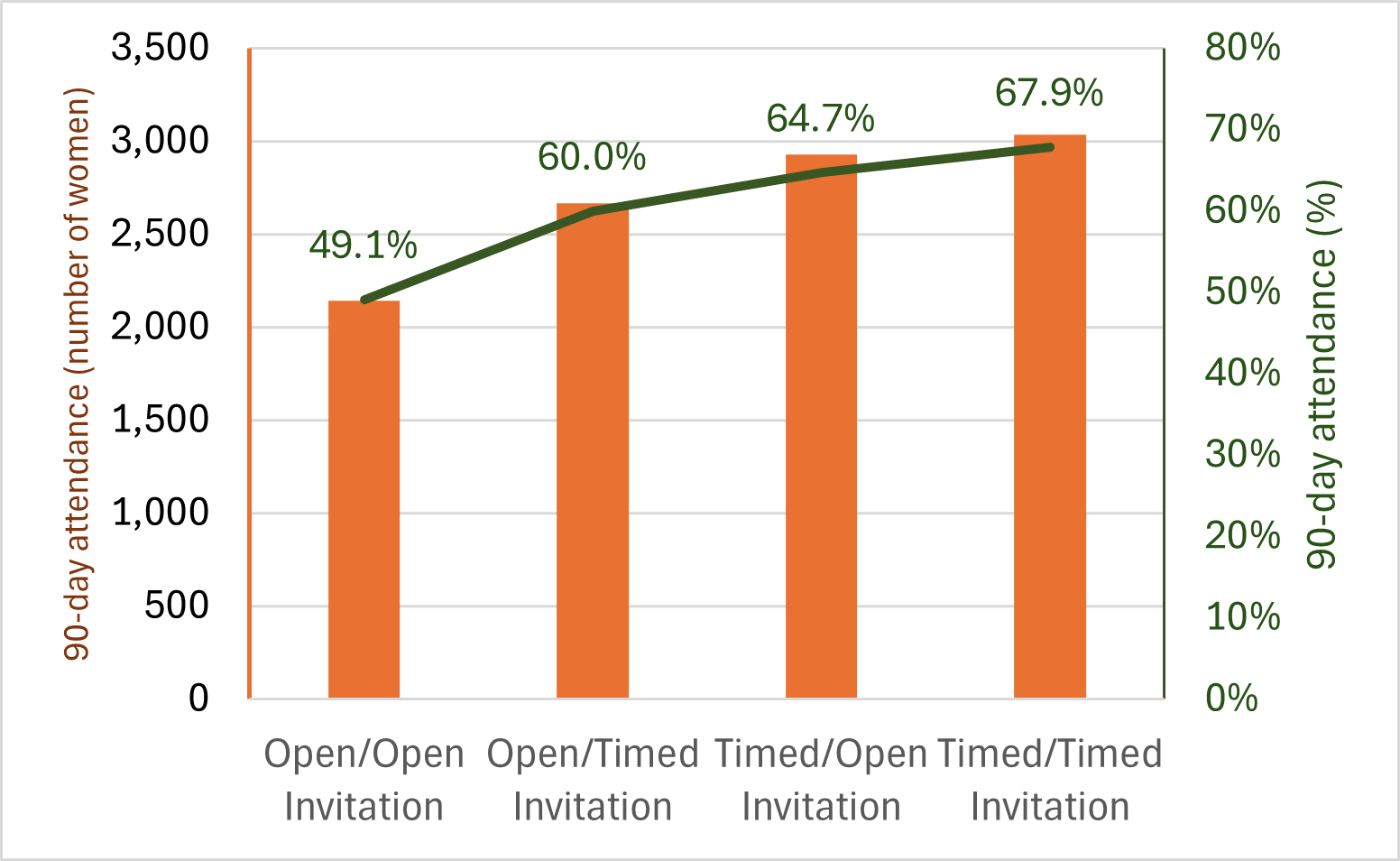
Number and proportion of 90-day attendance by invitation strategy: Number of women who attended represented as orange bars and percentages who attended of all women invited in each group as the green line
We then compared the effect of these different combinations of invitations for different levels of deprivation, using the Index of Multiple Deprivation, a common measure of deprivation in local areas. It is based on seven measures including income, employment, and health deprivation. Using these measures, neighbourhoods are ranked and this rank is available for each postcode area. We used them grouped into five groups from least to most deprived. Firstly, we saw that women living in the most deprived areas had the lowest attendance rates. This is in line with previously published reports that showed lower attendance in more deprived areas. Secondly, we saw the same trends of increasing attendance with timed invitations for all levels of deprivation. It even seemed that the impact of two timed invitations might be bigger in more deprived than less deprived areas, so implementing this could improve screening inequities.
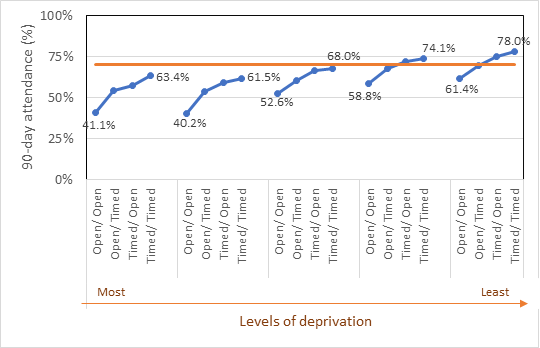
90-day attendance by levels of deprivation and invitation strategy
What happens now
The NHS Breast Screening Programme has now implemented the use of timed first invitations for all screening services in England and timed second invitations where possible. Even if this only leads to a 5% increase in attendance it could result in 84 additional lives saved across England every year. For me, as a screening participant, one less step of not having to make an appointment will definitely help me attend my screening appointment.

Follow the Topic
-
British Journal of Cancer
This journal is devoted to publishing cutting edge discovery, translational and clinical cancer research across the broad spectrum of oncology.



Please sign in or register for FREE
If you are a registered user on Research Communities by Springer Nature, please sign in