Can Today's Hardware Protect Tomorrow's Secrets?
Published in Electrical & Electronic Engineering, Physics, and Computational Sciences


Quantum Threat Is Closer Than You Think
Every day, billions rely on public-key cryptography for digital security, from online banking to healthcare records, depending on math problems today's computers can't solve. But what if tomorrow's computers can?
The rapid progress of quantum computing is turning a distant possibility into a real threat. Powerful quantum computers could crack public-key systems like RSA and ECC, endangering digital security worldwide. This has driven a major shift in cybersecurity towards post-quantum cryptography (PQC).
CRYSTALS-Kyber, chosen by NIST, is the top candidate for future key exchange security. But replacing current cryptography with quantum-resistant algorithms isn’t enough; they must also be efficient for real-world devices from cloud servers to IoT systems.
That challenge became the motivation behind our latest research.
Looking Beyond Cryptographic Algorithms
One key lesson from our research is that creating a secure cryptographic algorithm is just the first step. Successful deployment relies equally on efficient implementation and mathematical security.
In CRYSTALS-Kyber, the dominant operation is the Number Theoretic Transform (NTT), which speeds up polynomial multiplication and boosts performance but also causes the main computational bottleneck. Improving NTT efficiency can greatly enhance overall system performance.
Many studies focus on specific hardware or software; we wanted to see if a broader view reveals new insights. Instead of asking, "How can we make NTT faster?" we asked a different question:
How does the same cryptographic engine behave across classical software, modern FPGA hardware, and emerging quantum computing platforms?
Bridging Three Computing Worlds
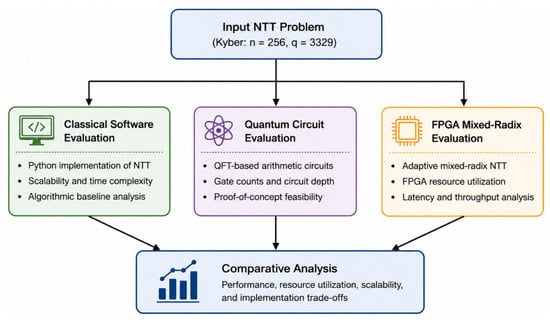
To answer this question, we developed a unified evaluation framework that investigates NTT implementations across three computational domains.
First, we implemented classical software versions to establish algorithmic baselines and study computational complexity. Next, we designed adaptive FPGA-based hardware architectures supporting multiple mixed-radix configurations to explore performance, latency, and hardware resource utilization. Finally, we investigated proof-of-concept quantum implementations using Qiskit to understand both the opportunities and current limitations of quantum circuit realizations.
Although these implementations target different computing environments, comparing them within a common framework clarifies the trade-offs future post-quantum systems will face.
Sometimes Simpler Is Better
One interesting outcome was that increased architectural complexity doesn't always mean better performance. People often assume larger radix configurations or more sophisticated hardware will always outperform simpler designs, but our evaluation shows a more nuanced reality.
Among the investigated architectures, the adaptive radix-2 implementation combined with Montgomery modular reduction consistently provided the best balance between operating frequency, latency, and hardware resource consumption. This configuration achieved an estimated operating frequency exceeding 230 MHz while requiring remarkably few hardware resources, making it particularly attractive for practical FPGA implementations.
This finding reinforces that the most effective solution isn't always the most complex. Careful architectural optimization often provides more practical value than just increasing computational sophistication.
What About Quantum Computing?
No discussion of post-quantum cryptography is complete without considering quantum computers. While current quantum hardware can't perform full cryptographic workloads, we explored future possibilities. Using IBM's Qiskit, we developed proof-of-concept quantum circuits for key arithmetic operations needed by the number theoretic transform.
These experiments weren't meant to replace FPGA implementations but to explore practical challenges like circuit depth, qubit needs, and noise sensitivity—factors restricting current quantum tech. Understanding these guides future research as hardware improves.
More Than Performance Numbers
For us, this project represents more than another hardware optimization study.
Preparing for the quantum era requires collaboration among cryptographers, hardware engineers, and quantum researchers, integrating secure algorithms, efficient hardware, and new computational paradigms. This unified approach helps transition post-quantum cryptography from theory to practice.
Looking Ahead
Quantum computers that could break current cryptography may be years away, but the shift to quantum-resistant systems has begun. Organizations worldwide are planning their migration before that day arrives.
Research on post-quantum cryptography now focuses on making algorithms practical, efficient, and deployable across diverse modern platforms, not just inventing stronger algorithms.
We hope our work aids this effort by offering a unified view on software implementations, FPGA acceleration, and quantum feasibility. Each platform has distinct advantages and challenges, but together they shed light on secure computing in the quantum age.
The journey toward quantum-safe cybersecurity has only just begun—and it is an exciting time to be part of it.
Final Thoughts
Preparing for the quantum era requires more than new cryptographic algorithms—it demands efficient and practical implementations. Through this research, we explored how software, FPGA hardware, and quantum computing can work together to advance CRYSTALS-Kyber toward real-world deployment.
We look forward to continuing our research on scalable, high-performance, and quantum-ready cryptographic solutions for the next generation of secure digital systems.
Our Related article: Adaptive FPGA-Based Mixed-Radix NTT Architectures with Classical and Quantum Evaluation for CRYSTALS-Kyber
Journal: Applied Sciences, 2026.
Published article: https://doi.org/10.3390/app16126183
ResearchGate: https://www.researchgate.net/publication/407264992

Dr. Qasem Abu Al-Haija is Chair of the Cybersecurity Department at Jordan University of Science & Technology (JUST), Irbid, Jordan. He received his Ph.D. in Computer Engineering from Tennessee State University (USA). He has been recognized as one of Stanford/Elsevier’s Top 2% Scientists worldwide (2023–2025). Dr. Abu Al-Haija has authored and co-authored more than 300 scientific publications, including journal articles, conference papers, books, and book chapters. His research interests span cybersecurity, artificial intelligence, Internet of Things (IoT), cyber-physical systems (CPS), machine learning, cryptography, smart systems, and secure digital transformation. He serves as a guest editor, reviewer, keynote speaker, technical program committee member, and organizer for international journals and conferences in AI and cybersecurity.