Carbon-Centric Blindness: The Hidden Water Cost of Green Hydrogen
Published in Bioengineering & Biotechnology, Chemistry, and Earth & Environment

The Spatial Contradiction of Mega-Scale Electrolysis
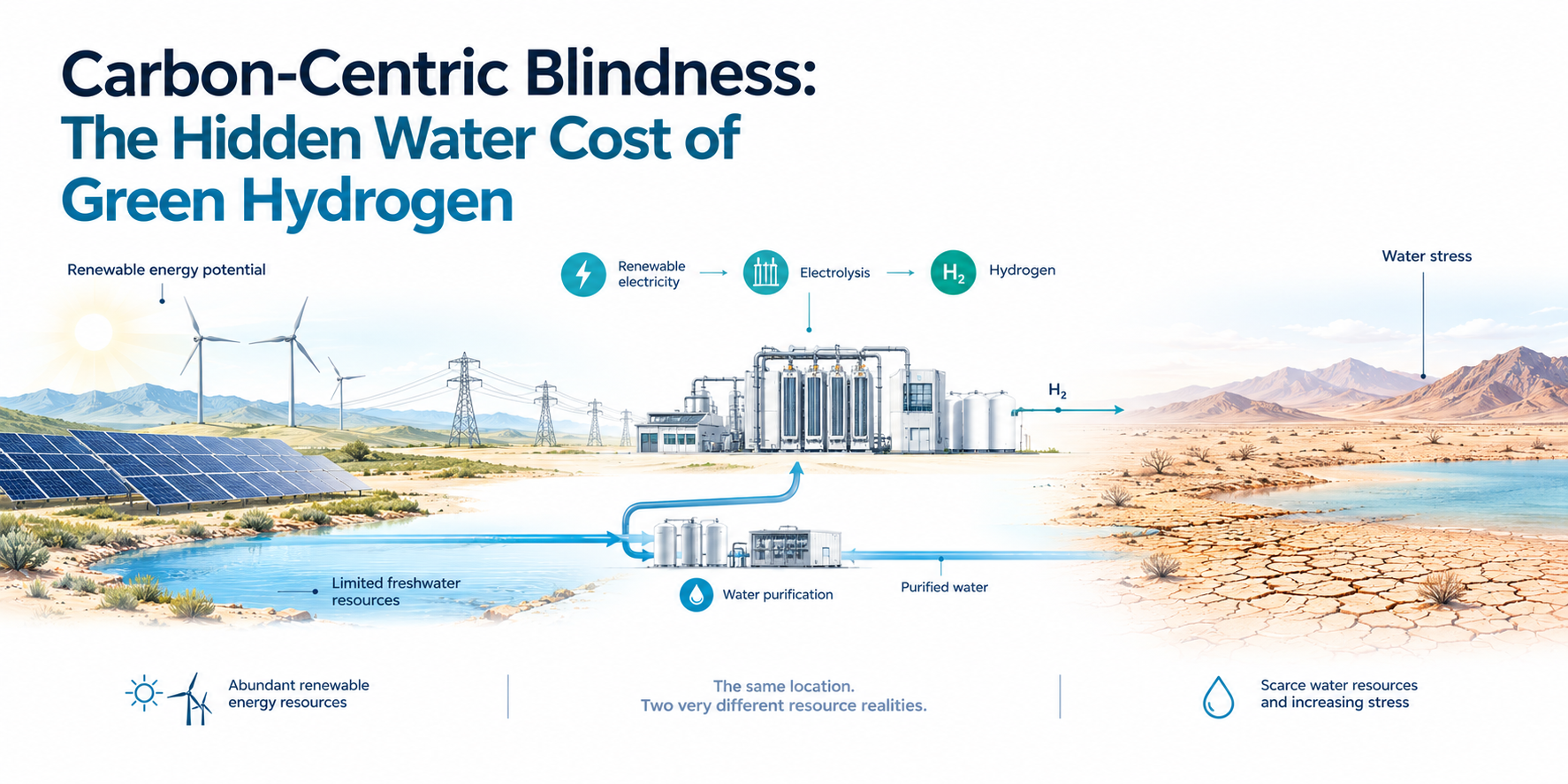
The global clean energy transition is currently operating under a fundamentally flawed geographic model. To produce economically viable green hydrogen, developers are targeting regions with maximum solar irradiance and wind potential—primarily arid and semi-arid landscapes like the Australian Outback, the Atacama Desert in Chile, and the deserts of North Africa.
This creates an immediate, severe hydro-ecological paradox. We are attempting to deploy the most water-intensive clean energy technology in the exact ecosystems that possess the least available freshwater. Mega-scale electrolysis is being forcibly superimposed onto ecologically fragile, water-stressed regions, setting the stage for profound environmental conflicts.
Beyond Theoretical Stoichiometry: The True Water Footprint
Proponents of green hydrogen frequently cite its theoretical stoichiometry: it takes approximately 9 liters of ultra-pure water to produce 1 kilogram of hydrogen.
From an engineering and operational standpoint, this figure is a dangerous underestimation. When we account for the extensive water demands of raw water purification (reverse osmosis), thermal management (cooling towers), and system inefficiencies, the true operational water footprint of commercial electrolysis frequently exceeds 20 to 30 liters per kilogram of hydrogen.
In arid export corridors, extracting this volume of water leaves developers with two destructive choices:
-
Fossil Aquifer Depletion: Draining irreplaceable, non-renewable groundwater reserves, directly threatening local socioeconomic water security.
-
Coastal Desalination: Relying on mega-desalination plants, which discharge hyper-saline, chemical-laden brine back into the ocean, driving severe marine ecotoxicity and accelerating spatial ecosystem fragmentation.
The Trap of Carbon-Centric Sustainability Metrics
How did this massive blind spot pass regulatory scrutiny? The answer lies in the deeply flawed sustainability frameworks governing the energy transition.
Currently, our ecological accounting systems suffer from carbon-centric blindness. A project is deemed "green" almost entirely based on its Global Warming Potential (GWP) and carbon footprint reduction. This myopic focus systematically externalizes local ecological carrying capacities and socioeconomic water justice.
This dynamic is birthing a new era of green extractivism. Arid, resource-rich regions in the Global South are being stripped of their most vital, scarce resource—water—merely to export "clean" energy to decarbonize heavy industries in the Global North. We are solving a global atmospheric crisis by triggering a localized hydro-ecological catastrophe.
Decoupling Hydrogen from Freshwater
If green hydrogen is to remain a viable pillar of global decarbonization, the chemical engineering and materials science communities must fundamentally decouple electrolysis from high-purity freshwater resources.
We cannot rely on conventional desalination. The technological horizon must pivot aggressively toward two paradigms:
-
Circular Wastewater Integration: Utilizing municipal and industrial wastewater effluents as the primary feed for electrolyzers, transforming a liability into a resource without straining municipal drinking supplies.
-
Direct Seawater Splitting: Scaling up advanced electrocatalysts and anti-corrosive membrane architectures capable of splitting untreated, raw seawater directly, bypassing the energetic and ecological penalties of pre-desalination.
Furthermore, regulatory bodies must abandon purely carbon-centric frameworks and adopt planetary-boundary-informed zoning, mandating that hydrogen mega-projects prove localized water neutrality before a single solar panel is installed.
Our pursuit of a decarbonized future cannot serve as a justification for the destruction of the world's most vulnerable watersheds. A clean energy transition that ignores water is not sustainable; it is merely shifting the ecological debt.
Do you believe direct seawater electrolysis will achieve commercial scale fast enough to prevent the depletion of arid aquifers, or must we immediately enforce strict hydro-ecological zoning laws on all new green hydrogen mega-projects? Let's discuss.
#GreenHydrogen #WaterEnergyNexus #Sustainability #GreenExtractivism #Electrolysis #Desalination #Decarbonization #EnvironmentalScience #WaterScarcity #SpringerNature
(This post builds upon my recent critical review exploring the hydro-ecological tradeoffs and localized water stress of the green hydrogen expansion. You can read the full, open-access paper in Critical Insights in Environmental Science and Technology (CIEST) here: Thirsty clean energy)

Dr. Akeem Adeyemi Oladipo is a globally recognized Research Professor of Materials and Environmental Chemistry at Eastern Mediterranean University. Ranked among the world’s Top 2% Scientists (Stanford/Elsevier 2026), he holds an elite Global Subfield Rank of 31 for single-year scientific impact and 427 for career-long achievements in Chemical Engineering. His interdisciplinary expertise bridges nanotechnology, renewable energy, and electro-optical analytical sensing. He specializes in advanced materials synthesis for wastewater treatment, highly sensitive electrochemical biosensors, and solar energy conversion. By integrating machine learning and artificial neural networks, his research drives scalable deep-tech innovations in environmental sustainability and energy storage.