Carbon quantum dot doped NH₂-MIL-53 for sustainable atmospheric water harvesting
Published in Materials

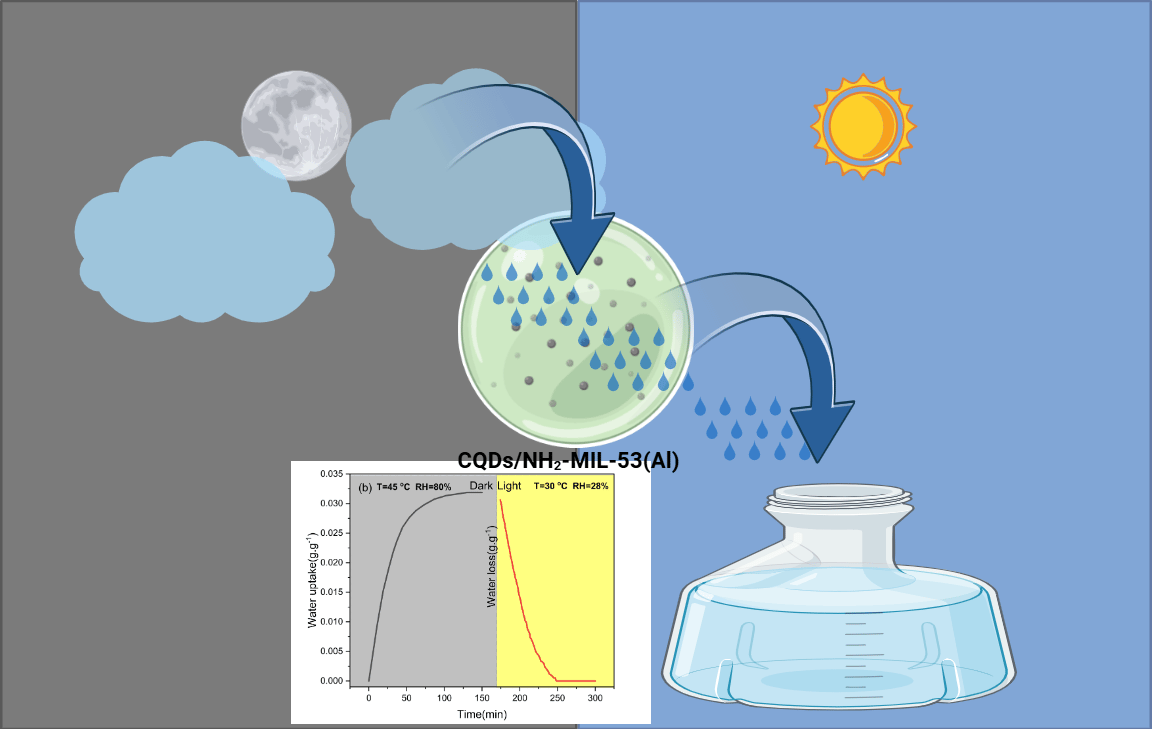

Sorption-based atmospheric water harvesting (SAWH) using metal–organic frameworks (MOFs) presents a promising solution to freshwater scarcity in arid regions. However, despite the intrinsic presence of abundant binding sites and polar functional groups, the practical application of MOFs remains limited due to their low adsorption/desorption efficiency and challenges associated with industrial-scale deployment in bulk form.
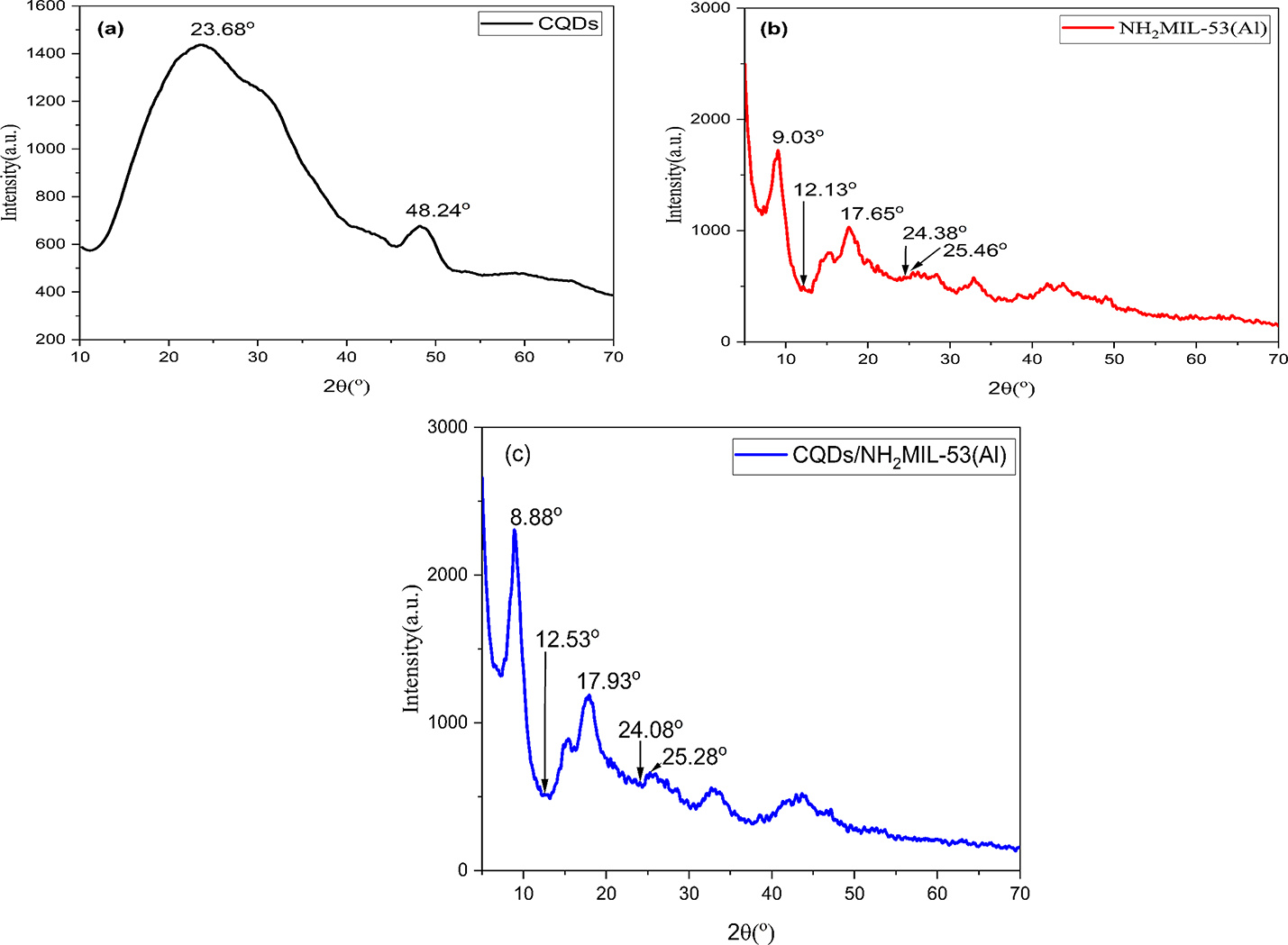
In this study, we developed a nanocomposite sorbent by doping carbon quantum dots (CQDs) onto the surface of NH₂-MIL-53(Al) via a hydrothermal method, ensuring the preservation of its original crystalline structure while enhancing its functionality. The hierarchical pore structure introduced by CQDs doping not only provides ample adsorption sites but also facilitates rapid moisture uptake and high solar-thermal conversion efficiency.
As a result, the material exhibits a significantly improved adsorption/desorption cycle, achieving complete water uptake and release within 300 min (150 min for adsorption and 150 min for desorption under simulated solar irradiation). Moreover, the nanocomposite demonstrates a water uptake capacity of 0.01317 g·g⁻¹ at 20% relative humidity (RH) and 0.092 g·g⁻¹ at 80% RH, surpassing the performance of most state-of-the-art MOF-based SAWH materials.
This work presents a simple yet effective strategy for enhancing the adsorption/desorption kinetics of NH₂-MIL-53(Al), offering valuable insights for the design of high-performance solar-driven water harvesting materials
I am an Assistant Professor in the Department of Chemistry at University of Raparin, Kurdistan, Iraq. I earned my BSc in Chemistry from the University of Sulaimani in 2006, followed by an MSc in Chemistry from Jamia Hamdard University in New Delhi, India, in 2013. I completed my PhD in Organic Synthesis, with a focus on biological activity and computational chemistry, at the University of Salahaddin-Erbil in Kurdistan, Iraq. My research expertise lies in the synthesis of heterocyclic compounds, polymers, Covalent Organic Frameworks (COFs), and Metal-Organic Frameworks (MOFs), particularly in the micro- and nano-scales. I lead an active research group at the University of Raparin, where I supervise Master's and PhD students working on innovative projects in materials chemistry, sustainable energy, and medicinal applications. I have published several papers in reputable journals indexed by prominent publishers such as Springer Nature, Elsevier, and Wiley, with a focus on green energy and the medicinal applications of novel materials. My research aims to bridge fundamental chemistry with practical, real-world solutions, particularly in the development of environmentally friendly technologies and therapeutic agents.
Follow the Topic
-
Discover Chemistry
A fully open access, peer-reviewed journal supporting multidisciplinary research and policy developments across all fields of chemistry.

Related Collections
With Collections, you can get published faster and increase your visibility.
Chemistry in Action: Multidisciplinary Approaches in Current Research and Novel Applications
This topical collection aims to highlight the role of Chemistry in multidisciplinary cutting-edge research. Currently, the traditional and siloed research approach is inadequate to solve the complex global challenges. Therefore, a new paradigm of multidisciplinary research is emerging, proposing innovative solutions that address issues from multiple angles by integrating insights from different fields. We call for submissions of papers reporting original Research, Reviews, Perspectives, Comments, Brief Communications, Case Studies, Registered Reports, and Data Notes that integrate chemical concepts and techniques with other fields such as Biology, Medicine, Pharmacy, Physics, Engineering, Environmental Science, Materials Science, and Food Science, among others. This collection is particularly interested in, but not limited to, manuscripts that address:
• Development of new materials with tailored features for specific applications.
• Design and synthesis of molecules for therapeutic or diagnostic purposes.
• Chemical approaches to clean generation and storage of energy.
• Sustainable chemical processes for environmental care and remediation.
• Integration of chemical principles with advanced engineering and fabrication
• Techniques.
Keywords: Materials chemistry, chemical synthesis, chemical engineering, sustainable chemistry, environmental sciences, biochemistry, pharmacy.
Publishing Model: Open Access
Deadline: Oct 31, 2026
Selected Papers from International Conference on Green Chemistry and Sustainable Development
Green chemistry advances sustainable development by enabling innovative chemical processes that minimize toxicity, waste, and resource consumption. The International Conference on Green Chemistry and Sustainable Development brings together scientists, researchers, industry leaders, and policymakers from around the world to share innovations, research findings, and strategies for promoting environmentally friendly chemical practices. The conference focuses on advancing green technologies, reducing environmental impact, providing renewable energy solutions, waste management, and supporting global efforts toward sustainable economic and social development. It serves as a platform for collaboration, education, and the exchange of ideas aimed at building a greener and more sustainable future through responsible scientific practices and sustainable industrial development.
Homepage: https://www.acsfuo.org/abstract
Keywords:Sustainability, Renewable resources, Biodegradable materials, green chemistry, Waste reduction, Renewable energy, Eco-friendly processes
This Collection supports and amplifies research related to SDG 7, SDG 9, SDG 10, SDG 13, and SDG 15.
Publishing Model: Open Access
Deadline: Nov 30, 2026