Chelation of perovskite surface for stable solar cells
Published in Electrical & Electronic Engineering
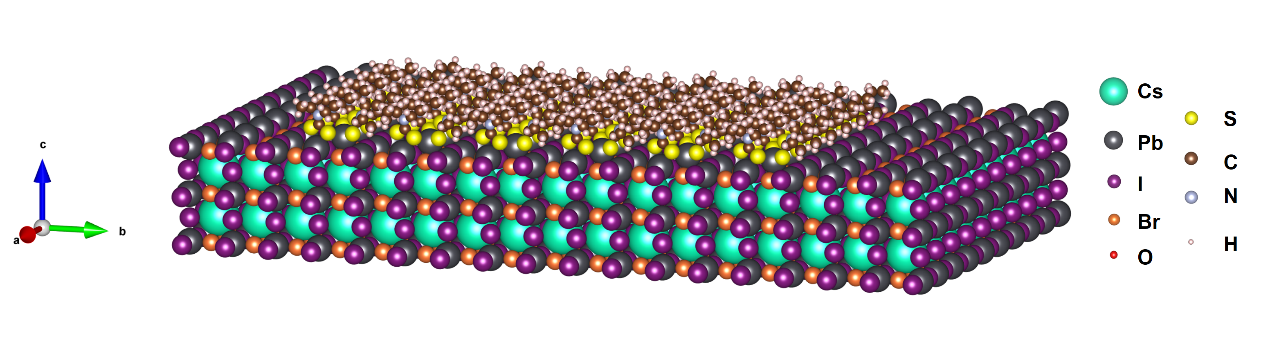

Recent progresses in solution processed perovskite film have identified the detrimental roles of surface and grain boundaries, which usually caused structural degradation and trap-assisted recombination. Toward these issues, surface engineering has been recognized as a basic strategy of gaining high performance perovskite solar cells. Many organic molecules and polymers has been developed for surface passivation of perovskites. The earliest ones are fullerene (e.g. PCBM) and Lewis base (e.g. pyridine, thiophene), which weakly interact with perovskite surface by Van der Waal or coordination bonds. Later, ionic molecules were anchored to perovskite, which fill the charged defect sites via relatively larger electrostatic interactions. However, it is still challenging to get even stronger interaction strength to perovskite surface that can retain more reliable passivation under various environments.
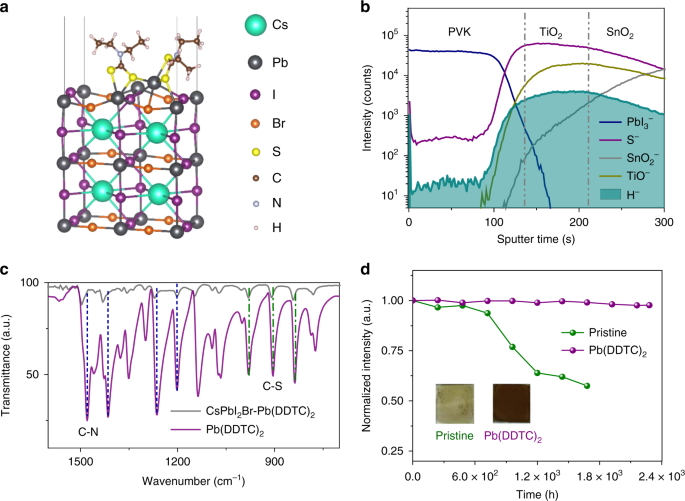
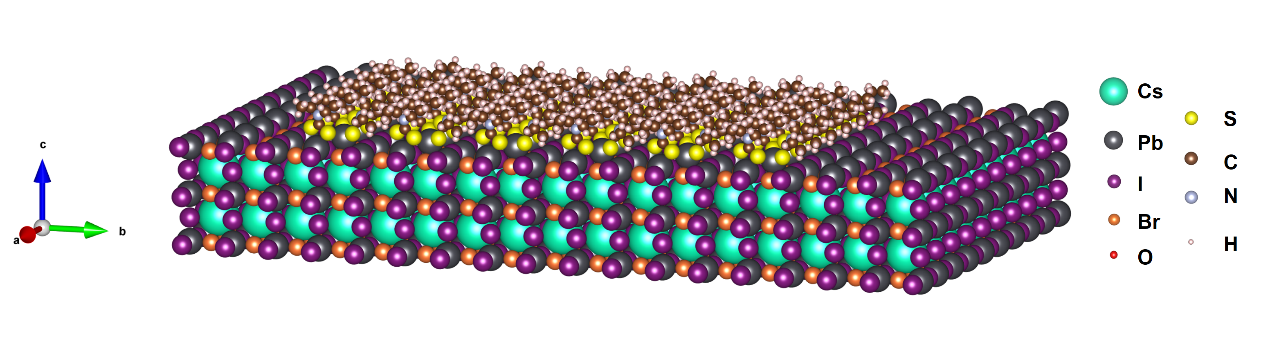
Our research group developed a new type of bonding, i.e., chelation, by using diethyldithiocarbamate (DDTC) molecule as a chelating agent for surface engineering to the CsPbI2Br perovskite (see Fig.1). The dithiocarbamate molecules can be coordinated to surface Pb sites via strong bidentate chelating bonding and form the lead diethyldithiocarbamate (Pb(DDTC)2) molecules. As proved by density functional theory (DFT), the Pb(DDTC)2 has a large adsorption energy of −1.73 eV on the surface, which is about 4-5 times larger than that of prevalent passivation molecules. Such strong chemical bonds between the surface under-coordinated defect and chelating agent enables a reliable passivated perovskite surface with long term stability under various environmental stimuli. Solar cell based on this chelated CsPbI2Br perovskite reaches a champion power conversion efficiency of 17.03%, a large open-circuit voltage of 1.37 V, and most importantly, an excellent device stability that can maintain 98% of its initial efficiency for over 1400 h in ambient condition. We believe that these findings provide scientific insights on the surface engineering of perovskite that can facilitate the further development and application of perovskite optoelectronics.
Please see more details: Nature Communications

Follow the Topic
-
Nature Communications
An open access, multidisciplinary journal dedicated to publishing high-quality research in all areas of the biological, health, physical, chemical and Earth sciences.

Related Collections
With Collections, you can get published faster and increase your visibility.
Women's Health
Publishing Model: Hybrid
Deadline: Ongoing
Tumor Microenvironment Crosstalk and Therapeutic Implications
Publishing Model: Hybrid
Deadline: Nov 02, 2026