Choosing our trade-offs: how Daksha can learn to pinpoint objects
Published in Astronomy

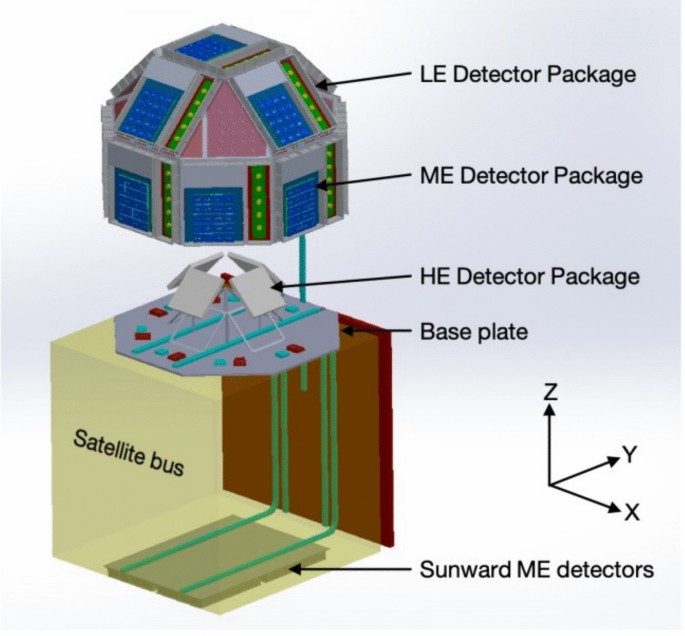

Every space telescope involves design trade-offs, and the real work of building one lies in deciding which of those trade-offs you are simply not willing to make. For Daksha – our proposed pair of satellites to hunt gamma-ray bursts and the electromagnetic counterparts of merging neutron stars – there was one we ruled out from the very beginning. The entire case for building Daksha rests on sensitivity: we want it to be the most sensitive all-sky instrument of its kind ever flown, catching the faint and distant bursts that other missions would never see. That led us to an “open detector” design: detectors pointing in all directions in the sky, with nothing obscuring them. A great many things about the design were open to negotiation, but sensitivity was not one of them.
This left us with a problem we kept circling back to: how could we improve source localisation, without losing sensitivity?
Daksha’s workhorses are Cadmium Zinc Telluride Medium-Energy Detectors – excellent at detecting a burst, but not designed to measure exactly where it came from. At best they can place a burst within a patch some five to ten degrees across. Most optical telescopes see less than a square degree at a time, so using them to chase the fading optical counterpart of a burst with only that information to go on is somewhat like being told your car keys are “somewhere in the house”. And for our most important science case – catching rapidly fading optical “afterglows” of the high-energy explosions – that follow-up is a big part of the game.
An established way to do better is a coded aperture mask, essentially an upgraded version of a pinhole camera: instead of a single hole, you place a carefully designed pattern of opaque and transparent elements above the detector. Every point of the sky corresponds to a unique shadow pattern, allowing us to trace back the source location from data. Many missions have done this beautifully in the past: so why not put such masks on Daksha's medium-energy detectors?
Because of our non-negotiable point: sensitivity. A coded mask works by casting shadows – meaning a substantial fraction of the incoming light is blocked, meaning each source appears “fainter” to us and the faintest sources become undetectable. This was too high a cost to pay for figuring out precise source positions.
What eventually broke the impasse came from looking at the spacecraft as a whole rather than at the medium-energy detectors in isolation. Daksha does not carry a single kind of detector; it carries three. Among them is a set of low-energy detectors sensitive to softer X-rays, making Daksha a genuinely broadband instrument. But these detectors were not being used for any imaging. And most bursts are bright enough that they can light up the soft X-ray band as well.
So the question turned itself around. Rather than asking how to bolt localisation onto our best detectors without ruining them, we began asking whether the low-energy detectors might take on a second role altogether: keep doing their spectroscopy, and also wear a coded mask to deliver sharp positions for the bright bursts, while the medium-energy detectors carry on at full sensitivity catching everything else. Thus, the two subsystems can do individual jobs well, rather than over-straining one and making it worse at both responsibilities.
It would be too easy to call this a free lunch, and the honest part of the story is in the trade-offs that do exist: they simply happen to fall in places we could live with. The localisation only works for bursts bright enough, or soft enough, to register well in the low-energy band; for everything fainter we fall back on the medium-energy detectors and their coarser position, which leaves us no worse off than when we started. The timing on the imaging side is slower. And there is a subtler effect we found genuinely interesting: imaging detectors of this kind are larger and collect more light, which in principle could improve our sensitivity in the soft band: but that is countered by an increased background decreasing the signal-to-noise ratio. And of course, this also increases the system cost.
A good deal of the paper is about turning this idea from a hopeful sketch into something with numbers behind it. Rather than designing a bespoke detector of our own, we looked at what already exists: silicon drift detectors developed for a European-Chinese X-ray timing mission and X-ray cameras built for a NASA CubeSat. We found that they could be accommodated onto the satellite without redesigning it from scratch. Then we did detailed simulations of their imaging abilities – and found that the most promising configuration reaches a localisation of around 0.7 degrees. This is about ten times sharper than where we began, and comfortably within what a follow-up telescope needs to begin its search.
Results of this feasibility study are very encouraging, but practical constraints need to be addressed next. The detectors would still need to be secured through international collaboration or developed at home, and which of those paths we follow is still open.
What is as satisfying as the number itself is the process of how we arrived at it: Daksha gained the ability to point without sacrificing the sensitivity that justified building the mission in the first place. The solution was not to make one detector do everything, but to let each detector do what it does best.
Follow the Topic

Related Collections
With Collections, you can get published faster and increase your visibility.
Earth Moon Mars (EMM) project - Dedicated Collection
Earth–Moon–Mars (EMM) is a project funded under the National Recovery and Resilience Plan (PNRR) aimed at fostering the scientific exploitation of the Moon in Italy. It is based on the idea of using the Moon as a privileged site for observing the Earth and the Universe, while at the same time supporting activities that will prepare for the human exploration of Mars. Click here for the announcement and author instructions.
Publishing Model: Hybrid
Deadline: Oct 01, 2026
The Plato Mission: revealing habitable planets around sun-like stars
Plato (PLAnetary Transits and Oscillations of stars) is the ESA's M3 mission. It will use its 26 cameras to study terrestrial exoplanets in orbits up to the habitable zone of Sun-like stars. Plato will measure the sizes of exoplanets, discover exomoons and even potential rings around them. Plato will also characterise planets' host stars by studying tiny light variations in the starlight it receives. The Plato mission is planned to be launched in Q1 2027. Click here for the Instructions for Authors.
Publishing Model: Hybrid
Deadline: Jul 31, 2026
Please sign in or register for FREE
If you are a registered user on Research Communities by Springer Nature, please sign in