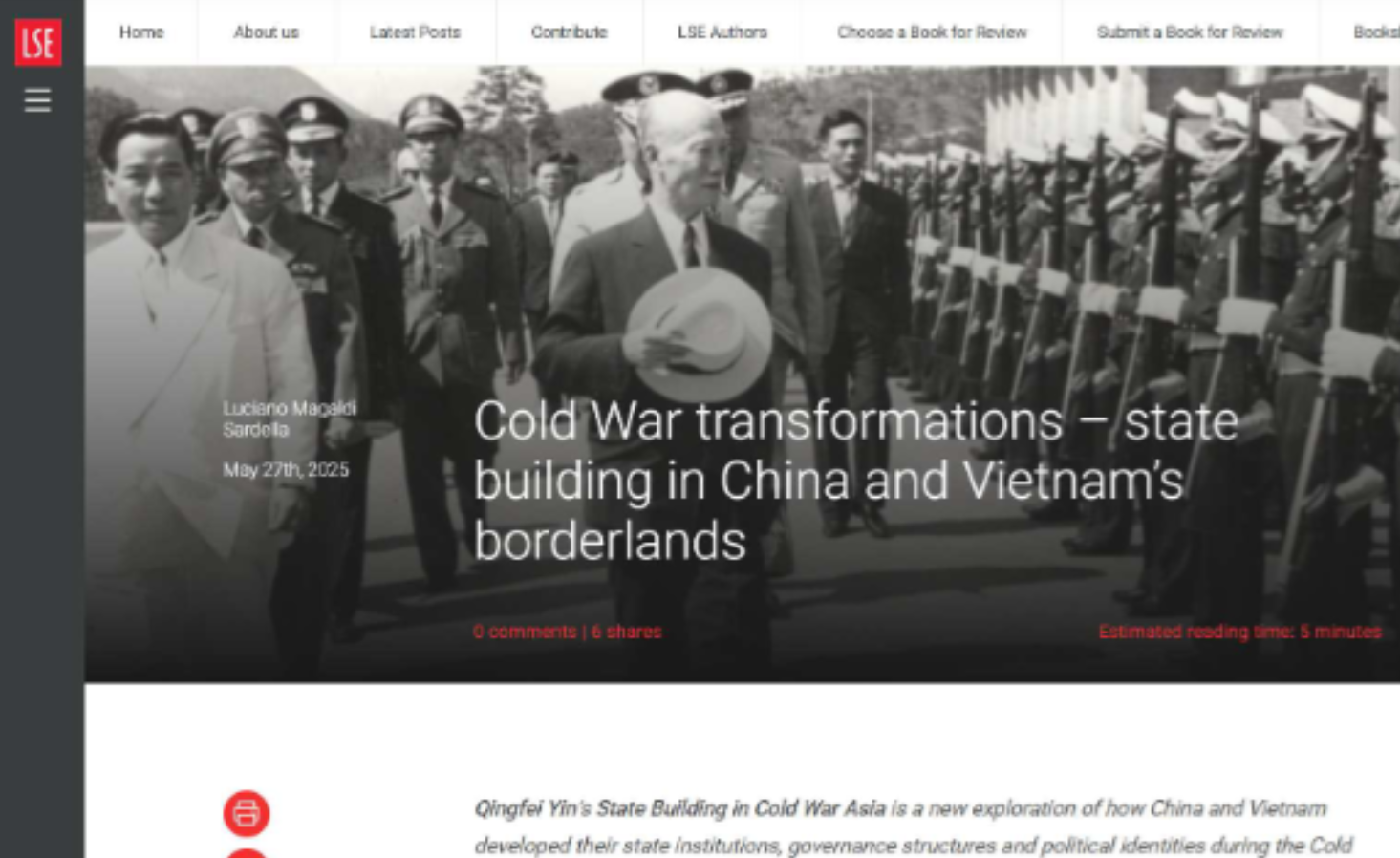
Cold War Transformations: State-Building, Sovereignty and Competition on the Sino-Vietnamese Border (LSE REVIEW OF BOOKS)
Published in Economics and Law, Politics & International Studies
SOURCE: https://doi.org/10.5281/zenodo.17725384
Cold War Asia is often narrated through the grand theatres of superpower rivalry - Korea, Vietnam, the Taiwan Strait - yet borderlands remain among its most revealing vantage points. Yin's archival excavation reorients our understanding of how revolutionary states forged and contested their authority at the margins.
Borderlands as crucible, not periphery
Yin's central intervention is to show that the Sino-Vietnamese frontier was far from peripheral. It emerges as a crucible in which solidarity and rivalry unfolded simultaneously.
This builds on borderland studies scholarship that has challenged methodological nationalism. Van Schendel's work on the Bengal borderland and Baud and van Schendel's framework for borderland studies argue that frontiers are not passive margins but active sites where state power is both projected and refracted. Scott's The Art of Not Being Governed similarly demonstrates how upland Southeast Asia has historically eluded lowland state consolidation, requiring specific technologies of rule.[2005][1997][2009]
Yin shows how both Beijing and Hanoi deployed everyday practices of governance - administrative consolidation, infrastructural expansion, ideological inculcation - that were inseparable from grand strategic imperatives. Building roads, establishing schools, demarcating communes and training cadres were not merely developmental acts; they were performances of sovereignty aimed at securing loyalty among ethnic minority communities such as the Zhuang, Tay and Nung, whose cross-border kinship complicated national belonging.
This echoes Migdal's state-in-society approach, where state formation is not a top-down imposition but a continuous negotiation with local society, and Tilly's dictum that war makes states, here reconfigured as Cold War competition makes borderland states.[2001][1985]
Comrades and competitors: cooperation and antagonism as simultaneity
The book's subtitle, Comrades and Competitors, captures its analytical core. Conventional historiography narrates Sino-Vietnamese relations as sequential: fraternal solidarity during the anti-French and anti-American wars, followed by antagonism culminating in the 1979 border war. Yin unsettles this linear narrative by demonstrating that cooperation and antagonism were simultaneous conditions, coexisting within the same geopolitical space.
Archival evidence from provincial archives in Guangxi and Lang Son reveals intricate choreography. Chinese advisors assisted Vietnamese land reform and border defence in the 1950s, while simultaneously mapping populations and resources for strategic purposes. Vietnamese cadres welcomed aid but resisted administrative models perceived as Sinocentric. Infrastructural projects such as cross-border railways were celebrated as symbols of socialist internationalism yet became sites of contestation over labour, taxation and jurisdiction.
This duality aligns with recent Cold War historiography that emphasises entanglement rather than bipolarity. Works by Chen, Bradley and others on Sino-Vietnamese relations show that socialist internationalism was never purely ideological but instrumental, shaped by security dilemmas and nation-building imperatives. Yin adds a borderland lens, showing how lived realities of local communities refracted broader tensions - smuggling, marriage migration and dual citizenship practices undermined attempts at clear demarcation.
The frontier thus becomes a dynamic theatre where sovereignty was not merely asserted but continuously negotiated and reconstituted, a process Sahlins described for the Pyrenees and Reeves for contemporary Central Asia as the everyday production of border.
Bridging Cold War history, Asian studies and state-building
By bridging Cold War history, Asian studies and theories of state-building, the book offers a compelling tableau of how revolutionary regimes shaped - and were shaped by - their contested peripheries.
For Cold War historians, Yin demonstrates that borderlands were laboratories of statecraft where ideological models were tested. For Asian studies, it provides granular evidence of how Chinese and Vietnamese revolutionary states dealt with ethnic difference, a theme central to Mullaney's work on ethnic classification in China and to Evans on nation-building in Vietnam.
For political science, it contributes to debates on infrastructural power and legibility, showing how roads, household registration and schooling made border populations legible to the state, yet also created new avenues for evasion and negotiation.[Mann][1984][Scott][1998]
Ultimately, the Sino-Vietnamese border stands as emblematic of a paradox at the heart of Cold War Asia: that cooperation and antagonism were not sequential phases but simultaneous conditions. Yin's archival excavation reminds us that to understand state-building, we must look not only to capitals but to the margins where sovereignty is most visibly a work in progress.
References
Baud, M., & van Schendel, W. (1997). Toward a comparative history of borderlands. Journal of World History, 8(2).
Bradley, M. P., & Chen, J. (2021). Rethinking Cold War history in Asia. Journal of Cold War Studies.
Chen, K. C. (1969). Vietnam and China, 1938-1954. Princeton University Press.
Evans, G. (1992). Internal colonialism and ethnic difference in Vietnam. Asian Studies Review.
Mann, M. (1984). The autonomous power of the state. European Journal of Sociology.
Migdal, J. S. (2001). State in Society. Cambridge University Press.
Mullaney, T. (2011). Coming to Terms with the Nation. University of California Press.
Sahlins, P. (1989). Boundaries: The Making of France and Spain in the Pyrenees. University of California Press.
Scott, J. C. (1998). Seeing Like a State. Yale University Press.
Scott, J. C. (2009). The Art of Not Being Governed. Yale University Press.
Tilly, C. (1985). War making and state making. In P. Evans et al. (Eds.), Bringing the State Back In. Cambridge University Press.
van Schendel, W. (2005). The Bengal Borderland. Anthem Press.
Yin, Q. (2024). State Building in Cold War Asia: Comrades and Competitors on the Sino-Vietnamese Border. Cambridge University Press.

- Pluriennal high-tech practictioner at Google Ireland (Dublin), Apple EU Headquarters (Cork), and Amazon Slovakia (Bratislava).
- Alumnus of Aspire Institute, Harvard Business School.
- Current Member of Harvard Aerospace and Defense Alumni Organization (HADAO).
- Former Member of the White House Historical Association (WHHA).
- Former Member of Yale Club of New Haven (YCNH).
- International Journalist with numerous pieces/interviews featured on London Daily News, New York Post, Los Angeles Journal, The Hill, The Washington Post Opinion, Fox News USA, The Associated Press, The Daily Mirror UK, Metro UK, BBC News World Services, AS USA, Yahoo, AOL, MSN, The Scottish Daily Express, The Daily Record Scotland's Champion, L' Essentiel Luxembourg, 20Minuten.ch, NYC Up Magazine, Yale Daily News, The Stanford Daily, The Psychologist, Popular Archeology, Hollywood Beats Magazine, Opera Gazet, Corriere della Sera, Blog L' Espresso-Repubblica "Fino a Prova Contraria", Blog Nicola Porro, Agenda Digitale.
- Contributing Academic Author to the "Stanford Social Innovation Review" at Stanford University.
- Contributing Academic Author to the Faculty of Law B., University of Oxford.
- Contributing Academic Book Critic to the LSE Review of Books with Executive Education Certificate in Communication from the London School of Economics (LSE) and Political Science.
- Alumnus of the Aspire Institute, Harvard Business School.
- Pro PhD and MBA at the European Open University, Germany.
- Open Researcher and Contributor ID (ORCID):
0009-0003-9392-9213
- Web of Science ResearcherID:
OYE-6074-2025
- Google Scholar:
https://scholar.google.com/citations?user=XALdgW8AAAAJ&hl=it
- Zenodo Author Page Profile:
https://zenodo.org/search?q=metadata.creators.person_or_org.name%3A%22Magaldi%20Sardella%2C%20Luciano%22&l=list&p=1&s=10&sort=bestmatch
- Academia.edu Profile: https://cambridge.academia.edu/LucianoMagaldiSardellaPhD
- ResearchGate Profile:
https://www.researchgate.net/profile/Luciano-Magaldi-Sardella