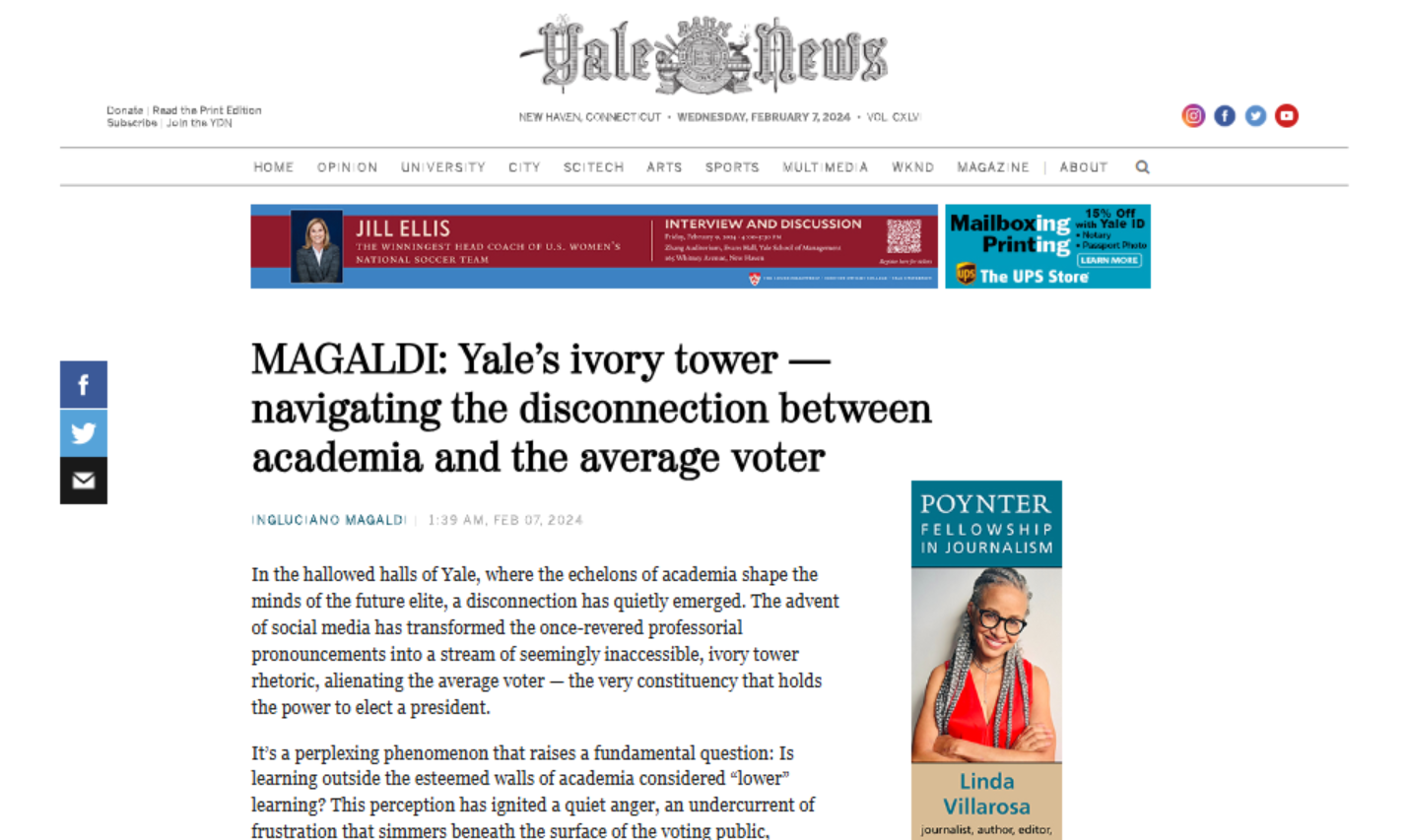
Yale's Ivory Tower? Navigating the Disconnection Between Academic Discourse and the Average Voter (YALE DAILY NEWS - YALE UNIVERSITY)
Published in Education and Law, Politics & International Studies
SOURCE: https://doi.org/10.5281/zenodo.17772300
The fraught relationship between academia and the democratic public has long animated debates about political communication, yet the gulf appears to be widening. This essay examines how the rhetorical habits of elite universities risk estranging scholars from the very citizens whose civic life they seek to illuminate.
Polysyllabic gravitas and the limits of cloistered resonance
The piece contends that professorial discourse at institutions such as Yale - replete with polysyllabic gravitas, theoretical abstraction, and invocations of concepts such as "authoritarianism" - often resounds faintly beyond the cloisters of Linsly-Chittenden Hall.
Research on academic style supports this observation. Hyland and Jiang document a long-term increase in nominalisation and abstraction in humanities and social science writing, which increases precision within specialist communities but reduces readability for non-specialist audiences. Lerchenmueller, Sorenson and Jena find that papers with higher jargon density receive more citations within academia but lower Altmetric attention beyond it.[2021][2019]
When such language fails to translate into registers that are accessible, affectively resonant and public-facing, it risks devolving into sterile echo rather than democratic engagement. This is consistent with what science communication scholars call the transparency paradox: complexity intended to convey nuance can be perceived as evasion or elitism by publics seeking clarity.[Fiske & Dupree, 2015]
Concepts such as "authoritarianism" are analytically valuable, as comparative politics literature shows, but without translational work - concrete examples, historical anchoring and acknowledgement of lived experience - they remain distant abstractions for average voters.
The asymmetry with populist communication
Meanwhile, populist communicators marshal emotive imagery, patriotic tableaux and sentimental resonance with devastating effectiveness. Their rhetorical arsenal speaks directly to the public imagination, shaping perceptions and mobilising sentiment in ways that academic discourse seldom achieves.
This contrast reveals a structural asymmetry well-documented in political communication.
Moffitt's work on populist style defines it as performative: emphasis on direct appeal, crisis narrative and visual symbols that create immediate identification. Mudde and Kaltwasser show that populism thrives on a moral dichotomy between people and elite, where academic language can be framed as evidence of elite detachment.[2017]
Research on affective polarisation [Iyengar et al., 2019] and narrative persuasion demonstrates that emotionally resonant, story-based messaging is more memorable and mobilising than abstract analysis. Citizens do not process political information solely through systematic evaluation; they use heuristic cues including warmth, relatability and shared identity, as described in dual-process models of persuasion.[Dahlstrom][2014]
The result is not that voters are anti-intellectual per se, but that intellectual rigour alone cannot secure civic relevance without rhetorical inclusivity. Experimental studies on elite cues [Zaller, 1992; Druckman et al., 2013] show that source perceptions shape message uptake: when scholars are perceived as culturally distant, even accurate information is discounted.
Why the simmering disaffection matters
The essay issues a clear admonition. Unless scholars learn to translate their rarefied idiom into language that is both rigorous and relatable, they risk remaining ensconced in an ivory tower of irrelevance - imperilling their civic mission and forfeiting their capacity to contribute meaningfully to democratic life.
This is more than a public relations concern. Gauchat's analysis of trust in science shows that perceived cultural distance predicts declining trust more strongly than educational attainment. Pew data on confidence in higher education indicates that the electorate's simmering disaffection, if left unaddressed, may harden into repudiation of scholarly authority itself, with consequences for evidence-based policy in public health, climate and governance.[2012]
Recalibration, not dilution
Ultimately, bridging this divide requires not a dilution of intellectual substance but a recalibration of communicative strategy.
Science communication research offers actionable models:
1. Translational rigour. Preserve analytical precision in specialist outputs while developing plain-language companion pieces, a practice shown to increase public engagement without reducing perceived competence.
2. Narrative grounding. Anchor abstract concepts like authoritarianism in concrete institutional behaviours and lived consequences, as recommended by research on explanatory frames.
3. Dialogic presence. Move beyond dissemination toward community-based dialogue, where scholars listen as well as speak, improving both trust and research relevance.
Academia must reconcile analytical precision with emotional resonance if it is to speak compellingly to the public it serves - not by mimicking populist affect, but by combining competence with warmth, the two dimensions Fiske and Dupree identify as central to credibility.
References
Dahlstrom, M. F. (2014). Using narratives to communicate science. PNAS, 111(4).
Druckman, J. N., et al. (2013). How elite partisan polarization affects public opinion. American Political Science Review, 107(1).
Fiske, S. T., & Dupree, C. (2015). Gaining trust as well as respect in communicating to motivated audiences. PNAS, 112(5).
Gauchat, G. (2012). Politicization of science in the public sphere. American Sociological Review, 77(2).
Hyland, K., & Jiang, F. (2021). Academic discourse and the loss of public relevance. Journal of English for Academic Purposes.
Iyengar, S., et al. (2019). The origins and consequences of affective polarization. Annual Review of Political Science, 22.
Lerchenmueller, M. J., Sorenson, O., & Jena, A. B. (2019). Gender differences in academic publishing. BMJ.
Moffitt, B. (2017). The Global Rise of Populism. Stanford University Press.
Mudde, C., & Kaltwasser, C. R. (2017). Populism: A Very Short Introduction. Oxford University Press.
Zaller, J. R. (1992). The Nature and Origins of Mass Opinion. Cambridge University Press.

- Pluriennal high-tech practictioner at Google Ireland (Dublin), Apple EU Headquarters (Cork), and Amazon Slovakia (Bratislava).
- Alumnus of Aspire Institute, Harvard Business School.
- Current Member of Harvard Aerospace and Defense Alumni Organization (HADAO).
- Former Member of the White House Historical Association (WHHA).
- Former Member of Yale Club of New Haven (YCNH).
- International Journalist with numerous pieces/interviews featured on London Daily News, New York Post, Los Angeles Journal, The Hill, The Washington Post Opinion, Fox News USA, The Associated Press, The Daily Mirror UK, Metro UK, BBC News World Services, AS USA, Yahoo, AOL, MSN, The Scottish Daily Express, The Daily Record Scotland's Champion, L' Essentiel Luxembourg, 20Minuten.ch, NYC Up Magazine, Yale Daily News, The Stanford Daily, The Psychologist, Popular Archeology, Hollywood Beats Magazine, Opera Gazet, Corriere della Sera, Blog L' Espresso-Repubblica "Fino a Prova Contraria", Blog Nicola Porro, Agenda Digitale.
- Contributing Academic Author to the "Stanford Social Innovation Review" at Stanford University.
- Contributing Academic Author to the Faculty of Law B., University of Oxford.
- Contributing Academic Book Critic to the LSE Review of Books with Executive Education Certificate in Communication from the London School of Economics (LSE) and Political Science.
- Alumnus of the Aspire Institute, Harvard Business School.
- Pro PhD and MBA at the European Open University, Germany.
- Open Researcher and Contributor ID (ORCID):
0009-0003-9392-9213
- Web of Science ResearcherID:
OYE-6074-2025
- Google Scholar:
https://scholar.google.com/citations?user=XALdgW8AAAAJ&hl=it
- Zenodo Author Page Profile:
https://zenodo.org/search?q=metadata.creators.person_or_org.name%3A%22Magaldi%20Sardella%2C%20Luciano%22&l=list&p=1&s=10&sort=bestmatch
- Academia.edu Profile: https://cambridge.academia.edu/LucianoMagaldiSardellaPhD
- ResearchGate Profile:
https://www.researchgate.net/profile/Luciano-Magaldi-Sardella