Competitive Intelligence as a Dynamic Capability for Organizational Resilience

In an era of hypercompetition, shocks are no longer exceptions. They are the operating condition. Our recent open-access paper in Review of Managerial Science proposes a conceptual shift that may be useful for scholars working on strategy, intelligence, resilience, and dynamic capabilities.

Published in Business & Management

Like

Share this post

Choose a social network to share with, or copy the URL to share elsewhere

This is a representation of how your post may appear on social media. The actual post will vary between social networks

Explore the Research

SpringerLink
SpringerLink SpringerLink

Fostering organizational resilience in the age of hypercompetition: unpacking the role of competitive intelligence through the dynamic capabilities view - Review of Managerial Science

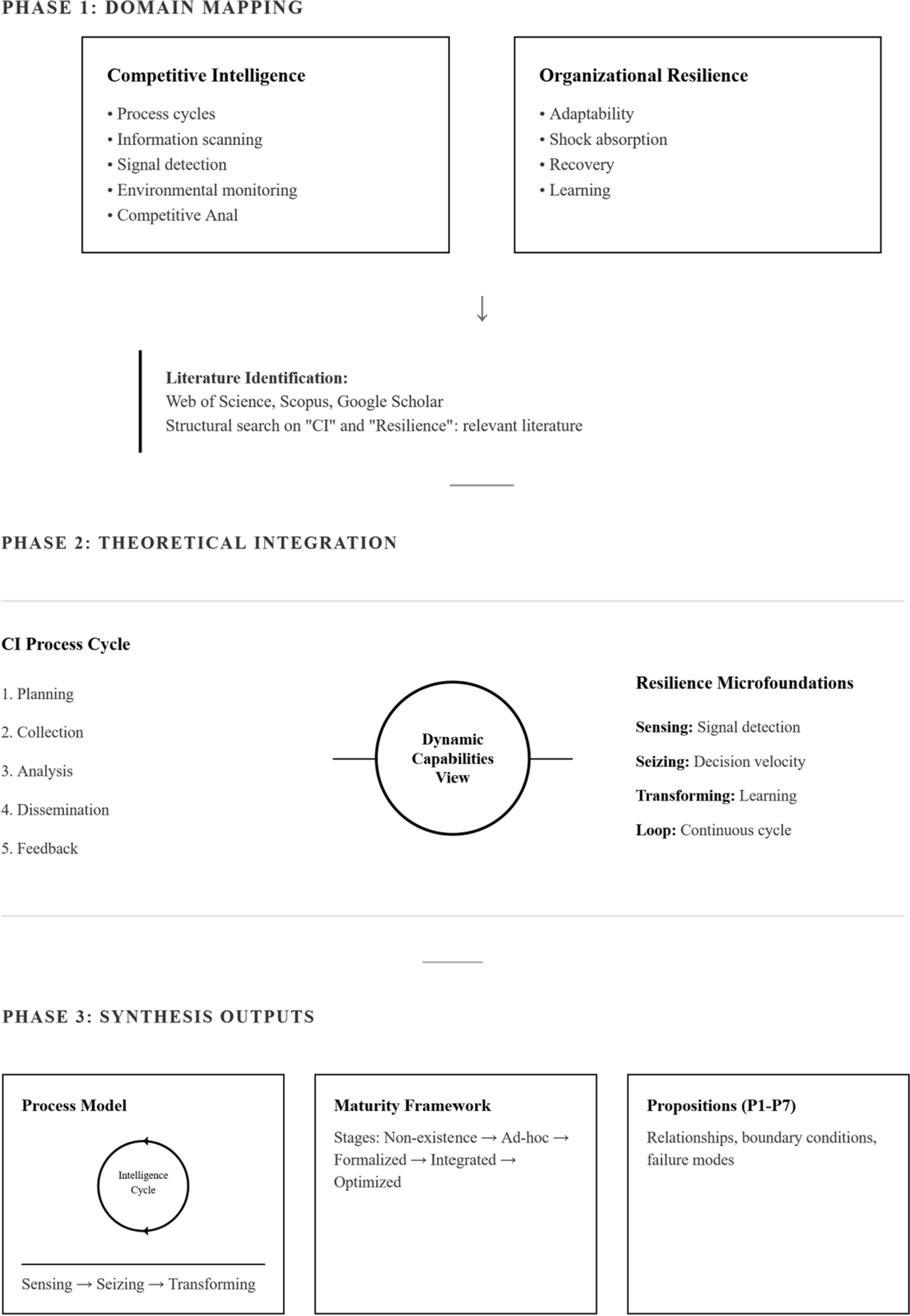
This paper examines the intersection of competitive intelligence (CI) and organizational resilience (OR) through a incremental conceptual framework grounded in the Dynamic Capabilities View (DCV). We reconceptualize the CI process not as a linear function, but as a core organizational dynamic capability that enhances a firm’s ability to withstand and adapt to external disruptions. We argue that CI operationalizes the three core functions of dynamic capabilities: (1) Sensing external threats and opportunities, (2) Seizing strategic advantages through informed decision-making, and (3) Transforming the organization’s resource base through continuous learning. The research presents a comprehensive maturity model that delineates six distinct stages of CI capability development, from non-existence to complexity, providing a developmental path for strengthening these resilience-enhancing capabilities. The paper also introduces a quantifiable assessment methodology that utilizes Likert-scale metrics to evaluate an organization’s CI maturity. Despite limitations regarding cultural and resource constraints, this study provides a robust theoretical foundation for future empirical investigation. The framework developed herein demonstrates particular utility for managers seeking to build a systematic, capabilities-based approach to fostering resilience in the face of market volatility and exogenous shocks.

Instead of treating competitive intelligence (CI) as a linear information pipeline and organizational resilience (OR) as a post-crisis outcome, we reconceptualize CI as a core dynamic capability that continuously enables organizations to sense, seize, and transform in response to external change.

Grounded in the Dynamic Capabilities View, the paper contributes three elements that may be relevant for both theory building and empirical work:

First, a process model that maps CI phases directly onto sensing, seizing, and transforming mechanisms, emphasizing feedback and learning rather than static recovery.

Second, a CI maturity model that frames intelligence development as a non-linear capability trajectory, including risks of regression, maladaptation, and “efficient fragility.”

Third, a quantifiable assessment framework using Likert-scale indicators that can support future empirical validation across organizational contexts.

We see this work as an invitation rather than a closure. It opens space for empirical testing, cross-cultural comparison, and integration with emerging AI-supported intelligence systems.

The full paper is openly available.

We welcome discussion, critique, and collaboration from the academic community.

Please sign in or register for FREE

If you are a registered user on Research Communities by Springer Nature, please sign in