Constrained chaos in the pathobiome of a new slow spreading coral disease
Published in Microbiology



In the latest recorded mass-bleaching event (2017-2018), 15,000 km2 of reef area were impacted - an area larger than a football field for every visitor of the English premier league in these years. If we are to put an economic value on this devastation, it is estimated that that bleaching event alone cost the world in excess of US$1.5-9 billion of ecological services, not to mention the biodiversity loss in various locations around the world.
It is now widely agreed that if reefs are to stand a chance in the coming century, we have to limit the production of greenhouse gases, restricting the warming of sea surface temperatures. But, it is not only high temperature - causing heat stress and subsequent coral bleaching - we have to worry about. Often reefs collapse due to the interaction of multiple stressors. The preacher might speak of the apocalyptic riders of coral reef destruction. Besides heat-stress, these are habitat degradation, nutrient pollution and on its pale horse coral disease.
Especially the combination of heat-stress and disease has proven to be fatal. Often corals can recover from heat-stress and subsequent bleaching, which does not automatically lead to their death. But, bleaching weakens their immune defence, which makes them susceptible to diseases, such as white syndrome or black-band disease and diseases can wipe out entire reefs after bleaching events.
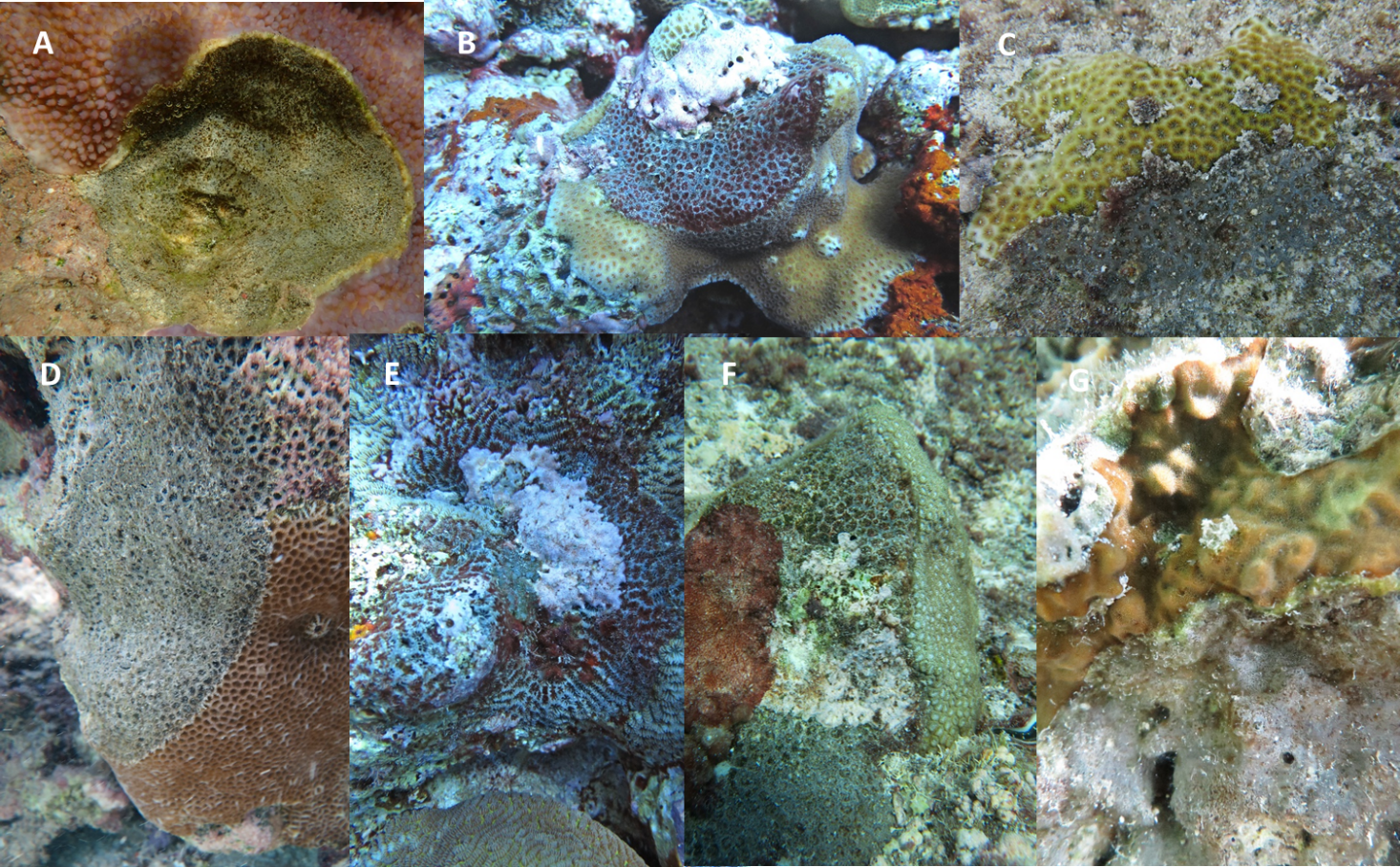
Many of the coral diseases known to date exhibit rapid rates of infection and disease progression. The new coral disease, which we described in our study (https://microbiomejournal.biomedcentral.com/articles/10.1186/s40168-019-0759-6) shows that despite a number of similarities with other diseases, grey patch disease shows surprisingly slow progression rates and a relative low virulence. This slow infection process provided us with the opportunity to investigate infection dynamics between disease and the coral host in much greater detail than it has been done before. And what we found was a microbial battle field.
Corals are characterised by a relatively simple level of cellular organisation. But they build relationships with algae and bacteria of fascinating complexity. This turns them into what is being dubbed as a meta-organism, with their own microbiome representing a rich assembly of algae, viruses, fungi, bacteria and protists. When a coral gets exposed to a disease, the pathogens first have to compete with the ‘smaller’ players in the coral meta-organism before they can establish themselves and destroy the coral tissue.
We have shown that in the case of the grey patch disease, the process of overcoming the coral defences and disrupting its microbiome is the work of several interacting pathogenic microbes. Histological analyses of coral tissues and electron microscopy revealed that specific fungi and cyanobacteria grow together below the coral surface and undermine coral tissue close to the skeleton. At the same time, small coccoid bacteria and ciliates drill into coral tissue and launch a surface attack.
Nevertheless, the coral meta-organism (also referred to as the ‘holobiont’) is able to fight back. Across two field seasons, we observed the dynamics of disease patches on affected corals. And while some of the disease patches progressed, the lesions in other corals stopped and healthy tissue was able to grow back, recolonizing the corals white skeleton. Making these observations was indeed like observing a microbial battlefield between two alternative communities and a moving front line.
Further in depth assessments of the microbial community structure, showed us that different disease patches were surprisingly (and in contrast to current ecological theory) very similar to each other. We believe that this similarity can be explained by the tight competition between the coral meta-organism and the disease benefiting microbial community. Only when a certain assemblage of collaborating pathogenic microbes is present, they can compete against the coral. If some of these agents are lost, however, the coral can win the battle, recolonizing previously lost terrain.
From the perspective of a coral, being infected by grey patch disease may actually be not all that bad, that is in comparison to other more deadly diseases such as the one spreading fast through the Caribbean as we speak (Stony Coral Tissue Loss Disease). The question now is whether we can use this knowledge to help corals affected by these other diseases. For example, black-band disease, which has rapid outbreaks and causes high rates of coral loss, is remarkably similar to our newly discovered disease and known to be caused by a similar consortium of pathogens. If we inflict a disruption on the disease loving microbial communities, maybe we will be able to decrease their virulence and aid the coral in its micro war. Indeed, the use of probiotics (aka the good bacteria) has been proposed as one way to fight the onslaught of factors affecting our reefs around the world. In this instance, inoculation with good bacteria would at the very least slow down the apocalyptic tandem of heat-stress and coral disease.
Follow the Topic
-
Microbiome
This journal hopes to integrate researchers with common scientific objectives across a broad cross-section of sub-disciplines within microbial ecology. It covers studies of microbiomes colonizing humans, animals, plants or the environment, both built and natural or manipulated, as in agriculture.

Related Collections
With Collections, you can get published faster and increase your visibility.
Oncobiome
This collection of papers delves into the burgeoning field of oncobiome research, exploring the intricate relationship between cancer and the microbiome. The oncobiome encompasses the diverse microbial communities residing in and on the human body, which influence cancer development, progression, and treatment responses. By examining these interactions, our aim is to unravel the complex mechanisms through which the microbiome impacts oncogenesis and therapeutic outcomes.
This compilation highlights cutting-edge research, offering insights into potential diagnostic markers and novel therapeutic strategies, thereby advancing our understanding of cancer biology and paving the way for innovative, microbiome-targeted cancer treatments.
This is a cross-journal collection between:
Experimental Hematology and Oncology
Articles will undergo the standard peer-review process of the journal to which they are submitted and are subject to either the BMC editorial policies or those of BJC Reports. Articles will be added to the Collection as they are published. The Editors have no competing interests with the submissions which they handle through the peer review process. The peer review of any submissions for which the Editors have competing interests is handled by another Editorial Board Member who has no competing interests.
Publishing Model: Open Access
Deadline: Ongoing
The Apple Microbiome
Microbiome and Environmental Microbiome are calling for submissions to our Collection on the Apple Microbiome.
With world apple production estimated at 84 million tons, the microbiome of the apple has significant implications for agriculture, food security, and human health. Understanding the complex interactions between apple plants and their associated microbial communities can lead to improved crop management strategies, enhanced fruit quality and longevity, and sustainable agricultural practices. Recent advances have highlighted the role of specific bacteria and fungi in promoting plant health and resilience against specific pathogens. Moreover, detailed profiling of these microbial communities, revealing their diversity and functional potential facilitate exciting future developments, such as the identification of beneficial microbial consortia for biocontrol and the formulation of tailored probiotic treatments for both plants and humans. By advancing our collective understanding in this area, we can work towards a more sustainable and resilient agricultural system.
Topics of interest include but are not limited to:
-Microbial diversity and function associated with apples
-Effects of soil health and rhizosphere interactions on apple production
-Impact of climate change on the apple microbiome
-Role of the apple microbiome in fruit quality
-Microbiome-driven strategies for disease resistance
This collection is open for submissions from all authors on the condition that the manuscript falls within both the scope of the collection and the journal it is submitted to.
All submissions in this collection undergo the relevant journal’s standard peer review process. Similarly, all manuscripts authored by a Guest Editor(s) will be handled by the Editor-in-Chief of the relevant journal. As an open access publication, participating journals levy an article processing fee (Microbiome, Environmental Microbiome). We recognize that many key stakeholders may not have access to such resources and are committed to supporting participation in this issue wherever resources are a barrier. For more information about what support may be available, please visit OA funding and support, or email OAfundingpolicy@springernature.com or the Editor-in-Chief of the journal where the article is being submitted.
Publishing Model: Open Access
Deadline: Sep 30, 2026