Constraining high-emission future West African monsoon with physics-weighted deep learning ensembles
Published in Earth & Environment
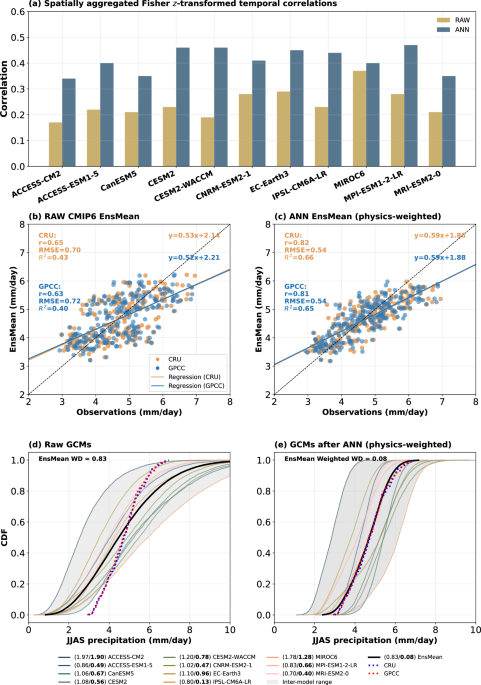

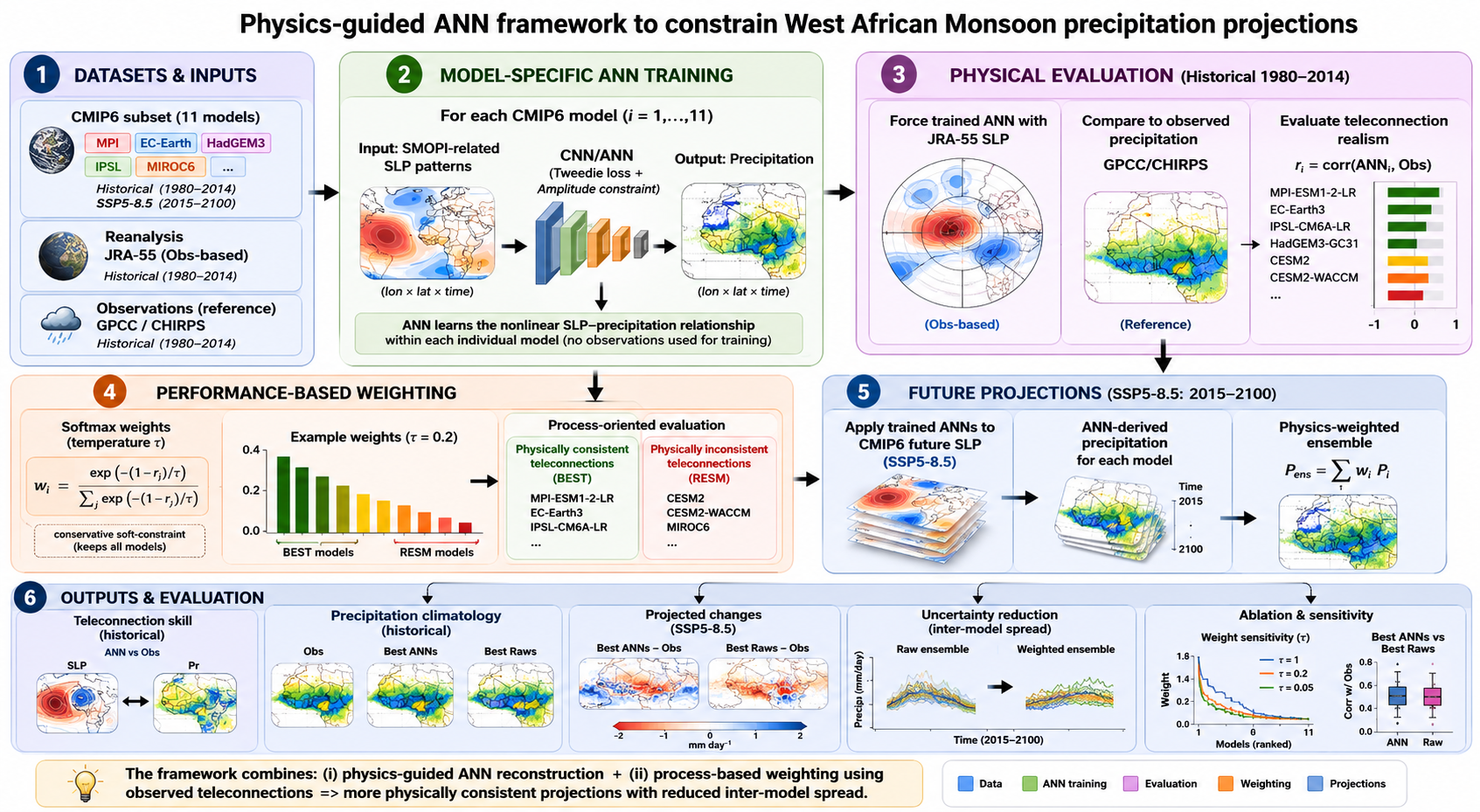
Using CMIP6 precipitation projections, sea-level pressure patterns and JRA-55 reanalysis datasets from 1958 to 2100, we provide evidence that the large inter-model spread in future West African monsoon rainfall under high-emission scenarios is due to climate model biases in large-scale circulation. We propose a physics-guided artificial neural network (ANN) method, governed by an amplitude-preserving constraint, which describes the nonlinear relationships between Sahelian monsoon ocean-pressure index (SMOPI) circulation patterns and regional precipitation. While climate model biases were the trigger for the large inter-model spread, up-weighting physically consistent models and down-weighting less reliable ones reinforces the performance-based weighted ensemble. Due to more realistic learned teleconnections, high-skill models reduce end-of-century spread by 20%, while lower-skill models shift by 33%. Our study suggests that this physics-weighted deep-learning architecture delivers more coherent projections, with minimal contribution from less reliable models and without collapsing ensemble diversity. This regime-shift approach offers a promising perspective for delivering computationally affordable pathways to robust climate information to support climate services in data-limited regions.

Please sign in or register for FREE
If you are a registered user on Research Communities by Springer Nature, please sign in