Constructing Intrinsically Safe Lithium‑Ion Battery Energy Storage via Gradient‑Laminated Ceramifiable Silicone Foams
Published in Materials

As the global transition toward carbon neutrality accelerates and energy storage infrastructures scale rapidly, lithium-ion batteries have become the cornerstone technology for renewable energy storage and electric vehicle proliferation. However, as battery systems push toward higher energy densities, the catastrophic risks of thermal runaway propagation (TRP)—characterized by ultrahigh-temperature gas jets exceeding 800°C, ejection velocities surpassing 200 m s-1, and explosive secondary combustion—have escalated markedly, posing severe threats to entire battery modules and energy storage power stations. Now, researchers from China University of Petroleum-Beijing and the China Academy of Safety Science and Technology, led by Professor Congling Shi, Professor Laibin Zhang, and their collaborators including Shuilai Qiu and Jingyao Xu, have presented a breakthrough gradient-laminated thermal protection composite that bridges the gap between passive insulation and dynamic impact resistance.
Why This Material Matters
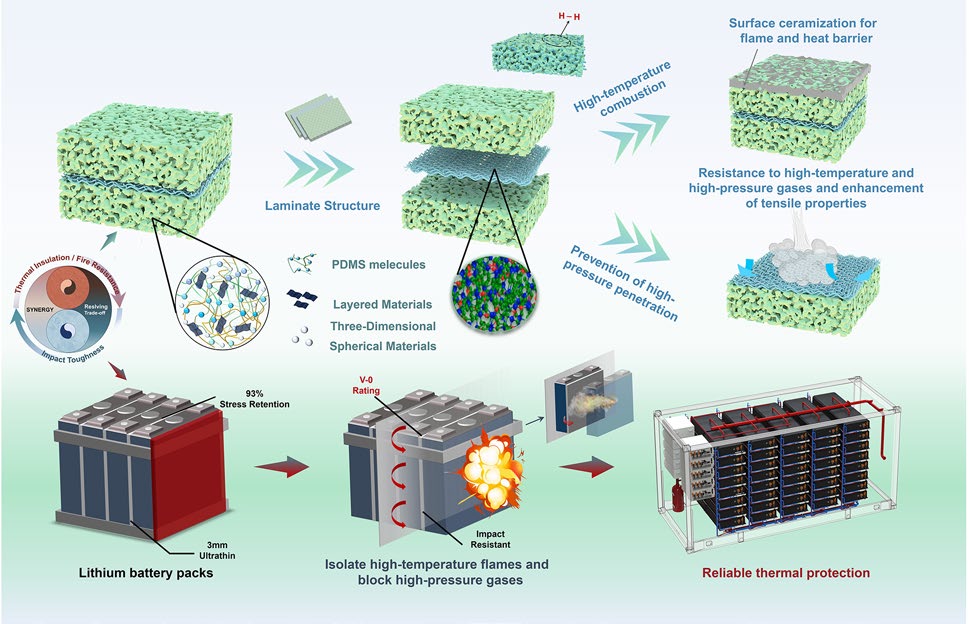
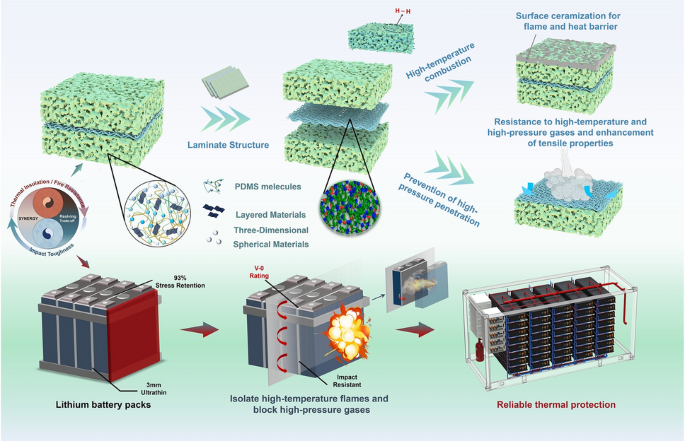
Traditional thermal insulation materials typically suffer from an intrinsic trade-off: organic foams like polyurethane and polystyrene offer low thermal conductivity but collapse catastrophically above 300°C, while inorganic fibrous materials provide fire resistance yet disintegrate under high-velocity gas jet impingement. The novel gradient-laminated ceramifiable silicone foam composite overcomes this universal dilemma by combining a flexible polydimethylsiloxane (PDMS) foam matrix with a load-bearing glass fiber fabric (GFF) skeleton, achieving both exceptional thermal insulation and robust mechanical durability under extreme coupled "high-temperature–high-pressure" conditions.
Innovative Design and Mechanism
The material is fabricated via a scalable reactive chemical foaming technique, where the silicone matrix tightly impregnates the interstices of the silane-modified GFF during foaming. This structural integration, combined with the inherently high tensile strength of the glass fibers (70–85 GPa), forms a robust secondary physical barrier. Multiscale functional fillers—including ammonium polyphosphate (APP), zinc borate (ZB), kaolin, and silica aerogel—activate a synergistic ceramification mechanism: upon exposure to elevated temperatures, flame retardants release inert gases and facilitate char layer formation, while kaolin and aerogel undergo liquid-phase sintering to generate a dense ceramic barrier composed of α-Zn₃(PO₄)₂ glassy phases and SiO₂ frameworks. The GFF interlayer serves as a mechanical firewall that resists high-pressure gas jet penetration even when one side is compromised.
Outstanding Performance
The optimized SF/GFFAPP-ZB-Aero-Kao composite delivers exceptional mechanical durability, maintaining stable elasticity across an ultrawide temperature range from −40°C to 300°C and retaining 93% residual stress after 1,000 compression cycles. Its thermal conductivity is reduced to 0.046 W m-1 K-1—approximately 50% lower than pristine silicone foam—enabling superior thermal insulation. Under extreme fire exposure, the foam transforms into a dense ceramic barrier, reducing total heat release by 54.4% and smoke production by 87.9%, while sustaining thermal protection for over 30 minutes at approximately 1,100°C. The material achieves a high limiting oxygen index of 33.5% and passes the UL-94 V-0 rating.
Applications and Future Outlook
When deployed in practical lithium-ion battery module testing with commercial 37 Ah prismatic cells, the 3 mm ultra-thin composite efficiently intercepts high-velocity gas jets and confines thermal runaway to a single cell, successfully preventing cascading failure across the entire module. In direct comparison, unprotected modules experienced full TRP within seconds, while modules insulated with conventional silicone foam merely delayed propagation. The composite's intrinsic conformability and adhesiveness ensure intimate contact with aluminum cell casings, eliminating interfacial air gaps and reducing thermal contact resistance. Fabricated via a scalable process inherently compatible with industrial roll-to-roll manufacturing, this composite paves a highly viable way for constructing intrinsically safe, next-generation energy storage power stations.
Stay tuned for more groundbreaking research from this collaborative team at China University of Petroleum-Beijing and the China Academy of Safety Science and Technology!

Editor of Nano-Micro Letters, which is an Open-Access, peer-reviewed journal reported papers that have at least one dimension ranging from a few sub-nanometers to a few hundreds of micrometers. The journal is published by Springer Nature and indexed by SCI, EI, SCOPUS, Pubmed, etc. The 2025 JCR Impact Factor is 38.5. The 2025 CiteScore is 58.9.
Follow the Topic
-
Nano-Micro Letters
Nano-Micro Letters is a peer-reviewed, international, interdisciplinary and open-access journal that focus on science, experiments, engineering, technologies and applications of nano- or microscale structure and system in physics, chemistry, biology, material science, and pharmacy.