Content analysis of HIV self-testing education on TikTok
Published in Research Data




When you think of TikTok, what comes to mind? Dance challenges, trending memes, quick laughs? Increasingly, it has also become a space where young people look for information about their health. For millions of people who may never pick up a medical textbook or sit through a lecture, platforms like TikTok are where they first hear about issues like mental health, contraception, or HIV. But what happens when life-saving information on these platforms is incomplete, misleading, or simply wrong? That was the question behind our recent study on HIV self-testing content on TikTok.
HIV self-testing, often called HIVST, is a relatively new approach recommended by the World Health Organization since 2016. It allows people to collect their own sample, either blood from a finger prick or oral fluid, carry out the test privately, and read the result on their own. This shift is crucial because too many people worldwide still do not know their HIV status, which prevents them from accessing treatment and increases the risk of unknowingly transmitting the virus to others. Self-testing is meant to break down barriers of stigma, distance, and confidentiality, making it easier for people to know their status. Yet, for self-testing to fulfill this promise, people must have clear, accurate, and trustworthy guidance on how to use the kits and what steps to take afterward.
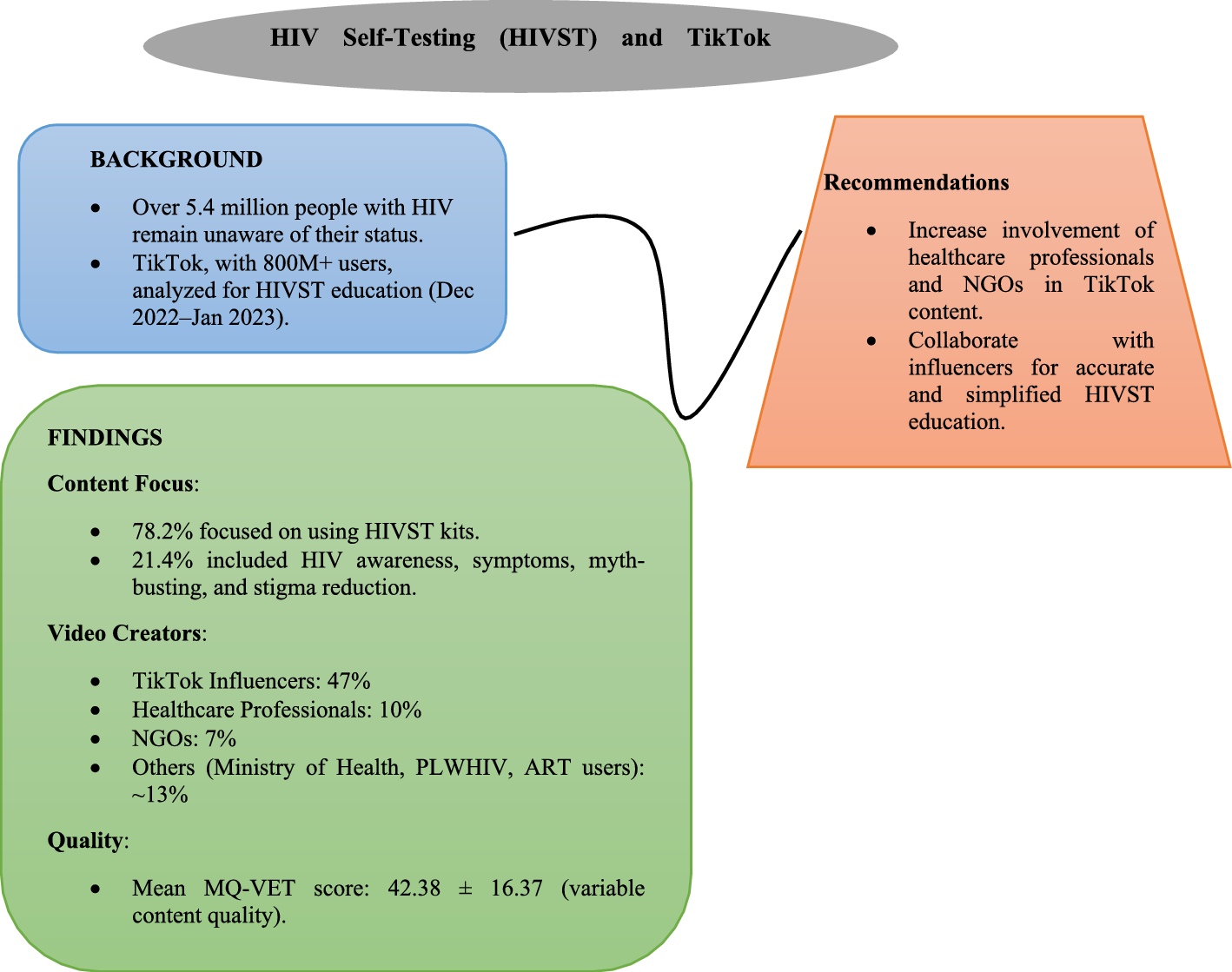
Our research, published in Discover Public Health, set out to examine exactly what people encounter when they search TikTok for HIV self-testing education. Between late December 2022 and early January 2023, we screened over one hundred videos using search terms such as “HIV self-testing,” “HIV,” “HIV awareness,” and similar hashtags. After excluding non-English and irrelevant content, we analyzed 78 videos that claimed to offer some form of HIV self-testing education. To judge their quality, we used a standard tool called the Medical Quality Video Evaluation Tool, or MQ-VET, which looks at dimensions like clarity, accuracy, comprehensiveness, and production quality.
We also examined the creators of these videos being uploaded on TikTok. The majority came from influencers and general TikTok users, accounting for nearly half of all the content. Health professionals, NGOs, and ministries of health were far less visible, posting only a handful of videos between them. Interestingly, the type of uploader did not seem to predict whether a video was high-quality or not; some influencers did a reasonable job, while some professionals did not meet the mark. Still, the imbalance shows that the people and institutions most qualified to provide accurate health information are underrepresented on the platform.
Out of the 78 TikTok videos analyzed, four out of every five videos concentrated on instructions to use the kits, but only one in five went further to address issues like why testing matters, how to cope with stigma, or what steps to take after a positive result. That means a large portion of the TikTok audience is being shown how to use a kit but not necessarily being equipped with the context or next steps that are just as important.
Even more concerning was the overall quality of the videos. On the MQ-VET scale, the average score was just 42 out of 100. In other words, most videos fall in the weak- to low-quality range. A video that looks slick, entertaining, and trustworthy can still miss critical information. Inaccurate or incomplete guidance in this case is not just a small mistake; it could leave someone without proper follow-up, unsure of their result, or unaware of where to seek help.
The reach of these videos also varied dramatically. Altogether, the 78 videos we studied had been viewed more than 166,000 times, with some individual posts reaching tens of thousands of viewers. That level of reach is powerful; if accurate content goes viral, it could play a significant role in bridging the HIV diagnosis gap. But if low-quality content is amplified instead, it risks spreading confusion or giving people a false sense of security.
So what does this mean for the future of HIV self-testing education online? First, it highlights the urgent need for healthcare professionals, researchers, NGOs, and ministries to step into these spaces more boldly. If influencers are already shaping the conversation, why not collaborate with them to produce videos that are both engaging and medically sound? TikTok thrives on creativity storytelling, humor, trends, and short, relatable content, yet those formats can be adapted to carry accurate, impactful messages about health.
Second, it is not enough to simply upload accurate videos. They must be designed to compete within TikTok’s algorithm, which rewards engagement rather than accuracy. That means producing content that is visually appealing, easy to understand, emotionally resonant, and aligned with the way TikTok users consume media. Otherwise, even the best content may remain invisible.
Finally, this study raises bigger questions about how social media platforms handle health information. Should platforms like TikTok work with health authorities to certify or highlight reliable sources? Could there be badges or labels to help viewers distinguish between casual commentary and medically verified content? These are policy questions that go beyond individual creators but are essential if we want to make social media a safer place for health education.

Follow the Topic
-
Discover Public Health
This is an open access journal publishing research from all fields relevant to public health.

Related Collections
With Collections, you can get published faster and increase your visibility.
The Economics of Longevity: Health Expenditure and Societal Implications for Public Health Systems
The relationship between health investment and life expectancy has long been a focal point in public health research and policy. As nations grapple with rising healthcare costs and varying health outcomes, understanding how financial allocations influence population health becomes increasingly critical. Numerous studies have illustrated that increased spending on health services often correlates with improvements in life expectancy; however, the complexities of this relationship are not fully understood. Factors such as socioeconomic status, healthcare accessibility, and the efficiency of health systems play significant roles in determining how investments translate into health outcomes.
At the national level, health investments primarily encompass government expenditure on healthcare systems, public health initiatives, and health infrastructure. Nations that allocate substantial resources toward healthcare often experience better health outcomes and increased life expectancy among their populations. For instance, countries with robust healthcare funding tend to provide more comprehensive services, including preventive care, chronic disease management, and health promotion programs, all of which contribute to enhanced population health. However, it is crucial to consider how these investments are distributed across different segments of the population. Inequities in health spending can exacerbate existing disparities, leading to significant differences in life expectancy among various demographic groups. Effective health investment strategies must address these disparities to ensure that improvements in life expectancy are equitable and inclusive.
The motivation for this Collection arises from the urgent need to bridge the gap between health expenditures and tangible improvements in life expectancy. Recent global health crises and ongoing disparities in health outcomes across different populations have underscored the necessity for a deeper exploration of how resource allocation affects health dynamics. This Collection seeks to provide a platform for researchers and practitioners to discuss empirical evidence, theoretical frameworks, and innovative approaches to understanding these critical interactions. By fostering dialogue around effective health investment strategies, we aim to contribute to the development of more equitable and efficient health systems worldwide.
The purpose of this Collection is to gather comprehensive research that elucidates the dynamics between health investment and life expectancy across diverse contexts. We welcome contributions that analyze historical trends, comparative studies, and policy evaluations, as well as those that explore the implications of financial investments on health equity. By highlighting interdisciplinary perspectives and fostering collaboration, this Collection aspires to advance the discourse on optimizing health investments for improved population health outcomes.
Topics of interest include, but are not limited to:
- Economic evaluations of health interventions
- Policy impacts on health spending and life expectancy
- Health equity and investment disparities
- Longitudinal studies on health expenditures and population health
This Collection supports and amplifies research related to SDG 3.
Keywords: health expenditure; healthcare economics; life expectancy; economic evaluation; population health; health investment; health policy
Publishing Model: Open Access
Deadline: Dec 31, 2026
Digital Frontiers in Public Health: Data-driven Solutions and Technologies for Efficiency, Effectiveness, and Equity
In recent years, the landscape of public health has been transformed by unprecedented access to high-quality data, advances in data storage and processing, and a growing willingness to share information across jurisdictions. The global response to the COVID-19 pandemic exemplified how coordinated data use and technological innovation can accelerate decision-making, enhance surveillance, and save lives. These developments mark a new era in which the application of modern data analytics in evidence-driven public health practices is not only possible but essential.
Building on this momentum, contemporary innovations are contributing to significant improvements in the three Es of public health: efficiency, effectiveness, and equity. Improved efficiency enables resources to be allocated and managed in a manner that generates the maximum attainable outputs; enhanced effectiveness ensures that public health policies, interventions, and practices achieve the expected health outcomes; and strengthened equity promotes fair access to healthcare and public health services across all populations. Together, these dimensions reflect the evolving priorities and capabilities of modern public health systems.
This Collection, “Digital Frontiers in Public Health: Data-driven Solutions and Technologies for Efficiency, Effectiveness, and Equity,” invites contributions that explore these themes through empirical studies, methodological advancements, case studies, and policy analyses. We seek manuscripts that highlight innovative data applications, cross-sector collaborations, digital health initiatives, and strategies that enhance equity through technology and data integration, as well as collaborative public health practices.
Topics of interest include, but are not limited to:
- Applications of novel data linkage and analytics methods in public health
- The role of participation and co-creation in addressing public health issues
- Digital and technological innovations in public health
- Complete or partial assessments of triple Es in public health
- Economic evaluations of public health interventions
By showcasing diverse approaches from around the world, this Collection aims to provide a comprehensive overview of how data-driven innovations are reshaping public health practice today, and in the future. Researchers, practitioners, and policymakers are encouraged to share their insights and experiences to contribute to this critical dialogue on the future of public health.
This Collection supports and amplifies research related to SDG 3.
Keywords: digital applications; data sharing; data infrastructure; economic evaluations; health equity; public health; policy analysis; health informatics
Publishing Model: Open Access
Deadline: Sep 30, 2026