Continuous Fabrication of Bioinspired All-Biomass Aerogel Fibers for Thermal Insulation
Published in Materials and Mechanical Engineering
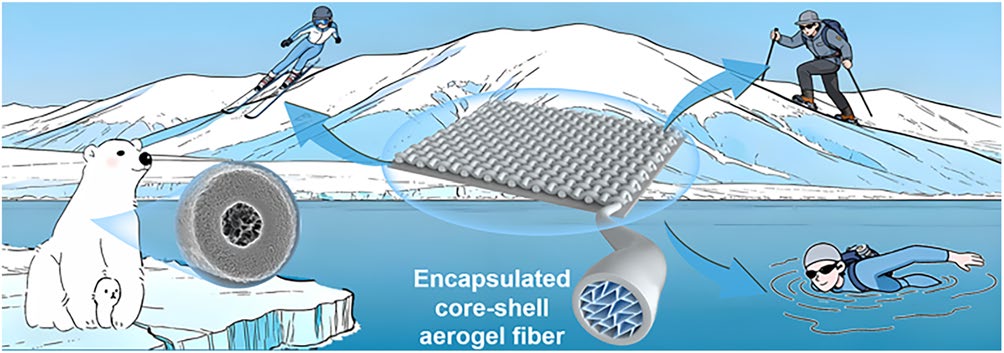

As demand grows for lightweight, flexible thermal-protection textiles in wearable electronics, outdoor clothing, and extreme environments, conventional insulation materials face persistent challenges in balancing thermal performance, mechanical durability, and environmental sustainability. Researchers from Wuhan Textile University, the Institute of Chemistry of the Chinese Academy of Sciences, and Zhejiang Sci-Tech University have developed a continuous fabrication strategy for all-biomass aerogel fibers inspired by the porous core–shell structure of polar bear hair. By combining silk fibroin and cellulose in a hierarchical architecture, the team has created flexible, lightweight fibers with effective thermal insulation and promising potential for sustainable textile applications.
Why This Thermal-Insulation Fiber Matters
Aerogels are attractive thermal-insulation materials because their highly porous structures suppress heat transfer. However, conventional inorganic aerogels can be brittle and difficult to process, while many polymer-based alternatives raise concerns about sustainability. Biomass-based aerogels offer an environmentally promising alternative, but their limited mechanical robustness and compatibility with textile manufacturing have hindered wider use. Transforming these materials into continuous fibers that combine low thermal conductivity, flexibility, and scalability is therefore essential for practical wearable thermal management.
Innovative Design and Mechanism
Inspired by polar bear hair, the researchers constructed a self-encapsulating core–shell fiber using silk fibroin as the core and cellulose as the outer shell. The fibers are produced through coaxial wet spinning, directional freezing, solvent exchange, and ambient-pressure drying. Directional freezing creates radially aligned, sheet-like pores within the silk fibroin core, while alcohol treatment solidifies this structure. During drying, hydrogen-bond-driven cellulose shrinkage causes the shell to contract around and encapsulate the core. This hierarchical architecture restricts air convection and promotes multiple reflections of infrared radiation, helping reduce heat transfer without relying on conventional synthetic insulating materials.
Outstanding Performance
The optimized aerogel fibers achieve a porosity of 79.78%, a density of 0.193 ± 0.01 g cm-3, and a thermal conductivity of 52.4 ± 4.2 mW m-1 K-1. A single fiber can withstand a tensile load of up to 200 g without additional reinforcement, demonstrating its potential for textile processing. The fibers can be woven into fabrics that provide better thermal insulation than the tested PET, nylon, cotton, and wool textiles under the reported conditions. In cold-water immersion tests, a gloved hand maintained a surface temperature of approximately 24°C, compared with 19.6°C with cotton gloves and 15.4°C without gloves. The woven fabric also retained its thermal performance after washing and exhibited stable temperature regulation during repeated cycling between −20 and 80°C.
Applications and Future Outlook
The continuous, ambient-pressure fabrication process enables the production of fiber spools and large-area woven fabrics, offering a potential pathway toward scalable manufacturing. The fibers also demonstrated promising biodegradability, with more than 90% structural disintegration within six weeks under the reported simulated environmental conditions. These features make them attractive candidates for thermal-protection clothing, wearable thermal management, and equipment designed for cold or demanding environments. Further work on long-term durability, repeated washing, and practical large-scale textile integration will be needed before widespread deployment. By combining bioinspired architecture with renewable materials and continuous processing, this study advances the development of more sustainable, high-performance thermal-insulation textiles.

Editor of Nano-Micro Letters, which is an Open-Access, peer-reviewed journal reported papers that have at least one dimension ranging from a few sub-nanometers to a few hundreds of micrometers. The journal is published by Springer Nature and indexed by SCI, EI, SCOPUS, Pubmed, etc. The 2025 JCR Impact Factor is 38.5. The 2025 CiteScore is 58.9.
Follow the Topic
-
Nano-Micro Letters
Nano-Micro Letters is a peer-reviewed, international, interdisciplinary and open-access journal that focus on science, experiments, engineering, technologies and applications of nano- or microscale structure and system in physics, chemistry, biology, material science, and pharmacy.