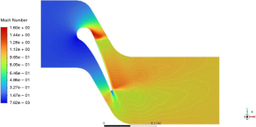
Cooled MarkII blade surface pressure and temperature distribution by a conjugate heat transfer analysis using Reynolds stress baseline turbulence model
Published in Mechanical Engineering

-
Conjugate Heat Transfer (CHT) Analysis: The paper highlights the importance of CHT in analyzing the thermal and pressure distribution on turbine blades. This could be a topic of interest for researchers and engineers working on gas turbine efficiency and cooling systems.
-
Turbulence Models: The study compares different turbulence models, including the RSM-BSL model, which showed the best agreement with experimental results. This could spark a discussion on the effectiveness of various turbulence models in CFD simulations.
-
Cooling Channel Design: The paper discusses the impact of cooling channel configuration on blade temperature distribution. This could be relevant for discussions on optimizing cooling systems in turbine blades.
-
Experimental Validation: The study includes experimental validation of the cooling mass flow rate distribution, which could be a point of discussion for those interested in the practical application of numerical simulations.