Covalent Organic Framework Membranes through Sequential Imine Exchange for Precise Molecular Separation
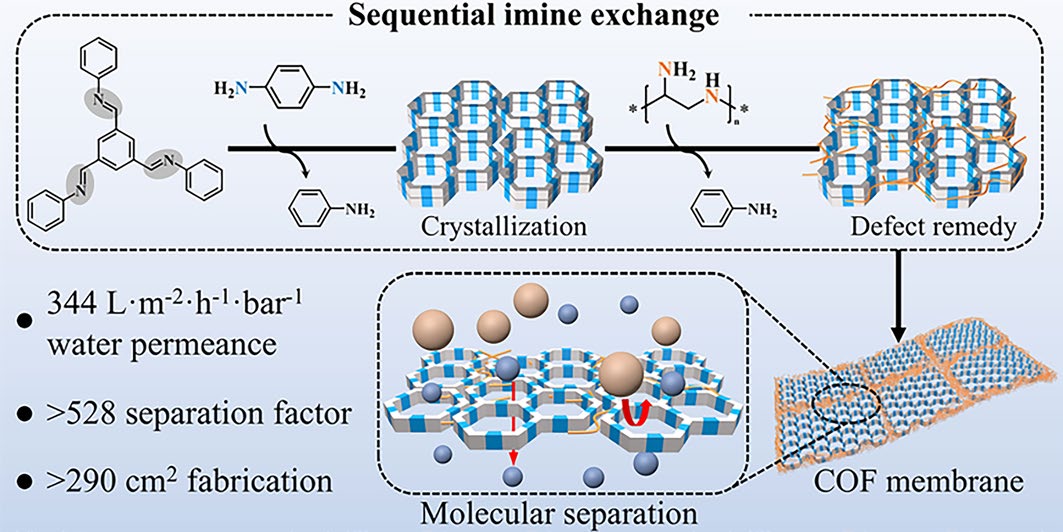

Membrane separation technology is increasingly important for resource recovery, pollution control, and energy-efficient chemical processing, where rapid and precise molecular sieving is essential. Covalent organic framework (COF) membranes offer highly ordered nanopores for selective transport, yet achieving both high crystallinity and defect-free continuous structures remains challenging. Researchers from Hainan University and Tianjin University, led by Professors Yanan Liu and Zhongyi Jiang, developed a sequential dynamic imine exchange strategy that decouples COF crystallization from defect repair, enabling highly crystalline membranes with high permeance, exceptional molecular rejection, and large-area fabrication.
Why These COF Membranes Matter
Conventional imine COF membrane synthesis suffers from a kinetic mismatch: imine condensation occurs rapidly, while crystal rearrangement is much slower. This can produce intercrystalline defects and amorphous regions that compromise molecular sieving and membrane integrity. The researchers overcome this limitation by separating crystallization and defect repair into sequential steps, transforming a competing process into a coordinated two-stage fabrication strategy.
Innovative Design and Mechanism
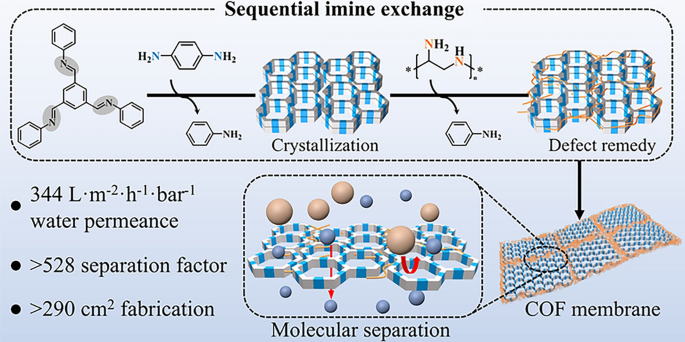
The strategy uses two amines with distinct imine-exchange energy gaps. 1,4-Phenylenediamine (PDA), with a lower energy gap of 1.77 kcal mol-1, first promotes rapid and reversible COF crystallization. Its dynamic exchange enables structural rearrangement and helps avoid kinetic trapping. Subsequently, hyperbranched polyethyleneimine (PEI), with a higher energy gap of 4.54 kcal mol-1, connects adjacent COF crystallites and repairs intercrystalline defects through its abundant amino groups and flexible chains. This sequential mechanism allows crystallization to occur before defect remediation, producing continuous and highly crystalline molecular-transport channels.
Outstanding Performance
The optimized IELZU1-PEI membrane achieves a water permeance of 344 ± 10 L m-2 h-1 bar-1 while maintaining >99.9% Congo red rejection. It effectively rejects dye molecules above approximately 490 Da and also delivers a methanol permeance of 462 ± 22 L m-2 h-1 bar-1. The defect-free channels enable highly selective mixed-dye separation, with separation factors of 714 for methyl orange/Coomassie brilliant blue, 528 for methyl orange/Evans blue, and 729 for Acid Blue 25/Congo red. The membrane also maintains high rejection during repeated filtration and 16 h of continuous nanofiltration.
Applications and Future Outlook
The sequential exchange strategy provides flexible control over membrane pore size, enabling COFs with theoretical pores ranging from 14–24 Å. A 24 Å membrane achieves a water permeance of 600 ± 51 L m-2 h-1 bar-1, demonstrating the ability to balance permeability and molecular sieving. Importantly, the fabrication process produces membrane areas exceeding 290 cm2 within 3 h, highlighting its scalability. By independently controlling crystallization and defect repair, this approach offers a versatile platform for high-performance COF membranes targeting nanofiltration, molecular separation, resource recovery, and pollution control.

Editor of Nano-Micro Letters, which is an Open-Access, peer-reviewed journal reported papers that have at least one dimension ranging from a few sub-nanometers to a few hundreds of micrometers. The journal is published by Springer Nature and indexed by SCI, EI, SCOPUS, Pubmed, etc. The 2025 JCR Impact Factor is 38.5. The 2025 CiteScore is 58.9.
Follow the Topic
-
Nano-Micro Letters
Nano-Micro Letters is a peer-reviewed, international, interdisciplinary and open-access journal that focus on science, experiments, engineering, technologies and applications of nano- or microscale structure and system in physics, chemistry, biology, material science, and pharmacy.