Creating Light-matter Entanglement on a chip
Published in Physics

An integrated circuit that manipulates photons
Inside modern electronic devices, thousands of circuit components like resistors and capacitors are integrated compactly on a micron-sized semiconductor chip, implementing logic gates and microprocessing. These circuit components are called electronics as they manipulate the flow of electrons in the circuit. A quantum analog of such devices could be a quantum photonic chip, which uses the quanta of light, called photons, to process and transmit information.
Photons are ideal information carriers as they travel in the speed of light, are resistant to environmental noises, and can be controlled with off-the-shelf optical elements like beamsplitters and phase shifters1.
Scheme for quantum photonic computing
In 2001, Knill, Laflamme and Milburn (KLM) proposed a ground-breaking scheme2, showing that universal quantum photonic computing is feasible with these linear optical components and photo-detectors, provided the photons remain pure and indistinguishable.
However, one significant drawback with the KLM scheme is that it is inherently probabilistic. To perform a conditional sign flip gate on two input photons that do not normally interact, the KLM scheme mixes them with additional photons, and measures out the latter to induce nonlinear interaction between the input photons. This measurement-induced nonlinearity only works with limited probability. Hence, it might result in major resource overhead if the gate success rate is not sufficiently high.
Deterministic platform for photonic chips
One alternative approach would be to replace these probabilistic gates by quantum dots3, which are well-known for not only their ability to emit ultra-pure indistinguishable photons, but also their potential to mediate deterministic interaction between photons.
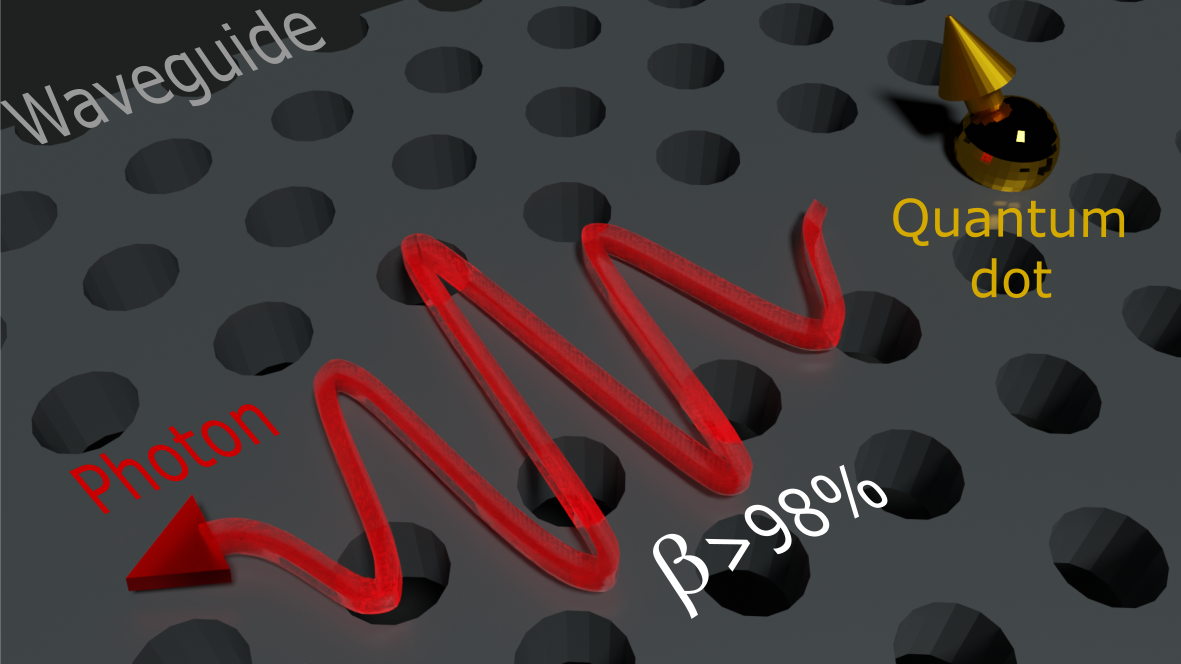
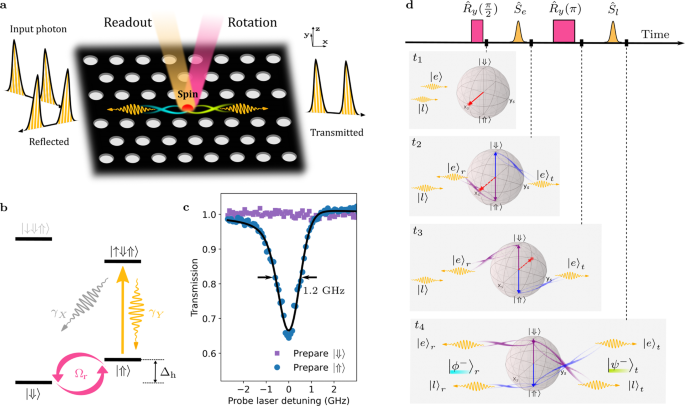
Our group (led by Prof. Peter Lodahl) specializes in integrating these quantum dots on a semiconductor chip. Quantum dots are nanometer-sized “artificial atoms” fabricated by stacking layers of different semiconductors. They are made from compounds like GaAs used in the electronic chips today, thus can naturally be combined with other linear optic elements to form a photonic chip. An electron spin trapped in such an atom can jump between energy levels, by absorbing or releasing energy of a photon. To make the energy exchange process more efficient, we fabricate waveguides to guide photons into a quantum dot with near-unity efficiency of β>98%4 (Fig. 1).
Significance of this work
In our work, we show that this waveguide-induced light-matter interface5 can be used to create entanglement between an incoming photon and the spin of a quantum dot. The photon is generated by a laser and launched into the waveguide—to mimic a flying photon arriving at the chip. One implication of this is that the quantum dot can act as the “middleman” to facilitate interaction between two flying photons, by repeatedly entangling itself with each photon. This spin-mediated nonlinearity, as opposed to the one used in the KLM scheme, is in principle deterministic.
Apart from having the potential to realize deterministic operations between photons locally on the chip, our work demonstrates that it is possible to transfer information between a stationary node (in this case, the quantum-dot spin) and a flying photon, a crucial ingredient to establish a remote connection between chips (DiVincenzo's sixth criteria6).
Quantum snooker
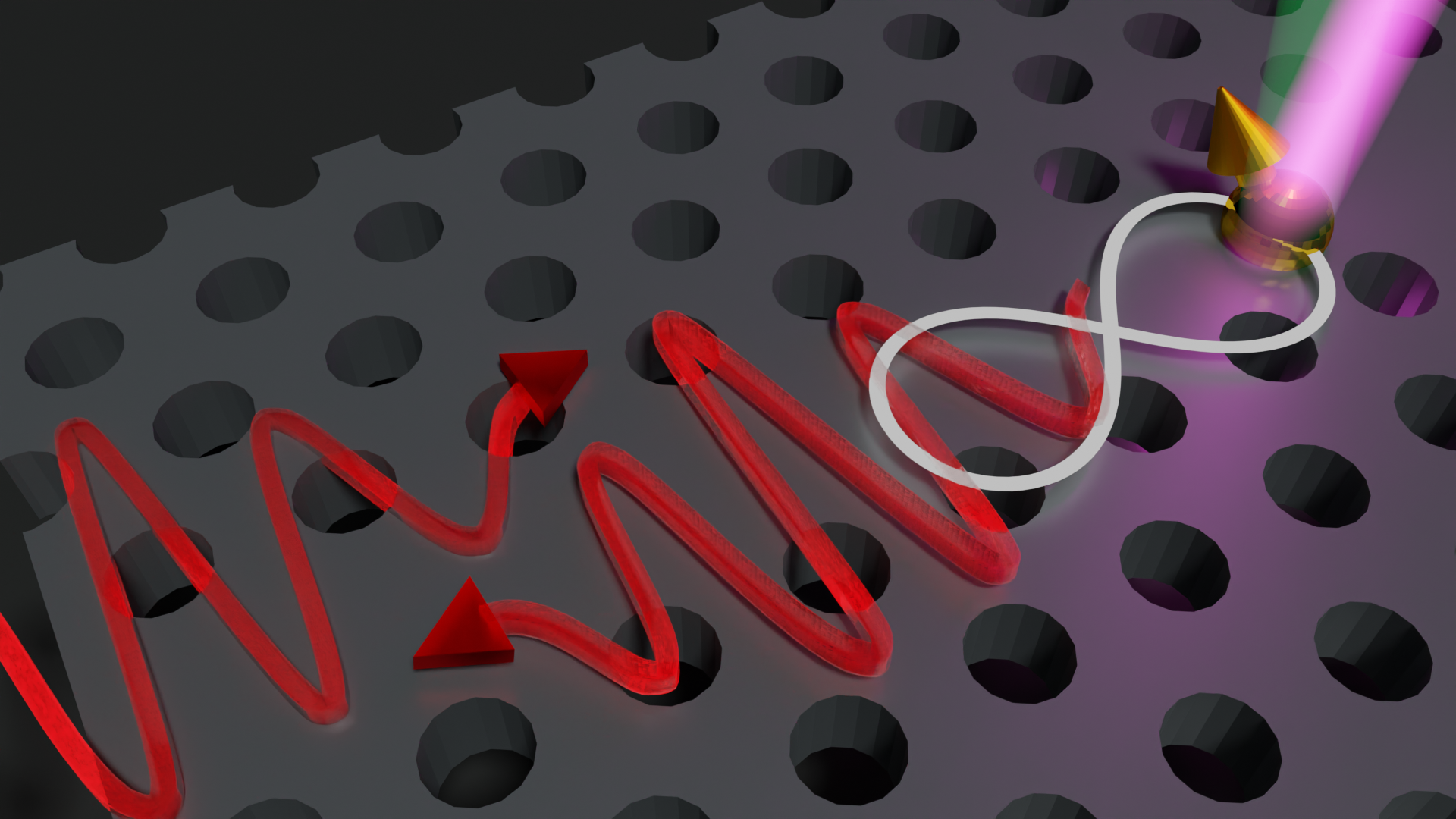
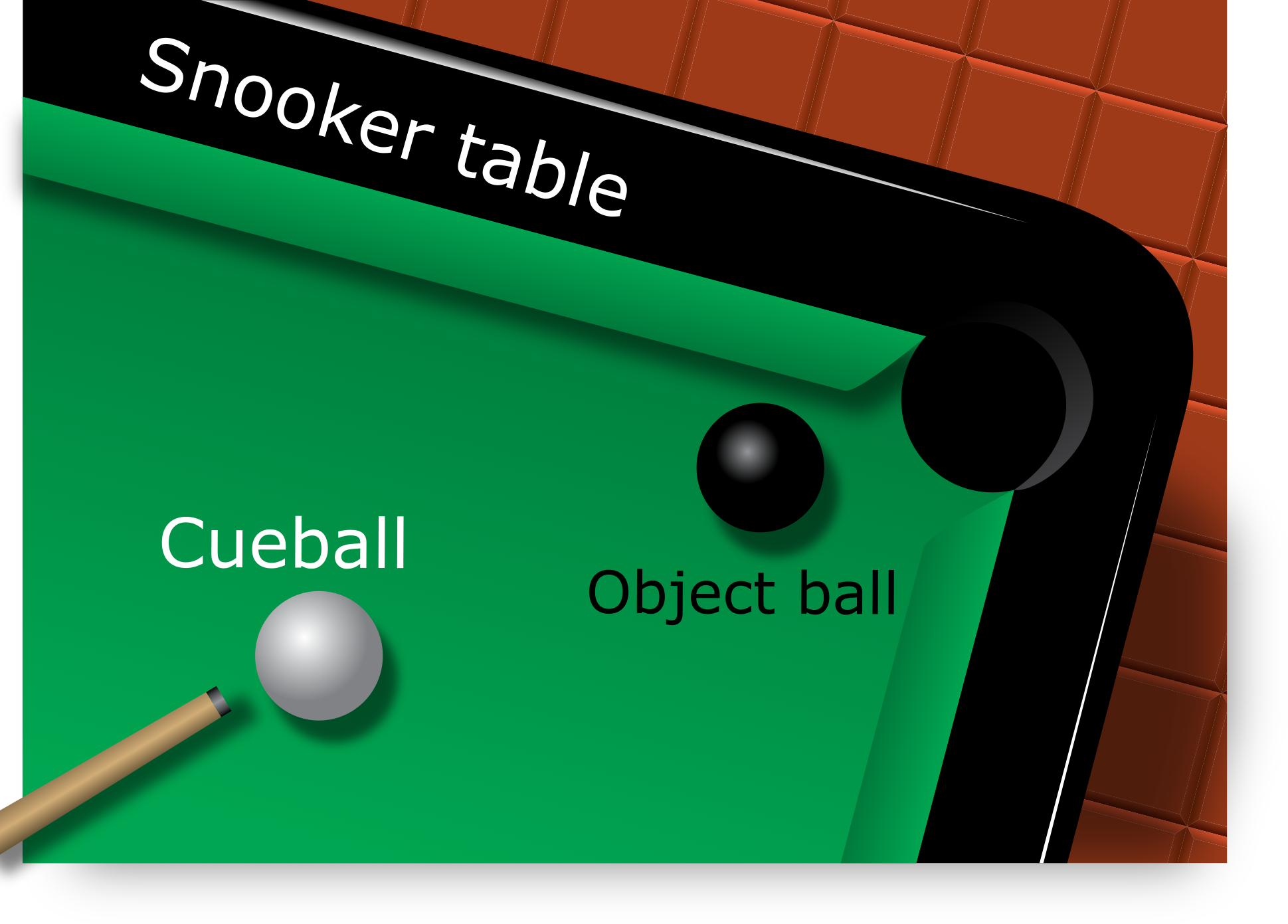
The process in which a photon interacts with the quantum dot, is very similar to how the balls interact in a snooker game. To score points, we strike the white cueball with some angle and force, for it to scatter on the object ball and sink it into a pocket. In our experiment, we strike a photon pulse (cueball) towards the quantum dot (object ball), where its direction of propagation (angle) is dictated by the waveguide. The quantum dot elastically reflects the pulse through Rayleigh scattering.
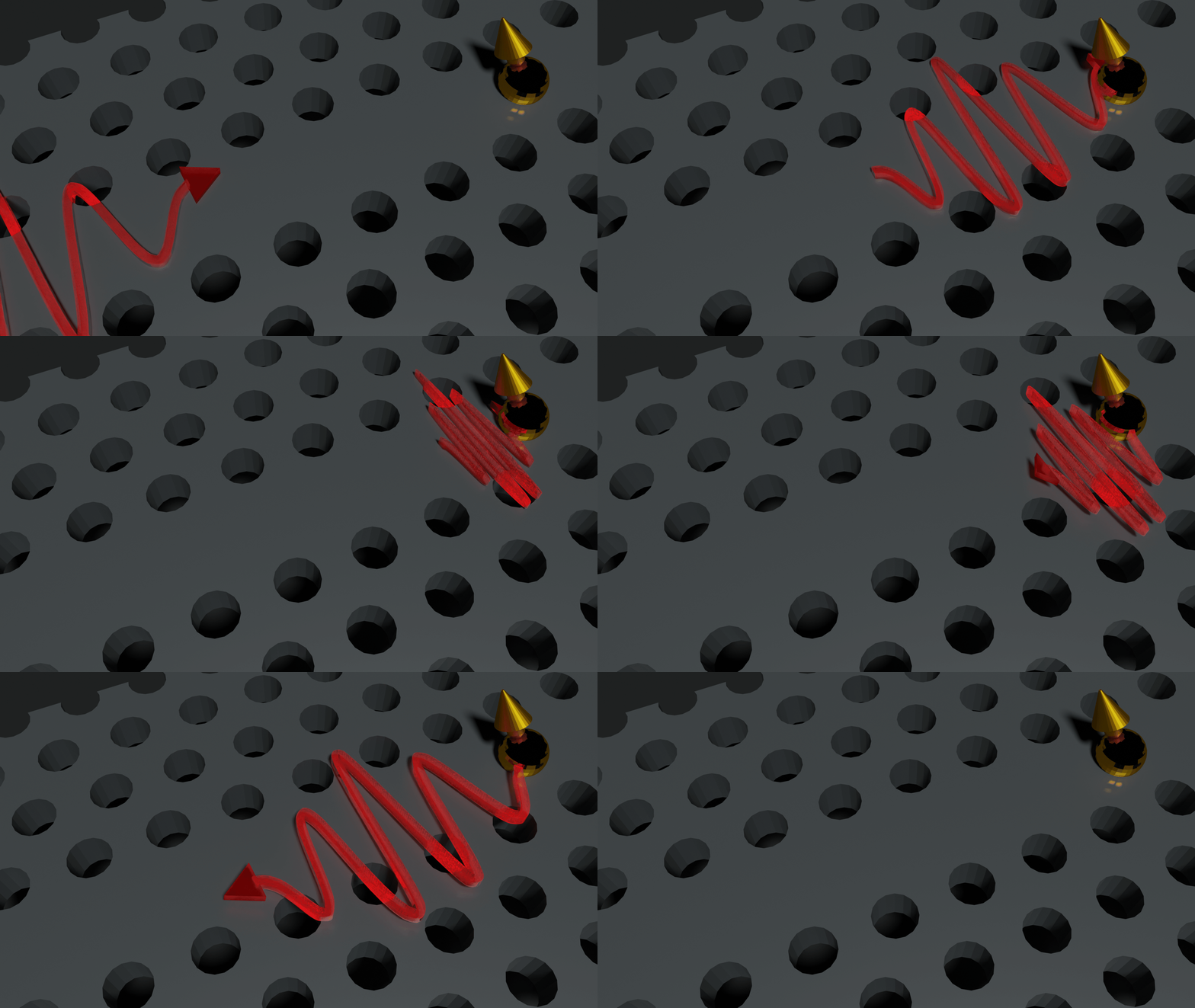
To generate entanglement between the two, we prepare the quantum dot in a superposition state of opposite spins (There’s no classical analog of this, but one could imagine having the object ball self-rotating simultaneously in opposite directions) and a photon encoded in two pulses. Half of the spin state (e.g., ⇑) resonates with a photon in the first pulse then reflects it back, while the other (⇓) does not and ignores the photon.
Now, if we reverse both spin states and send a second pulse to scatter, nonlocal correlation between the spin and photon is observed upon measurement of the pulses, i.e., the first pulse being reflected is only correlated with spin ⇓, while the second is linked to ⇑. The two particles are mingled via quantum entanglement.
What does this mean for us?
While this work does not help with analyzing snooker physics, it tells us that a lot of interesting information processing protocols are now possible on and outside a photonic chip. Two chips could be remotely entangled to exchange information, via repeated scattering of a single photon pulse. This pulse could be our next “photonic messenger”.
References
- J. L. O’Brien, A. Furusawa, and J. Vuckovic. Photonic quantum technologies.
Nature Photonics, 3(12):687–695, 2009. - E. Knill, R. Laflamme, and G. J. Milburn. A scheme for efficient quantum computation with linear optics. Nature, 409(6816):46–52, 2001.
- P. Lodahl. Quantum-dot based photonic quantum networks. Quantum Science
and Technology, 3(1):013001, 2017. - M. Arcari, et.al. Near-unity coupling efficiency of a quantum emitter to a photonic crystal waveguide. Phys. Rev. Lett., 113:093603, 2014.
- M.H. Appel, et.al. Coherent spin-photon interface with waveguide induced cycling transitions. Phys. Rev. Lett., 126:013602, 2021.
- D.P. DiVincenzo, The Physical Implementation of Quantum Computation. Fortschritte der Physik. 48 (9–11): 771–783, (2000).

Follow the Topic
-
npj Quantum Information
The scope of this journal spans across all relevant disciplines, fields, approaches and levels and so considers outstanding work ranging from fundamental research to applications and technologies.

Related Collections
With Collections, you can get published faster and increase your visibility.
Foundations and Advances in HPC/AI-Quantum Co-Design
Publishing Model: Open Access
Deadline: Dec 20, 2026
Quantum-Enabled Bioimaging
Publishing Model: Open Access
Deadline: Nov 04, 2026