Trust needs a spark and a path
Trust ignites where trustworthy people cluster, and then stays there.
Published in Social Sciences, Physics, and Statistics

Almost everyone shares one intuition about cooperation: if you want it, put the reliable people together. Our paper is about how that intuition is half right. Trust has two lives. It has to be born somewhere, and then it has to travel. The arrangement that is best at giving trust a birthplace turns out to be close to the worst at letting it travel. Working out that tension took most of the project.
A market stall and a chessboard
Suppose you hand a neighbour 100 euros for her market stall. The money turns into 300, and she decides how much to give back. If she returns half, trusting her pays. If she returns one third, you get your 100 euros back exactly. Anything less, and you lose.
That is the trust game. You are the trustor, she is the trustee, and the fraction of the 300 she returns is her return ratio.
Now imagine thousands of these players arranged on a chessboard. Some trustees return a lot, others very little, while trustors can choose whether to invest. Over time, successful behaviour spreads. What matters to us is how the generous and stingy trustees are arranged: clustered together, scattered at random, or alternating. We call that spatial correlation.
Where it started
The project began with a suggestion from Chaoqian Wang, who pointed me to a 2008 paper by Matjaž PercMatjaz Perc and Attila Szolnoki. They gave every player in a grid of prisoner's dilemma games a fixed personal factor that multiplied their earnings, a stand-in for differences in wealth and status. Uniform, exponential and power-law factors all helped cooperation. The authors then made those factors spatially correlated, and found that cooperation deteriorates as the correlation length grows. Attila joined this project later. At the time he was an author I was reading.
The trust game struck us as a cleaner canvas. Its only free parameter is the return ratio, and unlike most parameters in this literature it is something experimenters actually measure. Laboratory trust games have reported it since 1995.
A question we had not thought to ask
In the uniform case, where every trustee returns the same fraction, the model has a clean answer. Trust survives only for return ratios between one third and four ninths, and earlier studies of this spatial trust game had worked out both bounds. The lower one is the break-even point from the market stall: at one third, the trustee hands back exactly what was entrusted. The upper one is stranger. Above four ninths trust collapses as well, and the cause is too much generosity. When returns are high enough, investing stays profitable even after a defector appears, so trustors stop withdrawing, and withdrawal was their only punishment. A community generous enough loses the ability to discipline itself.
We had treated that window as an internal landmark of the model. Much later, in review, a referee asked something we had not thought to ask: among all the trustee distributions we were simulating, which one is closest to the heterogeneity that laboratory experiments actually observe?
So we went back to the data, none of which the model had ever been fitted to. Berg, Dickhaut and McCabe's 1995 investment game reports returns that are not spread smoothly at all: a large mode at zero, where the trustee keeps everything, and then clusters at simple fractions, with zero, one third, one half and two thirds covering more than ninety percent of decisions, and a mean near 0.35. Johnson and Mislin's meta-analysis of 162 replications, in 35 countries and with more than twenty-three thousand participants, gives a mean of about 0.37, with individual study means running from 0.11 to 0.81.
Both means fall inside the window, close to its lower edge. Real trustees, averaged over three decades and thirty-five countries, are barely trustworthy enough. And the shape matters as much as the mean: the laboratory distributions are right-skewed and L-shaped, nothing like a normal curve. That is exactly the corner of the Beta family that our simulations find most favourable to trust. We would not have looked without being asked.
An expectation that only half held
Once the uniform case was settled, I started moving trustworthy trustees around.
The 2008 paper had found cooperation deteriorating as spatial correlation grows, so I expected clustering to work against trust here in the same monotone way. The sweeps did not come out monotone.
They also did not tell me why. That came from putting two pictures side by side: the field of return ratios across the lattice, and the strategy configuration the dynamics settled into.
Where trustworthy trustees clustered, trust ignited even when the lattice-wide mean return ratio was below one third, where investing should not have paid. But the same patches sat inside rings of low-return neighbours, and went nowhere.
A cluster of generous partners is kindling and firebreak at once.
Break the clusters up, interleave the generous and the stingy, and the fire spreads easily. But when the average return is below one third, nowhere is concentrated enough to light it.
The overall level of trust and the threshold for trust to appear at all pull in opposite directions. The level peaks near zero correlation, while the threshold keeps falling as clustering increases.
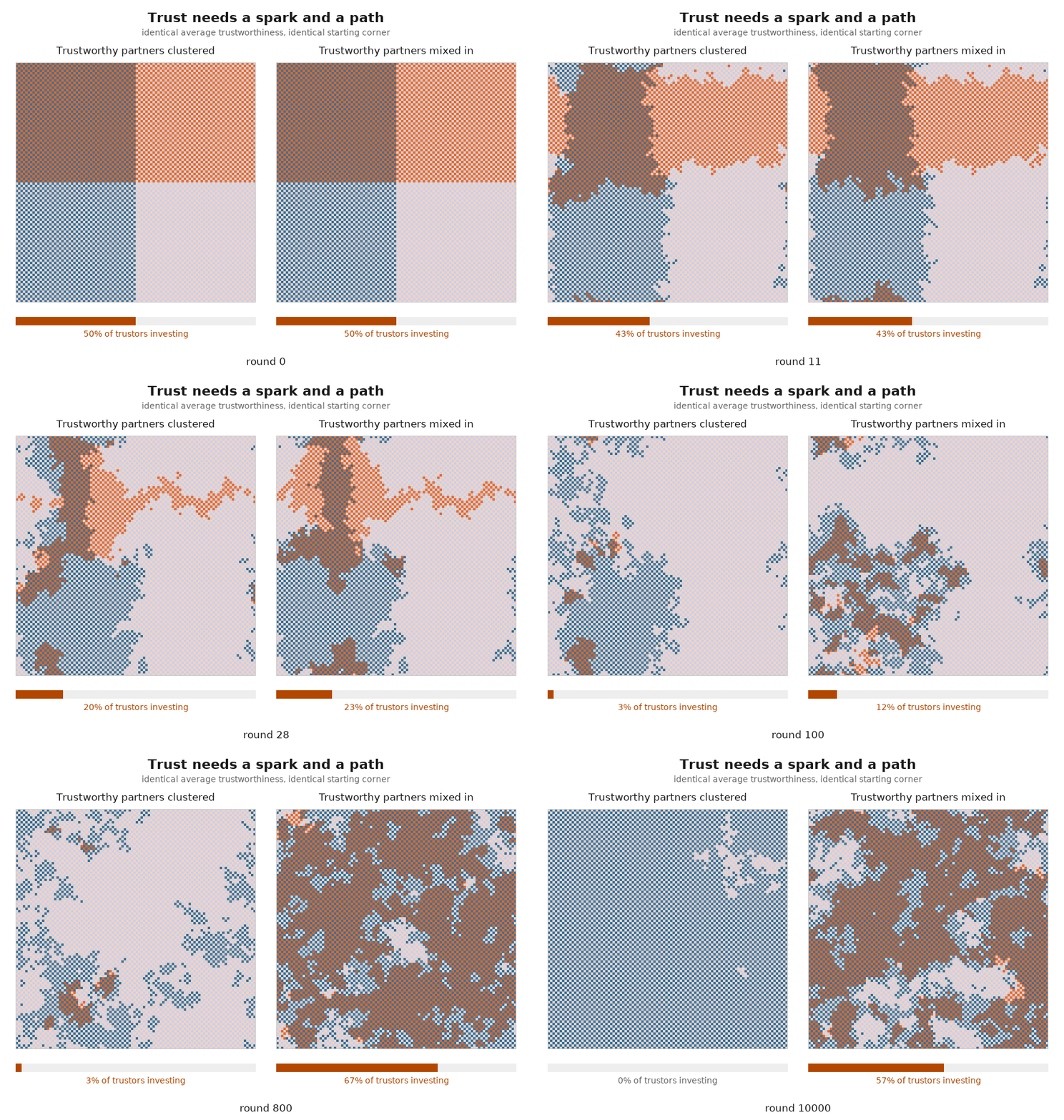
Same average return ratio (0.35, just above one third), same starting corner. Left: trustworthy partners clustered. Right: the same partners mixed in. Rounds 0 to 10000; the bar shows the share of trustors investing.
A pattern drawn by hand
The part I enjoyed most is the one thing in this project I designed rather than measured.
Back on the chessboard, trustors and trustees occupy interleaved squares. You play the game with the neighbours above, below, left and right, and you copy strategies from the neighbours on the diagonals. Looking at a weakly correlated field one afternoon, I noticed that high and low return ratios alternate along the rows and columns but run continuously along the diagonal. The diagonal is exactly the direction along which strategies are imitated.
So I asked whether it could be designed on purpose, and it can. There is a periodic tiling in which three local environments alternate along the diagonal: pockets where a trustor faces four generous trustees, pockets where it faces four stingy ones, and transition zones linking them. I only saw how symmetric it was after it was finished. Its Moran's I, the measure of spatial correlation we use throughout, is exactly zero.
It does not behave like an algorithmically generated field with the same Moran's I of zero. It holds trust only near a mean return ratio of one third, much as a strongly negatively correlated field does, while the random field supports trust across a far wider range. One number does not settle how heterogeneity behaves.
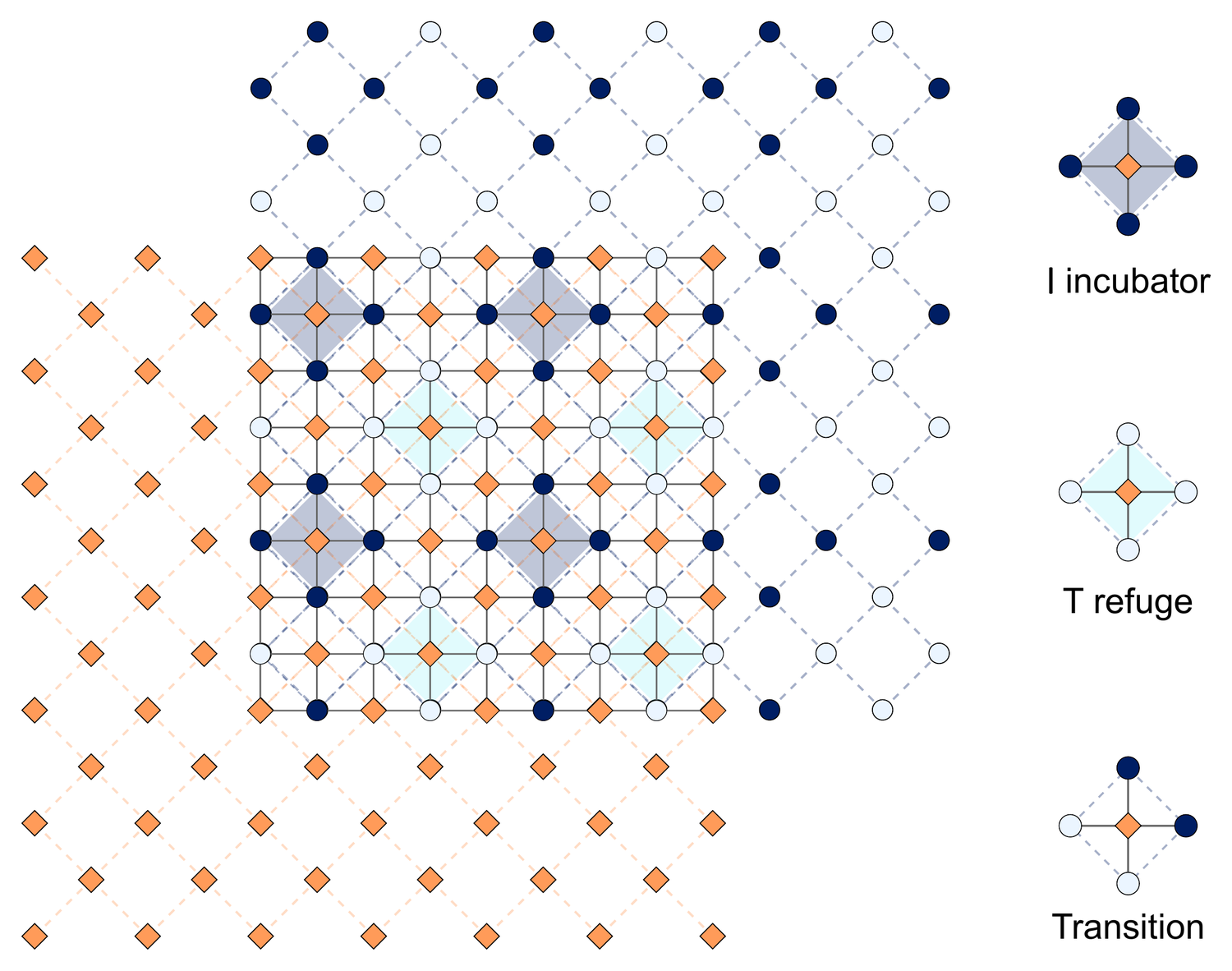
The tiling drawn by hand. Incubator, refuge and transition motifs alternate along the diagonal, the direction of imitation. Its Moran's I is exactly zero. Figure 6 of the paper.
Forty minutes at Muxuyuan station
I should be honest about how slowly this went.
Most of the work was done in the library of Southeast University in Nanjing, during a six-month exchange from Changsha. That had the happy side effect of putting me in the same city as Chaoqian Wang. I would press Run on a parameter sweep and my laptop would need forty-eight hours. Some sweeps took three or four days.
One winter evening the library closed for the night, and I set off for the metro with a simulation still running on the laptop. Partway home I noticed the battery was nearly gone. So I got off early, at Muxuyuan station, found a wall socket, and sat on the floor for forty minutes until the battery was full again. Only then did I get back on the train and finish the trip home.
Later my advisor Xin Lu secured us time on a supercomputing platform, which is what made the fine sweeps of Moran's I possible. Attila Szolnoki joined at exactly that point. I had written to ask how to combine value and spatial heterogeneity inside a single continuous family of distributions, and his replies were always fast.
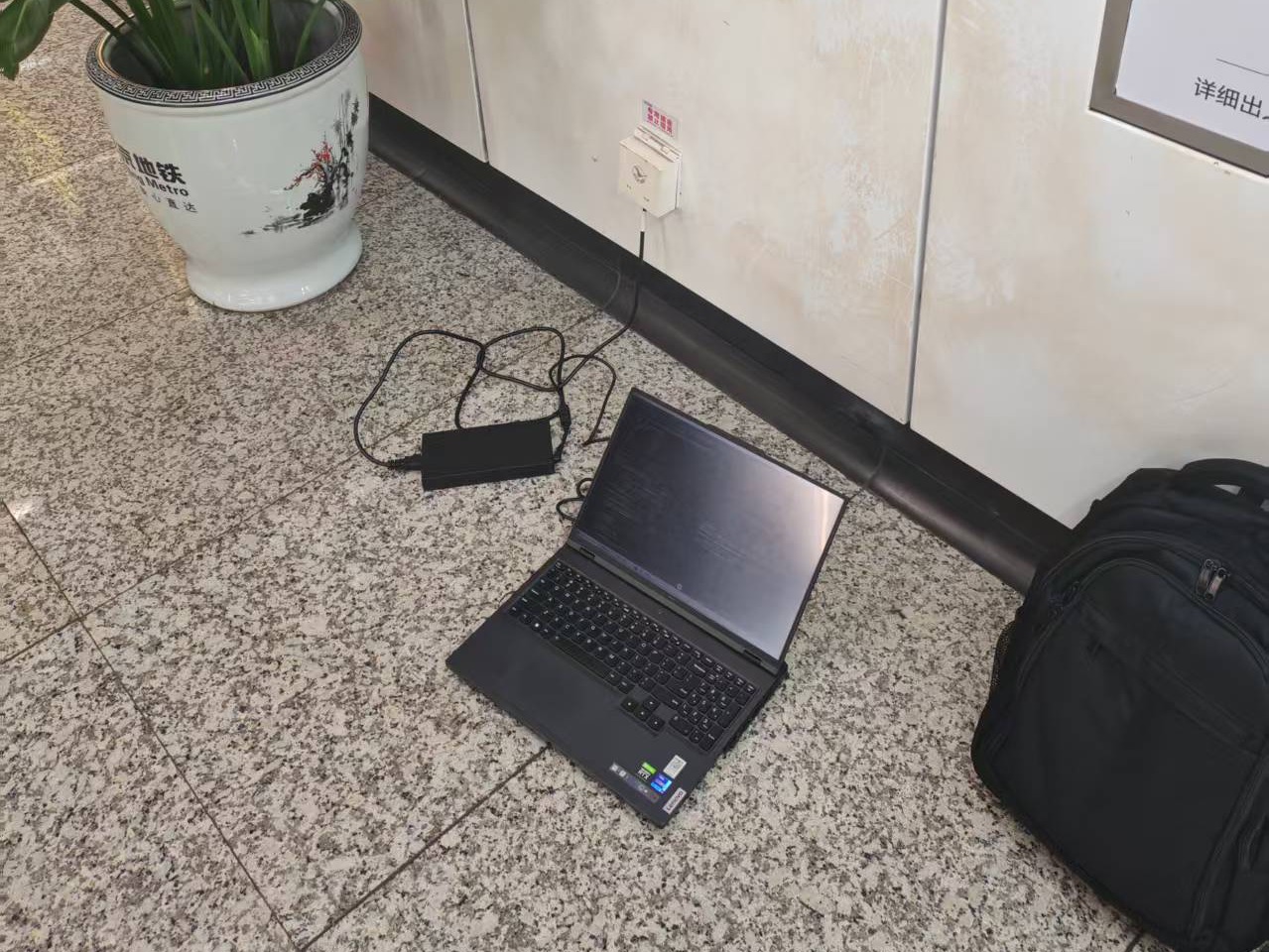
Muxuyuan station, Nanjing, one winter evening. The library had closed, and on the ride home the laptop was about to die with a simulation still running, so I got off early to charge it. Forty minutes on the floor, then back on the subway. Photo: Haidong Zhang.
What stays with me
The sweeps do have an optimum, near zero correlation, but it is not what I keep coming back to. What I keep coming back to is that trust has two jobs to do, one after the other. It has to catch somewhere, and then it has to travel. On our lattices, the structure that lets trust start is not the structure that lets it spread.
If there is practical advice here, it concerns who interacts with whom rather than where anyone lives. Where general trustworthiness is low, concentration may be the only way to get anything started. That same concentration is what later keeps trust bottled up, and building bridges out of it is a separate job.
We are now curious about what happens when trustworthiness itself evolves instead of staying fixed, and when the network is allowed to rewire. Whether that tension survives those changes is, as far as we can tell, open.

PhD student, National university of Defense Technology
Follow the Topic
Complex Systems
Physical Sciences > Physics and Astronomy > Theoretical, Mathematical and Computational Physics > Complex Systems
Statistical Physics
Mathematics and Computing > Statistics > Applied Statistics > Statistics in Engineering, Physics, Computer Science, Chemistry and Earth Sciences > Statistical Physics
Social Sciences
Humanities and Social Sciences > Social Sciences