When 1 + 1 Doesn't Equal 2: Making Rival Molecules Work Together in Perovskite Solar Cells


In just over a decade, perovskite solar cells have crossed 26% certified efficiency, closing in on silicon. What still holds them back is a diverse population of ionic defects, vacancies, misplaced ions, undercoordinated metals, each trapping charge carriers and eating into performance and stability.
The idea behind this paper started from a pretty simple place. In our group, we had been working on different molecules to passivate these surface defects. Lewis bases worked well for one kind. Lewis acids worked well for another. Each made devices better on its own.
So at some point, the obvious question came up: why not just use both? If each one fixes a different problem, putting them together should fix more problems. Just throw all the good stuff in.
The 1 + 1 = 0.5 problem
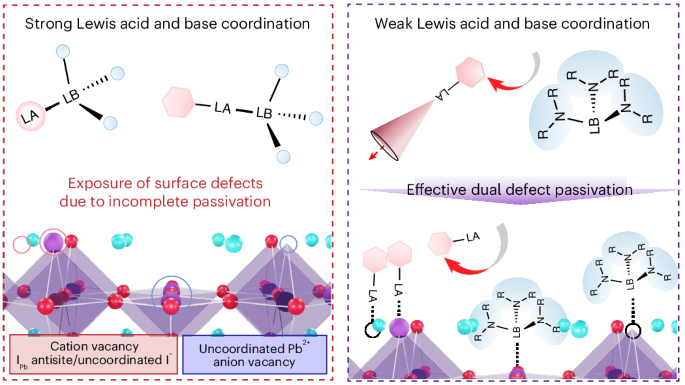
Lewis acid and Lewis base passivation has always been attractive for tackling these defects because of its chemical selectivity. Bases coordinate to electron-deficient sites like exposed Pb2+. Acids interact with electron-rich defects like antisite iodide. And neither disrupts the crystal structure, which is a real advantage over many other approaches.
But here is the reason nobody combines them. Lewis acids and Lewis bases are, by nature, attracted to each other. Put them in the same solution and they form a stable complex, an adduct, consuming each other's reactive sites before either one reaches the surface. What you expected to be 1 + 1 = 2 turns into something closer to 0.5. Both molecules lose their ability to do the job they were selected for.
This is such a well-known problem that the community has largely moved on from the idea. You pick an acid or a base, not both.
Same solution, different targets
We could have moved on too. But the original intuition still felt right: the defects are chemically diverse, so the passivation should be too. The problem was not the concept but the molecules.
So we reframed the question: can we find a pair that does not react with each other, but still reacts with defects?
The answer came from molecular geometry. The Lewis acids we chose, fluorinated aromatic iodobenzenes, have a reactive site that is highly directional. It requires a precise linear alignment to form a strong bond. The Lewis bases we chose, phosphine-based donors, carry enough steric bulk around their reactive center to block that precise alignment. In solution, the acid and base bump into each other but cannot form a stable complex. The geometry does not allow it.
The key realization was that surface defects do not impose the same geometric constraint. They are open and accessible from many angles, so both the acid and the base can bind to their respective defect sites without steric resistance. The two molecules effectively ignore each other but remain fully active toward the surface. We call this chemical orthogonality.
The right pair, the right ratio
This principle sounds clean on paper, but getting the balance right took real effort. We screened sixteen combinations of four acids and four bases, and the performance landscape was far from obvious. Some pairs were still too reactive with each other. Others were so bulky that the base could not even access the defect sites properly.
The combination that worked, 1-iodo-3,5-bis(trifluoromethyl)benzene (IBTFMB) paired with tris(dimethylamino)phosphine (TDMP), sat in a narrow window where mutual interaction was weak enough to preserve independence but both molecules were still compact enough to reach their targets on the surface.
But identifying the right pair was only half the problem. Within that pair, we still needed the optimal ratio and concentration. So we turned to a combinatorial spray-inking system that deposits concentration gradients across a single substrate, letting us map out a wide parameter space in parallel rather than one device at a time.
We then added a third component, a diammonium salt that provides electrostatic passivation through a completely different mechanism, building a three-molecule system where each one addresses a distinct source of loss.
27.4%, and what it took to get there
Devices made with this multi-molecular passivation strategy reached 27.4% power conversion efficiency, with a certified quasi-steady-state value of 25.8% by The National Laboratory of the Rockies. Under accelerated aging at 85 degrees C with continuous illumination, they retained over 90% of their performance after more than 1,000 hours.
A small corner of a large space
Looking back, what we are most satisfied with is that the original, naive idea turned out to be right. You can use both. You just have to pick molecules that would rather bind to defects than to each other.
But we also recognize that we have only explored a small corner of a much larger chemical space. The steric and electronic relationships that govern whether two molecules can coexist without reacting are rich and nuanced, and our sixteen-combination screen barely scratches the surface. There are many more acid-base families, functional group combinations, and steric profiles worth exploring, and the rules of chemical orthogonality we identified here are likely just one chapter of a longer story.
This is also where we see a role for AI-driven discovery. The interplay between steric bulk, electronic structure, and binding selectivity creates a design space that is difficult to navigate by intuition alone. Machine learning trained on interaction energies, molecular geometries, and device outcomes could accelerate the search for new orthogonal pairs, potentially uncovering combinations no chemist would think to try. We see this as an open question, one where data-driven exploration and chemical understanding can reinforce each other.
Follow the Topic
-
Nature Chemistry
A monthly journal dedicated to publishing high-quality papers that describe the most significant and cutting-edge research in all areas of chemistry, reflecting the traditional core subjects of analytical, inorganic, organic and physical chemistry.