Deep-Earth Coupling Reveals the Driver of Multidecadal Changes in Earth's Rotation
Published in Earth & Environment


For decades, geophysicists studying Earth rotation, the geomagnetic field and the differential rotation of the solid inner core have been fascinated by a remarkable yet puzzling multidecadal signal. Variations in this long-period signal provide a rare window into motions occurring thousands of kilometres beneath our feet—a field broadly known as core dynamics.
The liquid outer core plays a central role in this system. The motion of electrically conducting fluid within the outer core generates Earth’s main magnetic field. At the same time, these fluid motions interact with both the mantle above and the solid inner core below, allowing angular momentum to be exchanged between different layers of the planet. Understanding the physical mechanisms responsible for the observed changes in Earth’s rotation therefore requires us to connect observations at the surface with the dynamics of the deep interior.
Coupling the Core and Mantle
A breakthrough came in 1988, when Dominique Jault and colleagues demonstrated that exchanges of angular momentum between the core and mantle could explain changes in Earth’s rotation. Published in Nature, this work opened the way for subsequent studies linking motions in the liquid core to observed variations in the length of day.
However, the physical mechanism responsible for the observed decadal-to-multidecadal variations has remained uncertain.
At least three major coupling mechanisms have been proposed. Electromagnetic coupling results from interactions between the magnetic field and electrically conducting material across the core-mantle boundary. Topographic coupling arises from pressure forces acting on small-scale variations in the shape of the boundary. Gravitational coupling, meanwhile, results from gravitational interactions between density anomalies in the inner core and the mantle.
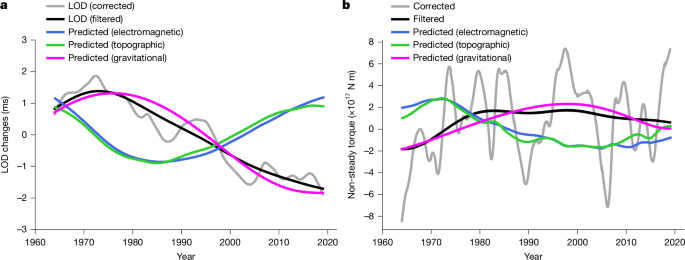
In our study, we focus on the multidecadal component of the observed changes in the length of day. This long-period signal provides a particularly valuable opportunity to investigate gravitational coupling, which has previously been difficult to constrain because observations of differential inner-core rotation have had limited temporal resolution. At the same time, predictions of electromagnetic and topographic coupling continued to depend on simplified representations of processes occurring at the core-mantle boundary.
Gravitational Coupling as the Driver
To determine which mechanism can account for the observed multidecadal variation in the length of day, we build predictions based on models of the torques acting on the mantle. These models are anchored by observations and depend on parameters that are not well known. To find which torque and which set of parameters better fit the length of day changes over the past six decades, we use a Markov chain Monte Carlo (MCMC) approach.
Our results reveal a striking pattern: the gravitational torque acts in the direction required to explain the observed changes in Earth rotation, whereas the electromagnetic and topographic torques generally oppose it.
This conclusion is further supported by the behaviour of zonal flows in the outer core. Near the core-mantle boundary, flows in the polar region move in opposite direction to flows at mid-latitude and equatorial regions, consistent with gravitational coupling acting as the primary driver.
Together, these results provide evidence that gravitational interactions involving the inner core play a central role in driving multidecadal variations in Earth rotation.
What This Tells Us About the Deep Earth
The inferred torque parameters also provide new constraints on the structure and dynamics of regions that are otherwise extremely difficult to observe directly.
Our estimate of the strength of gravitational coupling is smaller than values proposed in earlier studies. Such a weak coupling may be compatible with the interpretation that large structures near the base of the mantle-often referred to as mantle piles-are hot and compositionally denser than surrounding material. The low gravitational coupling also supports that lenses of postPerovkite in between these piles may have a relatively low viscosity.
We also infer an inner-core viscous relaxation timescale of roughly 10 years. This suggests that the inner core deforms much more rapidly than the mantle and that its shape adapts relatively rapidly in response to stresses imposed by its surrounding.
Constraints on the electrical conductivity of the lowermost mantle and possible stratification at the top of the outer core remain less robust. These properties are connected to several unresolved aspects of deep-Earth structure and dynamics, and better observations and improved models will be needed to make further progress.
Looking Ahead
The results raise several intriguing questions. Is the approximately six-year oscillation observed in the length of day also excited by gravitational coupling? Could improved models eventually allow us to predict future changes in inner-core rotation and the length of day? And could observations of Earth rotation, in turn, help us improve models of fluid motion deep within the core?
Future satellite missions with improved spatial and temporal resolution, together with better models of the crustal contamination, will provide increasingly precise observations of geomagnetic change. These advances should lead to higher-resolution reconstructions of core flow.
By combing these observations with measurements of Earth rotation and inner-core motion, we may gain an increasingly detailed picture of how Earth’s deep layers interact-and how motions thousands of kilometres beneath the surface subtly change the length of our day.

As a geodynamicist, I am interested in using core dynamics to understand the structure and evolution of Earth and other planets. My research spans Earth rotation, core flow inversion, and dynamo processes, with the overarching goal of revealing the internal structure and dynamics of planetary bodies.
Follow the Topic
-
Nature
A weekly international journal publishing the finest peer-reviewed research in all fields of science and technology on the basis of its originality, importance, interdisciplinary interest, timeliness, accessibility, elegance and surprising conclusions.

Related Collections
With Collections, you can get published faster and increase your visibility.
Carbon Dioxide Removal
Publishing Model: Hybrid
Deadline: Jan 16, 2027
Cancer Neuroscience: from mechanisms to therapy
Publishing Model: Hybrid
Deadline: Jan 30, 2027