Creating steady Floquet states in graphene via mid-infrared irradiation
Published in Physics
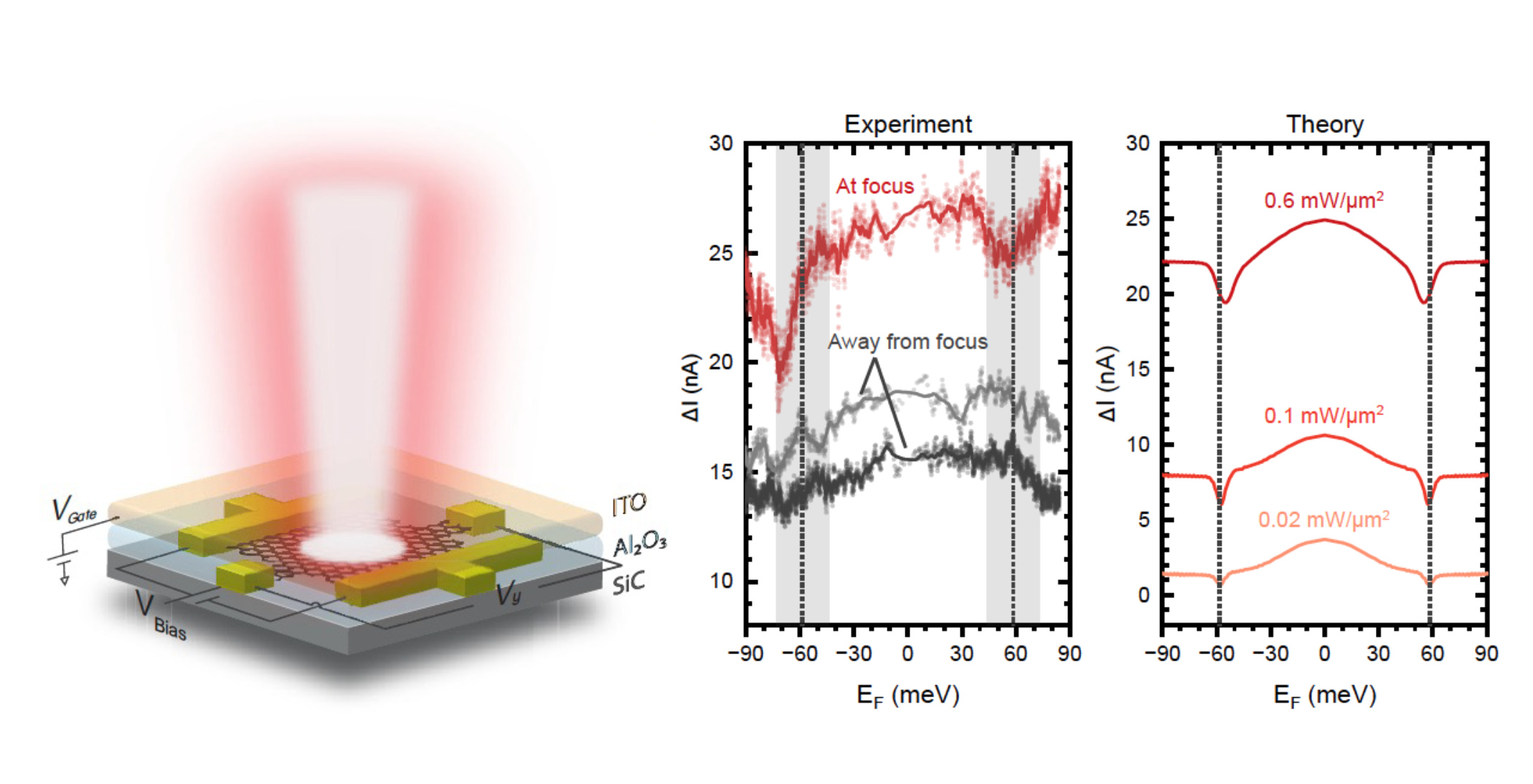
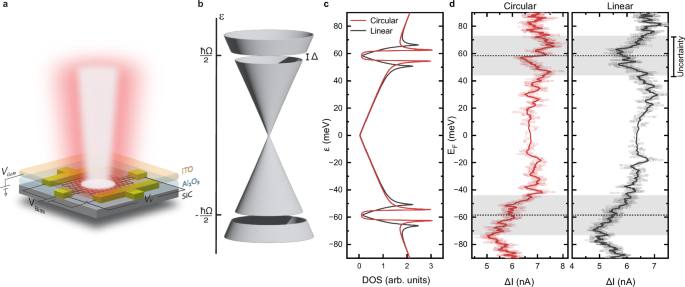

The need to control and manipulate quantum materials for electronics applications has led to a burst of interest in their properties out of equilibrium. The possibility of creating new electronic quantum phases via optical irradiation, on demand, has fascinated quantum materials researchers since the pioneering works by Oka and Aoki and Syzranov, Fistul and Efetov almost two decades ago. Since that time, the progress in theory of Floquet-Bloch engineering of electron band structure, when electrons are getting placed into simultaneously time- and spatially-periodic potential, has been tremendous, and was advancing much faster than corresponding experimental developments. The major challenge in experimentally achieving Floquet-Bloch states is the fast electron scattering processes, which coincides with very rapid heating of the material by the high intensity radiation necessary to achieve Floquet transformation of electron bands. In theory, further progress requires further development of models which include many-body effects.
The first experimental demonstrations of Floquet-Bloch states were achieved using ultrafast techniques, with a focus on modifications of electron bands and transverse anomalous Hall photoresponse. Later experiments with continuous wave microwave sources did not access the Floquet physics of delocalized Bloch states. In our work recently published in Nature Communications, we characterized the transport properties of graphene driven by a CW mid-infrared laser. In such metallic systems, the Floquet dressing of single-particle bands by resonant periodic drives is intertwined with many-body effects, such as electron scattering and population dynamics. By properly combining such parameters, we achieved a long-lived Floquet phase, where a non-equilibrium electronic population is stabilized by the interplay between coherent photoexcitation and incoherent phonon cooling. We demonstrated that at intermediate driving intensities and cryogenic temperatures, we could create low-entropy electronic steady states.
Our interests in the properties of infrared irradiation-related responses in quantum systems started decades ago. In different years, we investigated properties of THz photoresponse in GaAs and graphene quantum Hall systems . A more recent result in the same direction was the observation of enhanced polarization-sensitive photoelectric photoresponses in graphene sheets, where we found that highly localized electronic states are created at the interface junctions, which exhibit a unique energy spectrum and enhanced probabilities for optical transitions.
Our current work was initiated by very productive discussions that Prof. Luis E.F. Foa Torres and I had several years ago during my sabbatical time spent with his group at the University of Chile. Soon, Prof. Paola Barbara from Georgetown accepted our invitation to join these efforts. Later, our research collaboration expanded, when our students Yijing Liu, Gabriel Gaertner, John Huckabee and co-authors Christopher Yang, Iliya Esin, Cyprian Lewandowski, Alexey Suslov, Frederik Nathan, and Gil Refael from Caltech, Bar-Ilan, NHMFL, Florida State, and Niels Bohr Institute joined us with very powerful inputs from experiment, theory, and modelling.
The observation of non-equilibrium steady states using CW lasers, reported in our Nature Communications article, stimulates further investigations of low-temperature Floquet phenomena towards Floquet engineering of steady-state phases of matter.

Follow the Topic
-
Nature Communications
An open access, multidisciplinary journal dedicated to publishing high-quality research in all areas of the biological, health, physical, chemical and Earth sciences.

Related Collections
With Collections, you can get published faster and increase your visibility.
Neuroengineering
Publishing Model: Hybrid
Deadline: Oct 31, 2026
Women's Health
Publishing Model: Hybrid
Deadline: Ongoing
